
Eratigena duellica
(Simon, 1875)
Giant House Spider
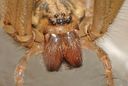
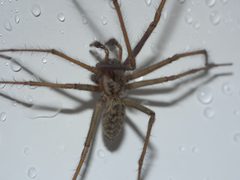
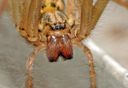
Eratigena duellica, commonly known as the giant house spider, is a funnel weaver spider in the Agelenidae. Originally described from Europe, it has been introduced to western North America, where it is established in British Columbia, Washington, and Oregon. The was transferred from the Tegenaria to Eratigena in 2013, and was restored as a distinct species separate from E. atrica in 2018 after being considered . It is one of the largest house-dwelling spiders in its range and constructs characteristic funnel-shaped webs.
Pronunciation
How to pronounce Eratigena duellica: //ɛˌræ.tɪˈdʒiː.nə duːˈɛl.lɪ.kə//
These audio files are automatically generated. While they are not always 100% accurate, they are a good starting point.
Identification
Distinguished from the closely related Eratigena atrica and E. saeva by subtle morphological differences that were used to restore them as separate in 2018; precise identification requires examination of genitalia or other detailed morphological features. The giant house spider is larger than most domestic spiders and constructs a distinctive flat sheet web with a tubular retreat at one edge. It may be confused with other large Agelenidae, but its association with human structures in its introduced North American range helps narrow identification.
Images
Appearance
A large spider with elongated legs and a robust body. The typically displays a pattern of dark and light markings. As a funnel weaver, it possesses prominent for silk production. is present, with mature individuals reaching substantial size relative to other domestic spiders.
Habitat
Strongly associated with human dwellings, including houses, garages, sheds, and other buildings. In its native European range, it also occurs in natural including rock crevices and under bark. In North America, it is primarily found in and around buildings in urban and suburban settings.
Distribution
Native to Europe; introduced and established in western North America including British Columbia (Canada), Washington and Oregon (United States). Records from other regions may represent misidentifications or additional introductions.
Seasonality
are most commonly encountered in late summer and autumn, when males wander in search of females. Activity continues year-round within heated buildings.
Diet
Feeds on insects and other arthropods that become trapped in its web; observed prey includes flies and other small common in domestic environments.
Life Cycle
Females deposit in silk egg sacs hidden within the funnel retreat. Spiderlings emerge and disperse, with development proceeding through multiple instars. Males mature and wander to find females, while females may remain in established webs for extended periods.
Behavior
Constructs a characteristic funnel web with a flat sheet portion and a tubular retreat where the spider waits for vibrations from prey. When disturbed, the spider rapidly retreats into the funnel. Males exhibit wandering during the mating season, often entering living spaces and causing alarm due to their size.
Ecological Role
An opportunistic of household insects and other arthropods; contributes to regulation of indoor pest . Serves as prey for various spider predators including other spiders and .
Human Relevance
Often evokes fear due to its large size and rapid movements, though it is not considered medically significant. The was popularized by humorist David Sedaris in his essay "April in Paris" from the book "When You Are Engulfed in Flames," in which he described keeping a specimen as a pet and feeding it flies. Frequently found in basements, garages, and dark corners of homes in its introduced range.
Similar Taxa
- Eratigena atricaAlso called the giant house spider and historically confused with E. duellica; separated as distinct in 2018 based on morphological differences
- Eratigena saevaThird in the complex restored to full species status in 2018; morphologically similar and requires detailed examination for reliable separation
More Details
Taxonomic History
Originally described as Tegenaria duellica by Simon in 1875. Transferred to Eratigena in 2013 when that was revalidated. Was treated as with E. atrica for a period before being restored as a separate in 2018.
Popular Culture
The gained unusual cultural prominence through David Sedaris's 2008 essay 'April in Paris,' in which the author described his relationship with a spider he named 'April' that he kept on his windowsill in Normandy, France.