
Coras juvenilis
(Keyserling, 1881)
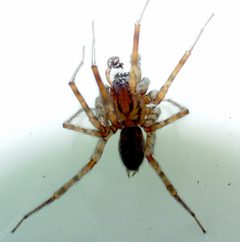
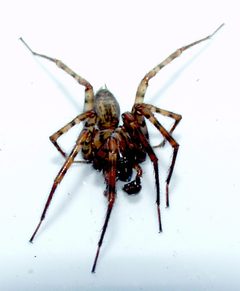
Coras juvenilis is a of funnel weaver spider in the Agelenidae, found in the United States. It is one of approximately fifteen species in the Coras, all native to eastern North America. The species has been documented as a prey item for the spider wasp Priocnemis minorata. Like other Coras species, it constructs small funnel-shaped webs with multiple retreats, often in sheltered locations.

Pronunciation
How to pronounce Coras juvenilis: //ˈkɔːrəs dʒuːˈvɛnɪlɪs//
These audio files are automatically generated. While they are not always 100% accurate, they are a good starting point.
Identification
-level identification within the Coras requires examination of genitalia and other microscopic characters. The genus can be distinguished from other funnel weavers by the relative size of the , which are larger than the anterior lateral eyes. Coras species also typically exhibit a pattern of dark lines on the .
Images
Habitat
Forested ; builds webs beneath stones, in rock wall crevices, under loose bark on trees and logs, and from sheltered locations on human structures such as building eaves and exterior walls. Some individuals have been observed wandering at night, possibly seeking new web sites.
Distribution
United States and Canada. Records indicate presence in eastern North America, with the Coras principally found east of the Mississippi River.
Seasonality
spiders are found in summer and fall. Juveniles and adults have been observed hibernating in silken retreats during winter months.
Host Associations
- Priocnemis minorata - preySpider wasp that paralyzes and provisions nests with spiders; C. juvenilis is a known record
Life Cycle
sacs are probably produced in autumn. Both and specimens hibernate in silken retreats under rocks during winter months.
Behavior
Constructs funnel-shaped webs with multiple retreats rather than a single retreat. Some individuals wander at night, possibly in search of new web locations.
Ecological Role
Serves as prey for spider wasps including Priocnemis minorata. As a small funnel weaver, it contributes to insect control in forested and semi-urban .
Human Relevance
Occasionally found in basements and cellars. Not known to possess medically significant venom.
Similar Taxa
- Coras medicinalisVery similar congeneric ; both share the -defining arrangement and patterning. Separation requires detailed morphological examination.
- Tegenaria domesticaBoth are funnel weavers, but Tegenaria has different arrangement ( lateral eyes larger than or equal to anterior eyes) and typically constructs larger webs with a single prominent retreat.
- Wadotes spp.Formerly placed in the same (Amaurobiidae) as Coras due to taxonomic confusion; both lack a cribellum. Wadotes differ in web structure and genital .
More Details
Taxonomic history
The Coras has undergone extensive taxonomic revision. It was originally described by Nicholas Marcellus Hentz in 1821 as Tegenaria medicinalis, then moved through Clubiona, Coelotes, and back to Tegenaria before Eugene Simon established the genus Coras in 1898. The genus was transferred from Agelenidae to Amaurobiidae in 1986 based on perceived relationships, then returned to Agelenidae when it was recognized that Coras and Wadotes lack the cribellum characteristic of Amaurobiidae.