
Coelotinae
F.O. Pickard-Cambridge, 1893
Genus Guides
2Coelotinae is a of funnel-web spiders in the Agelenidae, first established by F.O. Pickard-Cambridge in 1893. The subfamily has undergone repeated taxonomic revision, with constituent historically moved between Agelenidae and Amaurobiidae based on morphological interpretations. Coelotinae is now firmly placed within Agelenidae and contains numerous genera distributed primarily across East Asia, with some representatives in North America. Members construct funnel-shaped webs and exhibit diverse preferences including forests, caves, and human structures.
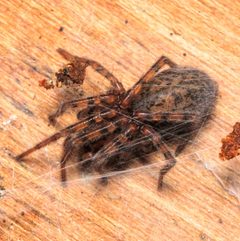
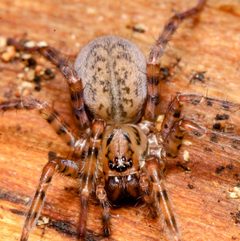
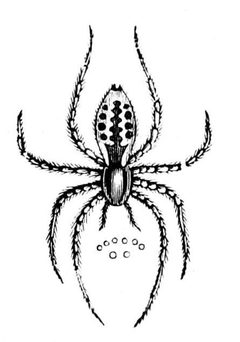
Pronunciation
How to pronounce Coelotinae: //sɛˌloʊtɪˈnaɪ//
These audio files are automatically generated. While they are not always 100% accurate, they are a good starting point.
Identification
Coelotinae spiders can be distinguished from other Agelenidae by genitalic characters, particularly male palpal and female epigynal structures. In the Coras, diagnostic features include larger than anterior lateral eyes, and distinctive dark line patterns on the . Cave-dwelling genera such as Troglocoelotes exhibit deep morphological adaptations to subterranean life: depigmentation, degenerated or absent eyes, and frequently attenuated bodies or appendages. The genus Platocoelotes is united by presence of a conductor on the male palp, broad shallow atrium, and distinct epigynal hoods.
Images
Habitat
Highly variable across . Forest-dwelling (e.g., Coras, Coelotes) inhabit evergreen broad-leaved forests, building webs under rocks, in rock wall crevices, beneath loose bark on trees and logs, and on human structures such as building exteriors and basements. Cave-associated species occur in two forms: troglobitic species (e.g., Troglocoelotes, cave-exclusive Platocoelotes) with obligate subterranean adaptations, and eurytopic species found in both cave and surface . Some species forage around cave openings.
Distribution
Primarily East Asian, with major diversity in China, Japan (64 Coelotes ), and Korea. Southwest China is a center of diversification with multiple . North American representation includes genus Coras (15 species, principally east of the Mississippi River from southeast Canada to Florida and west to Wisconsin and Louisiana). Some genera extend to northern Vietnam.
Seasonality
Coras medicinalis observed in summer and fall; sacs probably produced in autumn. Both adult and Coras observed hibernating in silken retreats under rocks during winter months.
Behavior
Human Relevance
Coras medicinalis was historically used in the 1800s to produce a tincture for fever relief, giving the its name. Some species commonly inhabit human structures including basements, cellars, and building exteriors. Generally harmless to humans.
Similar Taxa
- Amaurobiidae (historical placement)Coelotinae were moved to Amaurobiidae in 1986 based on morphological interpretations, but returned to Agelenidae because they lack the cribellum—a plate-like silk-spinning organ diagnostic of Amaurobiidae.
- Other Agelenidae subfamiliesCoelotinae webs are generally smaller than those of other funnel-web spiders, and the is distinguished by specific genitalic characters rather than web architecture alone.
More Details
Taxonomic instability
The has experienced exceptional taxonomic instability. The Coras alone was assigned to Tegenaria, Clubiona, and Coelotes before achieving current status, and placement shifted between Agelenidae and Amaurobiidae multiple times. Recent molecular and morphological work has stabilized its position within Agelenidae.
Cave adaptation radiation
Coelotinae contains one of the most diverse radiations of cave-adapted spiders, with like Troglocoelotes (exclusively troglobitic) and Platocoelotes (mixed cave/surface ) showing repeated evolution of subterranean traits including loss and depigmentation.
Sources and further reading
- BugGuide
- iNaturalist taxon
- Bug Eric: Spider Sunday: Coras
- A new Platocoelotes species and first description of the male of Platocoelotes icohamatoides from Hunan, China (Araneae: Amaurobiidae: Coelotinae)
- Nuconarius gen. n. and Hengconarius gen. n., two new genera of Coelotinae (Araneae, Agelenidae) spiders from Southwest China
- A new species of Coelotes Blackwall, 1841 (Araneae, Agelenidae, Coelotinae) from Huaping National Nature Reserve, northeast Guangxi, southern China
- A new troglobitic species of the genus Troglocoelotes Zhao & S. Li, 2019 (Araneae, Agelenidae, Coelotinae) from Guizhou, China
- A further study on the spider genus Baiyuerius Zhao, Li & Li, 2023, from China (Agelenidae, Coelotinae)
- Description of the unknown male of Vappolotestianjiayu Li, Zhao & Li, 2023 (Araneae, Agelenidae, Coelotinae) from China.
- Baiyuerius gen. nov., a new genus of Coelotinae (Araneae, Agelenidae) spiders from China and Vietnam.
- Yunguirius gen. nov., a new genus of Coelotinae (Araneae, Agelenidae) spiders from southwest China.