
Coras montanus
(Emerton, 1890)
Northern Spurred Woodland Funnelweaver
Coras montanus is a of funnel-web spider in the Agelenidae. It is native to North America, with records from the United States and Canada. The species is part of a of woodland-dwelling spiders that construct characteristic funnel-shaped webs with multiple retreats.
Pronunciation
How to pronounce Coras montanus: /ˈkoː.ras mɔn.ˈtaː.nus/
These audio files are automatically generated. While they are not always 100% accurate, they are a good starting point.
Identification
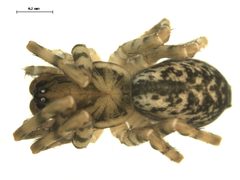
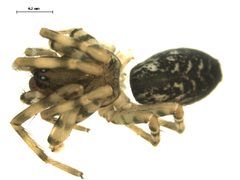
Members of the Coras can be distinguished from other funnel-web spiders by having the larger than the anterior lateral eyes—the middle pair of eyes in the front row is noticeably larger than the outer pair. The typically displays a pattern of dark lines. Mature females range 8–13 mm in body length, males 8–10 mm. The genus is further characterized by webs with multiple retreats rather than a single retreat, a trait typical of Coras.
Images
Habitat
Forested . Webs are constructed beneath stones, in rock wall crevices, under loose bark on trees and logs, and may be found well off the ground attached to structures such as building eaves. The has also been recorded from basements and cellars.
Distribution
United States and Canada. The Coras occurs principally east of the Mississippi River, from southeast Canada south to Florida and west to Wisconsin and Louisiana; C. montanus specifically has been documented in the United States and Canada.
Seasonality
spiders are found in summer and fall. sacs are likely produced in autumn. Both adults and juveniles have been observed hibernating in silken retreats under rocks during winter months.
Life Cycle
are laid in autumn. The spider overwinters as an or in silken retreats under rocks. Development resumes in spring, with adults present in summer and fall.
Behavior
Constructs funnel-shaped webs with multiple retreats, unlike many agelenids that use a single retreat. Webs may be positioned well above ground level. The spider hunts from the retreat, rushing out to capture prey that contacts the web.
Ecological Role
of small . Serves as prey for spider wasps, including Priocnemis minorata, which has been documented parasitizing Coras juvenilis.
Human Relevance
May occur in basements and cellars of human structures. Not medically significant. The related Coras medicinalis was historically used in the 1800s to make a tincture for fever relief, though this practice has been abandoned.
Similar Taxa
- Tegenaria spp.Also funnel-web weavers in Agelenidae, but Coras has multiple retreats and distinct arrangement with eyes larger than anterior lateral eyes.
- Eratigena spp.Larger funnel-web weavers with single retreats; Coras are smaller with multiple retreats.
- Wadotes spp.Closely related formerly placed with Coras in Amaurobiidae; both lack the cribellum characteristic of true amaurobiids and have been returned to Agelenidae.
More Details
Taxonomic history
The Coras has undergone extensive taxonomic revision. First described as Tegenaria medicinalis by Hentz in 1821, the type was moved through Clubiona, Coelotes, and back to Tegenaria before Simon established Coras in 1898. The genus was transferred from Agelenidae to Amaurobiidae in 1986, then returned to Agelenidae in 2021 based on the absence of a cribellum (a defining feature of Amaurobiidae). Coras montanus was described by Emerton in 1890.
Web structure
Coras webs are generally smaller than those of other funnel-web spiders, with multiple retreats instead of the single retreat typical of many Agelenidae. This structural difference is diagnostic for the .