
Cheiracanthium
C.L. Koch, 1839
Longlegged Sac Spiders, Yellow Sac Spiders
Species Guides
2- Cheiracanthium inclusum(black-footed yellow sac spider)
- Cheiracanthium mildei(Northern Yellow Sac Spider)
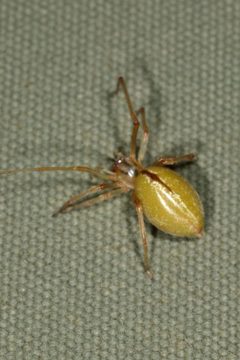
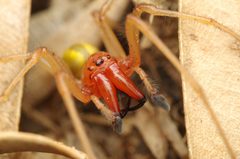
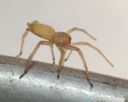
Cheiracanthium is a of araneomorph spiders in the Cheiracanthiidae, first described by Carl Ludwig Koch in 1839. Commonly known as longlegged sac spiders or yellow sac spiders, the genus contains over 230 accepted . These spiders are notable for their pale coloration, hunting , and habit of constructing silken retreats rather than permanent webs. They are frequently encountered in human dwellings, particularly in temperate regions, and have been the subject of controversy regarding their medical significance.
Pronunciation
How to pronounce Cheiracanthium: //ˌkaɪrəˈkænθiəm//
These audio files are automatically generated. While they are not always 100% accurate, they are a good starting point.
Identification
Distinguished from similar sac spiders in Clubionidae by the absence of a distinct groove in the center of the and lack of an obvious tuft of curved setae on the front edge of the . Tarsal orientation is unique among common house spiders—neither outward-pointing (Tegenaria) nor inward-pointing (Araneus). Males identifiable by modified, enlarged . males show 'leggier' appearance before final .
Images
Habitat
Highly variable; includes natural vegetation, agricultural fields, and human structures. In North America, C. mildei is frequently encountered indoors in northern states, while C. inclusum occurs both indoors and outdoors. Some are obligate tree dwellers in forest ; others inhabit grasslands, meadows, and the exterior surfaces of buildings. Agricultural landscapes with isolated trees support specialized species.
Distribution
Primarily Old World, with ranging from northern Europe to Japan, Southern Africa to India and Australia. New World representation limited to C. inclusum (Americas, Africa, Réunion) and C. mildei (Holarctic region, Argentina, introduced to North America). Present in British Columbia, Canada. Particularly diverse in Africa; at least three to four species occur in Egyptian cotton fields alone.
Seasonality
Nocturnally active year-round in suitable climates; primarily in late spring and summer. Spiderlings disperse after their next following hatching.
Host Associations
- Quercus ilex - Obligate association for C. ilicis; other show varying degrees of tree-dwelling
Life Cycle
Females deposit in a sac within a silken retreat. Spiderlings hatch and may return to the retreat after minor explorations before dispersing following their next . Retreats are typically not reused.
Behavior
hunters that do not construct snare webs; instead hunt 'on foot' for prey they overpower directly. Construct silken retreats (sleeping sacs) at wall-ceiling junctions or similar sheltered locations for daytime rest. Capable of rapid movement across ceilings and vertical surfaces due to tarsal claw tufts. Seldom aggressive; bites to humans usually result from accidental contact during sleep or when spider is trapped against skin.
Ecological Role
Beneficial in agricultural fields, contributing to pest control. Serve as conservation indicators for isolated trees in agricultural landscapes, highlighting the value of preserving remnant patches. Some demonstrate tendencies, adapting to human-altered environments.
Human Relevance
Frequently encountered in homes, causing alarm due to rapid movements and ceiling-dwelling habits. Bites can occur when spiders are trapped in bedding or clothing, causing pain, swelling, and occasionally —though severe has been disputed and largely disproven. Historically implicated in vehicle recalls due to web-blocking of fuel lines (later attributed to attraction to hose material rather than gasoline odor). Subject of ongoing debate regarding indoor versus outdoor synanthropy, with geographic and climatic variation in preference.
Similar Taxa
- ClubionaSimilar sac spider and retreat-building ; distinguished by presence of distinct groove and curved setal tuft on margin, which Cheiracanthium lacks. Less commonly encountered indoors.
- HibanaSimilar pale coloration and use; distinguished by different arrangement and abdominal patterning. Some previously misidentified as Cheiracanthium.
Misconceptions
Long considered to possess necrotic venom dangerous to humans; research on confirmed bites has largely disproven this, with studies finding no in most cases and only mild necrosis in rare instances. The theory that yellow sac spiders are attracted to gasoline smell—implicated in vehicle recalls—was disproven; spiders were actually attracted to the hose material itself.
More Details
Taxonomic Instability
placement has changed repeatedly: formerly Clubionidae, then Miturgidae (1997), then Eutichuridae (2014), now Cheiracanthiidae. These revisions reflect ongoing debate in arachnological classification.
Species Diversity
As of October 2025, the World Spider Catalog accepts 231 , with new species continuing to be described from Asia (China, Yunnan, Anhui, Guangxi, Xinjiang) and Europe.
Sources and further reading
- BugGuide
- Wikipedia
- GBIF taxonomy match
- iNaturalist taxon
- NCBI Taxonomy
- Catalogue of Life
- Bug Eric: Spider Sunday: Longlegged Sac Spiders
- Bug Eric: Housemates
- urbanization | Blog
- Spain | Blog
- Bug Eric: Book Review: Dr. Eleanor's Book of Common Spiders
- Bug Eric: June 2009
- BIOLOGY OF THE SPIDER CHEIRACANTHIUM JOVI1JM (ARANEIDA CLUBIONIDAE
- Picture 2 from: Morano E, Bonal R (2016) Cheiracanthium ilicis sp. n. (Araneae, Eutichuridae), a novel spider species associated with Holm Oaks (Quercus ilex). ZooKeys 601: 21-39. https://doi.org/10.3897/zookeys.601.8241
- Picture 3 from: Morano E, Bonal R (2016) Cheiracanthium ilicis sp. n. (Araneae, Eutichuridae), a novel spider species associated with Holm Oaks (Quercus ilex). ZooKeys 601: 21-39. https://doi.org/10.3897/zookeys.601.8241
- Figure 5 from: Morano E, Bonal R (2016) Cheiracanthium ilicis sp. n. (Araneae, Eutichuridae), a novel spider species associated with Holm Oaks (Quercus ilex). ZooKeys 601: 21-39. https://doi.org/10.3897/zookeys.601.8241
- Figure 2 from: Morano E, Bonal R (2016) Cheiracanthium ilicis sp. n. (Araneae, Eutichuridae), a novel spider species associated with Holm Oaks (Quercus ilex). ZooKeys 601: 21-39. https://doi.org/10.3897/zookeys.601.8241
- Five new species of the long-legged sac spider genus Cheiracanthium C.L. Koch, 1839 (Araneae: Cheiracanthiidae) from China
- Figure 1 from: Morano E, Bonal R (2016) Cheiracanthium ilicis sp. n. (Araneae, Eutichuridae), a novel spider species associated with Holm Oaks (Quercus ilex). ZooKeys 601: 21-39. https://doi.org/10.3897/zookeys.601.8241
- Figure 3 from: Morano E, Bonal R (2016) Cheiracanthium ilicis sp. n. (Araneae, Eutichuridae), a novel spider species associated with Holm Oaks (Quercus ilex). ZooKeys 601: 21-39. https://doi.org/10.3897/zookeys.601.8241
- Cheiracanthium ilicis sp. n. (Araneae, Eutichuridae), a novel spider species associated with Holm Oaks (Quercus ilex)