
Cheiracanthium inclusum
(Hentz, 1847)
black-footed yellow sac spider, American yellow sac spider, Agrarian Sac Spider
Cheiracanthium inclusum is a small, pale yellow spider native to the Americas, commonly known as the black-footed yellow sac spider or American yellow sac spider. It is an active hunter that does not construct webs to capture prey, instead relying on speed and agility to pursue arthropods. The builds small silk retreats during daylight hours and is frequently encountered both in natural vegetation and human dwellings. Despite historical misconceptions, its bite produces only localized without .
Pronunciation
How to pronounce Cheiracanthium inclusum: //ˌkaɪrəˈkænθiəm ɪnˈkluːsəm//
These audio files are automatically generated. While they are not always 100% accurate, they are a good starting point.
Identification
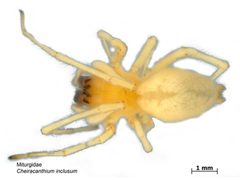
Distinguished from the European C. punctorium by geographic origin and subtle morphological differences. Separated from C. mildei (introduced to North America) by distribution patterns—C. inclusum is native and more common in southern regions, while C. mildei predominates in northern states and is more frequently found indoors. Differentiated from Clubiona sac spiders by the absence of a distinct groove on the and lack of a curved setal tuft on the . Males recognized by modified resembling 'boxing gloves' and more elongated leg proportions.
Images
Appearance
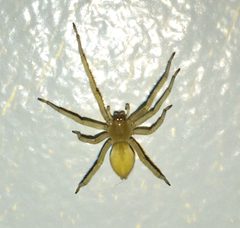
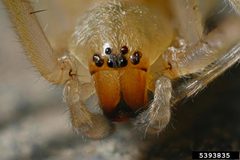
Small pale yellow to yellow-beige spider with distinct dark brown to black markings on the palps, , and (foot tips). Females measure 5–9 mm in body length, males 4–8 mm. Males exhibit a narrower body and larger leg span than females, with the front pair of legs longer than the other three pairs. An orange-brown stripe often runs down the midline of the . The eight are similarly sized and arranged in two parallel horizontal rows. Tarsal claw tufts composed of densely packed hairs enable climbing on smooth surfaces.
Habitat
Found in foliage of forests and gardens, trees and shrubs, and human-made structures including houses. In natural settings, occupies vegetation from ground level to . Indoors, retreats are constructed at wall-ceiling junctions and other elevated surfaces. Not a true synanthrope but frequently enters buildings during wandering.
Distribution
Native to North, Central, and South America, and the West Indies. Introduced to Africa and Réunion. In North America, occurs coast to coast except northernmost states. Native range excludes New England and Pacific Northwest where C. mildei predominates.
Seasonality
Active year-round with peak reproductive activity in June and July. Overwinters as or sub-adults. foraging occurs throughout warm months; retreat construction observed daily.
Diet
Active feeding on various arthropods including insects and other spiders. Prey detection relies primarily on substrate vibrations and palp sensory structures; vision is secondary due to habits.
Life Cycle
Females mate once and produce 1–5 masses, typically two. First egg mass laid approximately 14 days post-mating, containing 17–85 eggs (maximum reported 112). Eggs deposited in small (2 cm) silk tubes with females enclosing themselves for protection. Maternal guarding lasts approximately 17 days until spiderlings complete first . Second egg sac constructed about two weeks after . Males reach sexual maturity in 65–273 days (average 119 days), females in 65–273 days (average 134 days), with development rate influenced by temperature, humidity, and .
Behavior
hunter that does not build prey-capture webs. Constructs new silk retreat daily in under 10 minutes, which may be closed, open on one side, or open on both sides; retreats are not reused. Disperses between trees and shrubs by silk ballooning or bridging—excreting silk threads carried by wind to form scaffolds or remaining attached for aerial transport. Can travel vertically on silk lines, used for capturing airborne prey and evading . Rapid, agile movement with ability to run across ceilings and other smooth surfaces.
Ecological Role
contributing to . Documented predator of Green Lynx Spider (Peucetia viridans) sacs. Serves as prey for various predators including birds, larger spiders, , and ants. May function as agent for pest insects in agricultural and garden settings.
Human Relevance
Frequently encountered in homes due to wandering, causing concern despite minimal medical significance. Capable of biting humans, with bites causing moderate pain followed by itching; typically resolve within 7–10 days. Venom does not cause , contrary to historical misconceptions. Females bite more frequently than wandering males. Bites are rare events. Spiderlings and juveniles may inhabit vehicles, as evidenced by Mazda recalls due to silk nests clogging engine hoses.
Similar Taxa
- Cheiracanthium mildeiIntroduced European similar in appearance and natural history; C. mildei predominates in northern North American states and is more commonly encountered indoors, while C. inclusum is native and more abundant in southern regions. Requires examination of genitalia for definitive separation.
- Clubiona spp.True sac spiders formerly classified in same ; distinguished by presence of distinct groove and curved setal tuft on , features absent in Cheiracanthium. Clubiona less frequently found indoors.
Misconceptions
Historical belief that bites cause necrotic similar to brown recluse spiders has been disproven; actual bites produce only localized swelling and mild . Former classification in Clubionidae and Miturgidae reflects taxonomic revision rather than biological change. Not a true 'indoor spider' despite frequent house encounters—primarily an outdoor that wanders into buildings.
More Details
Taxonomic History
placement has changed multiple times: formerly Clubionidae (true sac spiders), then Miturgidae (prowling spiders), now Cheiracanthiidae following molecular studies. Some sources still reference Eutichuridae, a synonym of Cheiracanthiidae.
Sensory Adaptations
Reliance on palp-based mechanoreception and substrate vibration detection reflects to ; ocular input is minimized during dark-phase activity.