
Peucetia viridans
(Hentz, 1832)
Green Lynx Spider
Peucetia viridans is the largest North American lynx spider, distinguished by its bright green coloration and active hunting . Unlike web-building spiders, it pursues prey with agility comparable to jumping spiders, pouncing in a cat-like manner that inspired its . Females exhibit extended maternal care, guarding sacs and early spiderlings while reducing their own foraging activity. The occupies a notable position in agricultural , where it preys on both crop pests and beneficial insects.
Pronunciation
How to pronounce Peucetia viridans: //pjuːˈsiːʃə ˈvɪrɪdænz//
These audio files are automatically generated. While they are not always 100% accurate, they are a good starting point.
Identification
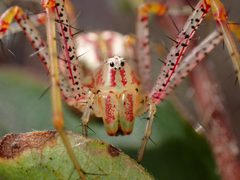
Distinguished from other lynx spiders by its larger size and bright green coloration. May be confused with Peucetia longipalpis in the southwestern United States; P. longipalpis tends to have a shorter, fatter, more domed with less pronounced markings. Reliable separation of these requires examination of mature sexual organs. The combination of green body, red interocular patch, chevron abdominal markings, and long black leg spines is diagnostic for P. viridans in most of its range.
Images
Habitat
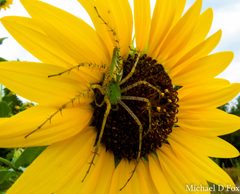
Primarily associated with herbaceous vegetation and low shrubs in open . Frequently found on flowering plants including agricultural crops, where it ambushes and herbivorous insects. Documented on prickly pear cacti (Opuntia spp.), Croton ciliatoglandulifer, and Cnidoscolus aconitifolius. Occupies fields, forest edges, and arid habitats. Females construct nursery webs around sacs, typically suspended from vegetation.
Distribution
Southern United States (from Maryland to Florida, west to California), Mexico, Central America, West Indies (especially Jamaica), and Venezuela. Distribution records include Cuba, Panama, and broader Caribbean region.
Seasonality
Active year-round in southern parts of range; peak activity during warmer months. Females construct sacs primarily in September and October. Spiderlings emerge after approximately four weeks (two weeks for eggs to hatch, two weeks until functional spiderlings exit sac).
Diet
Active of insects and other arthropods. Documented prey includes bees, , caterpillars, scarab beetles, and other spiders including conspecifics. Significant agricultural prey: bollworm (Helicoverpa zea), cotton leafworm moth (Alabama agrillacea), cabbage looper moth (Trichoplusia ni). Also preys on beneficial insects including honey bees.
Host Associations
- Croton ciliatoglandulifer - Specific plant association documented in Mexico
- Cnidoscolus aconitifolius - structure and use studied on this plant
- Opuntia spp. - Frequently observed on prickly pear cacti, using flowers for prey ambush and shade for shelter
Life Cycle
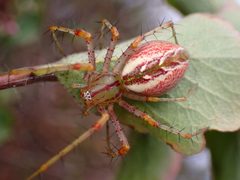
Eight instars from spiderling to maturity. Females produce 1–6 sacs, each containing 25–600 bright orange eggs. Egg sacs approximately 2 cm in diameter, bowl-shaped, guarded by female hanging upside down. Eggs hatch after approximately two weeks; spiderlings remain in sac another two weeks before emerging. Females may produce up to six egg sacs in captivity. Spiderlings add silk to maternal nursery web.
Behavior
active hunter that does not build prey-capture webs. Pursues prey by running and jumping with agility exceeded only by salticid spiders. Typically hunts by sitting motionless on vegetation to ambush passing insects. Females exhibit extended maternal care: guard sacs vigorously, attacking approaching threats; known to spit venom from as defense, sometimes reaching distances of approximately 30 cm. Reduced foraging activity during guarding period. Males perform courtship with leg waving and palp drumming, using enlarged forelegs in display; may engage in mate guarding.
Ecological Role
in agricultural and natural . Contributes to of lepidopteran crop pests in cotton and other crops. May exert significant pressure on both pest and beneficial insect , creating complex trade-offs in .
Human Relevance
Bites to humans are rare but painful, causing localized edema (documented cases: 25 mm swelling lasting two days; 10–20 cm swelling in another patient). Not deadly to humans. Valued in agricultural pest management for on economically important pests. Also poses risk to beneficial including honey bees.
Similar Taxa
- Peucetia longipalpisOverlaps in southwestern U.S.; distinguished by shorter, fatter, more domed with less pronounced markings; requires examination of genitalia for reliable identification
- Peucetia viridanaSimilar name and appearance; restricted to India and Myanmar, no geographic overlap
- Peucetia viridisSimilar name; occurs in Spain and Africa, no geographic overlap
More Details
Venom spitting defense
Females spit venom from when guarding sacs, a rare among spiders. Documented in response to researcher disturbance and presumed to function against vertebrate and large .
Color plasticity
Gravid females can change color to match background vegetation over approximately 16 days. Late-season individuals often shift from green to yellow with reddish streaks, possibly due to degradation of tetrapyrrole pigments.
Nomenclatural note
name 'viridans' is Latin for 'becoming green,' reflecting its coloration. Should not be confused with P. viridana (India, Myanmar) or P. viridis (Spain, Africa).
Sources and further reading
- BugGuide
- Wikipedia
- GBIF taxonomy match
- iNaturalist taxon
- NCBI Taxonomy
- Catalogue of Life
- Bug Eric: Green Lynx Spider
- Assassin ate | Beetles In The Bush
- The Mating Behavior of Peucetia viridans (Araneida: Oxyopidae)
- Distribution ofPeucetia viridans(Araneae: Oxyopidae) onCroton ciliatoglandulifer
- Costs and benefits of maternal behaviour in the green lynx spider (Oxyopidae, Peucetia viridans)
- POPULATION STRUCTURE, SEASONALITY, AND HABITAT USE BY THE GREEN LYNX SPIDER PEUCETIA VIRIDANS (OXYOPIDAE) INHABITING CNIDOSCOLUS ACONITIFOLIUS (EUPHORBIACEAE)
- New observations on prey scarab beetles and host plants of the green lynx spider, Peucetia viridans (Hentz, 1832) (Araneae: Oxyopidae) in Oaxaca, Mexico