
Peucetia
Thorell, 1869
Green Lynx Spiders
Species Guides
2- Peucetia longipalpis(Lesser Green Lynx Spider)
- Peucetia viridans(Green Lynx Spider)
Peucetia is a of lynx spiders ( Oxyopidae) distributed worldwide, containing approximately 47 as of 2025. The genus is notable for its association with plants bearing glandular trichomes, a specialized ecological relationship that has evolved independently across multiple continents. North American species include P. viridans, the largest lynx spider on the continent, and P. longipalpis in the southwestern United States. Several species exhibit complex maternal care and occupy distinct microhabitats that facilitate coexistence of sympatric .
Pronunciation
How to pronounce Peucetia: //ˌpjʊˈsɛtiə//
These audio files are automatically generated. While they are not always 100% accurate, they are a good starting point.
Identification
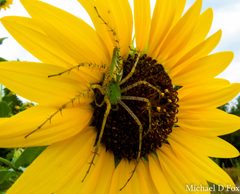
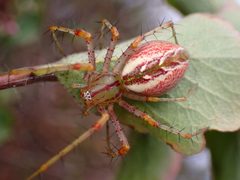
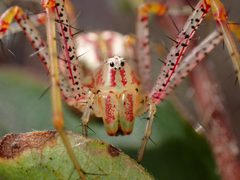
Peucetia are distinguished from other lynx spider by their large size relative to the — females of P. viridans reach up to 26 mm body length with legspans of 70 mm. Diagnostic features include prominent spines on the legs, a hexagonal arrangement of around the margin, and often bright green coloration with red markings. P. viridans and P. longipalpis require examination of mature sexual organs for definitive separation. The genus is further characterized by its consistent association with glandular-hair-bearing plants, a trait not universal in Oxyopidae.
Images
Habitat
in this are strongly associated with plants bearing glandular trichomes (sticky hairs), including members of Solanaceae, Asteraceae, and Melastomataceae. include sand scrub, forest edges, fields, and arid regions. In the Neotropics, sympatric species partition habitat by light availability—P. rubrolineata occupies shaded areas while P. flava prefers open areas. P. viridans occurs on low shrubs, prickly pear cacti, and various flowering plants across the southern United States.
Distribution
Worldwide distribution with strongest representation in tropical and subtropical regions. In the United States: P. viridans occurs from the southern Atlantic coast through the Gulf states to California; P. longipalpis is restricted to the southwestern US extending to Belize. P. viridana is to Asia. The has been documented in the Neotropical, Nearctic, Afrotropical, and Palearctic regions across more than 36 localities and 20 distinct vegetation types.
Seasonality
Activity patterns vary by and latitude. In temperate regions, are most abundant during late summer. In tropical regions, show continuous activity with fluctuations in abundance throughout the year. P. viridans is active diurnally year-round in southern portions of its range.
Diet
Active that hunt diurnally; diet includes bees, , caterpillars, and other insects. P. viridans has been observed capturing reduviid assassin bugs and exhibits . The association with glandular-hair-bearing plants provides access to insects trapped by sticky trichomes, which may constitute a significant food source.
Host Associations
- Trichogoniopsis adenantha (Asteraceae) - plant for P. rubrolineata and P. flava in Brazil; partitioning by shaded vs. open microhabitats
- Rhyncanthera dichotoma (Melastomataceae) - Glandular plant utilized by P. flava despite sticky trichomes
- Solanum thomasiifolium (Solanaceae) - plant for P. flava with potential antiherbivore effects
- Croton ciliatoglandulifer (Euphorbiaceae) - Distribution and use documented for P. viridans
- Cnidioscolus aconitifolius (Euphorbiaceae) - plant for P. viridans studies
- Madia elegans (Asteraceae) - Sticky tarweed plant; Peucetia sp. documented as in indirect defense system
- Opuntia spp. (Cactaceae) - Prickly pear cacti provide protected hunting platforms for P. viridans
Life Cycle
Females construct nursery webs around sacs; egg sacs contain 25–600 eggs and average 12–25 mm diameter. Spiderlings emerge and may add silk to the maternal web. Females in captivity have produced up to six egg sacs. Development includes multiple instars with differential microhabitat use by different instars. Leg occurs through molting in juveniles.
Behavior
hunters that rely on vision from their hexagonal arrangement. Exhibit active pursuit of prey through running and jumping, with agility exceeded only by Salticidae. Females display vigorous maternal defense of sacs against including Cheiracanthium inclusum, Crematogaster ants, Chauliognathus pennsylvanicus larvae, grasshoppers, and tree crickets. P. viridans females spit venom from fangs to repel perceived threats. Males perform with multiple palpal insertions during copulation.
Ecological Role
Top in vegetation ; contribute to indirect plant defense by suppressing herbivore . On sticky plants, they function as secondary predators that consume insects trapped by glandular trichomes, thereby reducing herbivore damage and increasing plant . Coexisting partition resources through differential use, reducing .
Human Relevance
P. viridans is frequently encountered and photographed due to its large size, bright coloration, and habits. Occasionally found in gardens and human-modified landscapes. Venom spitting has been documented in response to researcher handling. Not considered medically significant to humans.
Similar Taxa
- Other Oxyopidae genera (e.g., Oxyopes, Hamataliwa)Peucetia are substantially larger; P. viridans exceeds 20 mm body length while most lynx spiders are much smaller. arrangement and association with glandular plants also distinguish the .
- Salticidae (jumping spiders)Both groups are , visual hunters with agile movements. Peucetia lacks the enlarged characteristic of salticids and has a different eye arrangement (hexagonal ring vs. rectangular pattern).
More Details
Nomenclatural note on North American species
P. longipalpis and P. viridans are the only Peucetia documented in the United States. P. viridans occurs across the southern third of the country; P. longipalpis is restricted to the Southwest. These species require genitalic examination for reliable identification.
Unpublished dissertation impact
The 1980 dissertation by S.L. Szerlip on Apiomerus , which included descriptions of new , remains unpublished and therefore nomenclaturally unavailable. This has created identification difficulties for related research, as the names proposed therein (including 'A. floridensis' for Florida ) are invalid under ICZN Article 8. As of 2009, efforts were underway to locate Szerlip for potential coauthorship to validate this work.
Sources and further reading
- BugGuide
- Wikipedia
- GBIF taxonomy match
- iNaturalist taxon
- NCBI Taxonomy
- Catalogue of Life
- Bring on the Tourists! | Bug Squad
- Bug Eric: Green Lynx Spider
- Assassin ate | Beetles In The Bush
- The Mating Behavior of Peucetia viridans (Araneida: Oxyopidae)
- Costs and benefits of maternal behaviour in the green lynx spider (Oxyopidae, Peucetia viridans)
- Microhabitat use by Peucetia flava (Oxyopidae) on the glandular plant Rhyncanthera dichotoma (Melastomataceae)
- BIOLOGY OF THE SPIDER Peucetia arabica SIMON, 1882 (ARANEAE: OXYOPIDAE) UNDER LABORATORY CONDITIONS.
- Distribution ofPeucetia viridans(Araneae: Oxyopidae) onCroton ciliatoglandulifer
- Niche partitioning and coexistence of two spiders of the genus Peucetia (Araneae, Oxyopidae) inhabiting Trichogoniopsis adenantha plants (Asterales, Asteraceae): a population approach
- Associations of Spiders of the GenusPeucetia(Oxyopidae) with Plants Bearing Glandular Hairs
- POPULATION STRUCTURE, SEASONALITY, AND HABITAT USE BY THE GREEN LYNX SPIDER PEUCETIA VIRIDANS (OXYOPIDAE) INHABITING CNIDOSCOLUS ACONITIFOLIUS (EUPHORBIACEAE)
- Habitat selection and potential antiherbivore effects of Peucetia flava (Oxyopidae) on Solanum thomasiifolium (Solanaceae)