
Hamataliwa grisea
Keyserling, 1887
Lynx spider
Hamataliwa grisea is a of lynx spider in the Oxyopidae, first described by Keyserling in 1887. This small to medium-sized spider is known from the southwestern United States and Mexico. Like other oxyopids, it is an active hunter that relies on vision and speed rather than web-building to capture prey. The species is part of a characterized by distinctive arrangements and spiny legs adapted for ambush .
Pronunciation
How to pronounce Hamataliwa grisea: /həˈmætəˌlaɪwə ˈɡrɪsiə/
These audio files are automatically generated. While they are not always 100% accurate, they are a good starting point.
Identification
Hamataliwa grisea can be distinguished from other lynx spiders by its geographic range combined with morphological features. Within the Hamataliwa, identification typically requires examination of genitalic structures, particularly the male and female . The species occurs in a region where it may overlap with other Hamataliwa species; H. helia and H. cubensis are also found in parts of the southern United States and Mexico. Accurate identification to species level generally requires microscopic examination by a . The grayish coloration implied by the name may help separate it from more vividly colored , but this is not definitive without structural examination.
Images
Appearance
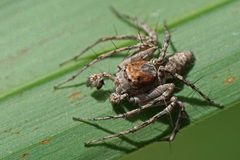
Lynx spiders in the Hamataliwa typically have a somewhat flattened body form with long, spiny legs. The is usually elevated, and the eight are arranged in a distinctive pattern characteristic of Oxyopidae: six eyes in a hexagonal arrangement forming the main eye group, with two smaller lateral eyes positioned lower. The coloration of H. grisea is suggested by its specific epithet ("grisea" meaning gray), though precise color description requires specimen examination. The legs bear prominent spines used in prey capture. Body size is moderate for the , with females generally larger than males.
Habitat
Found in terrestrial in the southwestern United States and Mexico. Specific microhabitat preferences are poorly documented, but lynx spiders in this are typically associated with vegetation where they can perch and ambush prey. They are often found on shrubs, grasses, and other low vegetation in open to semi-open habitats.
Distribution
Recorded from the United States (southwestern states) and Mexico. Distribution records indicate occurrence in both countries, with specific localities in Mexico and the southwestern United States. The appears to be restricted to this binational region.
Seasonality
Activity patterns are not well documented. As with many temperate and subtropical spiders, are likely most active during warmer months, but specific seasonal data are lacking.
Behavior
As a lynx spider ( Oxyopidae), H. grisea is an active hunter that does not build webs for prey capture. Instead, it relies on excellent vision (facilitated by large ), speed, and spiny legs to seize prey. Lynx spiders typically perch on vegetation and wait for or stalk passing insects, then pounce and grasp prey with their spined forelegs. They may also engage in hunting, moving actively through vegetation in search of prey.
Ecological Role
Functions as a of insects and other small arthropods in its . As a hunter, it contributes to the regulation of insect in shrubland and grassland . Its role in includes serving as both predator and potential prey for larger arthropods, birds, and other vertebrates.
Human Relevance
No significant direct interactions with humans are documented. Like most spiders, it is likely beneficial through on insect pests in agricultural and natural settings, though its specific economic impact has not been studied. Not known to be medically significant.
Similar Taxa
- Hamataliwa heliaAnother Hamataliwa occurring in the southern United States and Mexico; requires genitalic examination for reliable separation
- Oxyopes spp.Other lynx spiders in the same that share similar body plan and hunting ; Oxyopes often have more distinctive color patterns and different proportions
More Details
Taxonomic history
Described by Eugen von Keyserling in 1887, a German arachnologist who described numerous spider from the Americas. The Hamataliwa was established earlier and currently contains multiple species distributed primarily in the New World tropics and subtropics.
Research needs
Basic of this remains poorly known. Specific requirements, prey preferences, reproductive , and status have not been studied. The species would benefit from focused field research to document its and confirm its conservation status.
Sources and further reading
- BugGuide
- Wikipedia
- GBIF taxonomy match
- Catalogue of Life
- Meet 'Mantis Master Keeper' Andrew Pfeifer | Bug Squad
- Lifting the veil over mysterious desert truffles: Terfezia’s ecology and diversity towards cultivation | Blog
- Carried with the wind: mass migration of Larch Budmoth to the Russian High Arctic | Blog
- Mantispidae | Beetles In The Bush