
Oxyopes
Latreille, 1804
Grass Lynx Spiders, Lynx Spiders
Species Guides
8- Oxyopes acleistus
- Oxyopes aglossus
- Oxyopes apollo(jumping lynx)
- Oxyopes occidens
- Oxyopes panther
- Oxyopes salticus(Striped Lynx Spider)
- Oxyopes scalaris(Western Lynx Spider)
- Oxyopes tridens
Oxyopes is a large, globally distributed of lynx spiders comprising approximately 279-300 . Members are characterized by distinctive hexagonal arrangements and long, spine-like leg setae. They are active visual hunters that do not construct capture webs, instead employing ambush and stalking strategies to prey on insects. Several species have been documented as significant agents in agricultural systems, particularly in cotton and tea plantations.
Pronunciation
How to pronounce Oxyopes: //ˈɒksi.oʊˌpiːz//
These audio files are automatically generated. While they are not always 100% accurate, they are a good starting point.
Identification
Distinguished from wolf spiders (Lycosidae) and jumping spiders (Salticidae) by the combination of hexagonal pattern and prominent leg spines. The eye arrangement separates them from all other spider except other Oxyopidae. Within the , identification requires examination of genitalia under magnification; color patterns alone are unreliable due to extreme intraspecific variation.
Images
Appearance
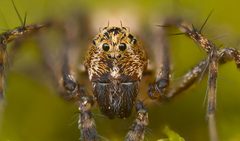
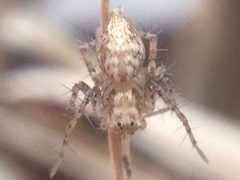
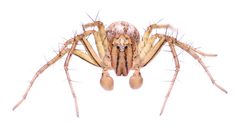
Small to medium-sized spiders with elongated bodies and long, slender legs bearing conspicuous spine-like setae. The most distinctive feature is the arrangement: six larger eyes positioned hexagonally on the prosoma, with two smaller eyes below. Body coloration varies extensively among , often featuring stripes or mottled patterns that provide camouflage in grassy vegetation.
Habitat
Predominantly grassy including meadows, prairies, fields, and agricultural crops. Many favor tall grasses and herbaceous vegetation where their elongated bodies and striped patterns provide effective camouflage. Some species occupy shrubs, perennials, cacti, and yucca in more arid regions.
Distribution
distribution with found on all continents except Antarctica. Particularly diverse in tropical and subtropical regions. Documented from North America (throughout continental U.S., southern Canada to Mexico), Central and South America, Caribbean, Europe, Africa, Asia (including Taiwan, India, Bangladesh, Indonesia), and Oceania (Galápagos Islands).
Seasonality
Activity patterns vary by latitude and . In temperate regions, immatures overwinter and reach adulthood in late spring to summer. In tropical regions, active year-round. Males often most abundant in autumn in temperate zones.
Diet
Active of insects and other small arthropods. Documented prey includes plant bugs (Lygus lineolaris, Adelphocoris rapidus), cotton fleahoppers (Pseudatomoscilis seriatus), larvae including tobacco budworm (Heliothis virescens) and cotton bollworm (Helicoverpa armigera), mosquitoes (Aedes sp.), aphids (Uroleucon ambrosiae), and tea mosquito (Helopeltis bradyi).
Life Cycle
Females deposit in silk sacs attached to vegetation, which they guard until hatching. Egg sac placement varies: some attach to grass stems with minimal webbing, others place beneath bark or in protected . Spiderlings emerge from guarded sacs; stages typically overwinter in temperate regions. Development from egg to spans one season in temperate areas, with timing varying by species and climate.
Behavior
Visual ambush that rely on acute eyesight rather than webs to capture prey. Hunting strategies include lying in wait on vegetation and actively stalking before pouncing. Produce silk for sacs and draglines but do not construct capture webs. Some exhibit territorial defense of egg sacs. Males of some species display iridescent abdominal , possibly for visual signaling.
Ecological Role
Important in terrestrial , particularly in agricultural settings where several function as agents of crop pests. Documented as significant predators in cotton agroecosystems and tea plantations. Contribute to regulation of herbivorous insect including aphids, plant bugs, and lepidopteran larvae.
Human Relevance
Valued as natural pest control agents in agriculture, with O. salticus and related studied extensively for their potential in . No medical significance; bites not considered dangerous to humans. Subject of ecological research on -prey dynamics and urbanization effects on genetic diversity.
Similar Taxa
- PeucetiaAlso in Oxyopidae; shares hexagonal arrangement and leg spines but generally larger with different body proportions and often green coloration
- Tibellus (Philodromidae)Similar elongated body and striped pattern for grass-dwelling camouflage, but lacks hexagonal arrangement and has different leg structure without prominent spines
- Thanatus (Philodromidae)Superficially similar ground-dwelling habitus and coloration, but more robust build, different arrangement, and hunts primarily on ground rather than vegetation
- Pardosa (Lycosidae)Similar active hunting and overlap, but wolf spiders have different arrangement (two large eyes), carry sacs attached to , and lack prominent leg spines
More Details
Taxonomic History
established by Pierre André Latreille in 1804. Generic name derives from Greek 'oxys' (sharp) and 'ops' (), meaning 'keen-eyed'. The type O. heterophthalmus was among the first described. Taxonomic revisions continue to resolve species boundaries, with molecular and morphological approaches sometimes incongruent; some species show extreme intraspecific variation in coloration and genitalia.
Agricultural Significance
Multiple have been investigated for biocontrol potential. O. salticus is among the most studied, with research demonstrating significant on cotton pests in Mississippi. O. javanus documented as of tea pests in Indonesian plantations. Their active hunting and high reproductive rates make them effective predators in crop systems.
Conservation Genetics
Recent research on O. sertatus in Taiwan demonstrates that rapid urbanization reduces genetic diversity and increases differentiation, highlighting sensitivity to fragmentation even in widespread .
Sources and further reading
- BugGuide
- Wikipedia
- GBIF taxonomy match
- iNaturalist taxon
- NCBI Taxonomy
- Catalogue of Life
- Bug Eric: Spider Sunday: Striped Lynx Spider
- Bug Eric: Spider Sunday: Slender Crab Spiders (and their look-a-likes)
- Bug Eric: September 2012
- Cup plant feeds brown ambrosia aphid, Uroleucon ambrosiae, which in turn provides dinner for lynx spiders, lady beetles, long-legged flies, flower flies, and green lacewings — Bug of the Week
- Bug Eric: Spider Sunday: "Arachtober" is B-a-a-a-a-a-ck!
- The jumping lynx spider Oxyopes salticus Hentz, 1845 and its Neotropical relatives (Araneae: Oxyopidae)
- The Vertical Distribution of Helopeltis bradyi and Oxyopes javanus on Tea
- Lynx Spiders of Khulna District of Bangladesh : Genus Oxyopes Latreille (Areaneae : Oxyopidae)
- Reproductive behaviour and biology of Oxyopes chittrae Tikader (Araneae: Oxyopidae) occurring on cotton
- Species delimitation and taxonomic revision of Oxyopes (Araneae: Oxyopidae) of Taiwan, with description of two new species
- New distributional record of <i>Oxyopes fabae</i> Dhali, Saha and Raychaudhuri, 2015 (Araneae: Oxyopidae) from Western Ghats, Kerala
- Rapid urbanization reduces genetic diversity and increases genetic differentiation of a lynx spider Oxyopes sertatus in central Taiwan.