
Cheiracanthium mildei
L. Koch, 1864
Northern Yellow Sac Spider, Long-legged Sac Spider
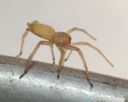
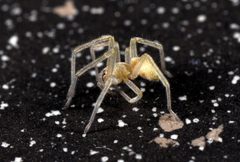
Cheiracanthium mildei is a medium-sized spider native to Europe and North Africa, introduced to North America and parts of South America. measure 7–10 mm in body length with pale green or tan coloration, darker palpi and , and characteristically long front legs up to twice the length of others. It constructs silken retreats rather than capture webs, hunting actively at night. The is frequently encountered in human dwellings, particularly in northern regions of its introduced range, and has been documented to bite humans with generally mild effects.
Pronunciation
How to pronounce Cheiracanthium mildei: /ˌkaɪrəˈkænθiəm ˈmɪldaɪ/
These audio files are automatically generated. While they are not always 100% accurate, they are a good starting point.
Identification
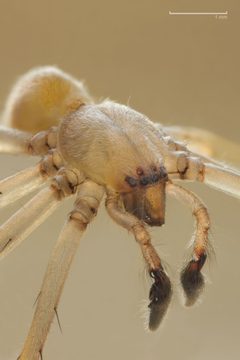
Cheiracanthium mildei can be distinguished from the native North American C. inclusum by geographic origin and subtle morphological differences, though definitive identification often requires expert examination. It lacks the distinct groove and abdominal setal tuft present in Clubiona sac spiders. Key identifying features include: pale green to tan body with darker brown mouthparts; front legs significantly longer than others (up to 2× length); double claws on each leg; and with a distinctive canoe-shaped tapetum lucidum that reflects light. Males are recognized by modified resembling 'boxing gloves' and a leggier appearance.
Images
Habitat
Strongly associated with human dwellings in the northeastern United States and eastern Canada, where it is more often found inside than outside. In its native European range, occurs in various including vegetation and artificial structures. Constructs silken retreats at wall-ceiling junctions and similar elevated indoor locations.
Distribution
Native to Europe and North Africa, extending through the Caucasus to Central Asia. Introduced to the United States (widespread across northeastern states and eastern Canada, also present in Washington state) and parts of South America. First introduction to the Americas likely occurred during periods of European .
Seasonality
Active year-round indoors in temperate regions; primarily with peak activity during nighttime hours. Spiderlings disperse after their next following from sacs.
Diet
of small insects and other arthropods; hunts actively without constructing capture webs. Documented as a predator of larvae in Africa and Middle Eastern regions, causing both direct mortality through consumption and indirect mortality through larval from plants.
Life Cycle
Females deposit in a silken sac within a retreat. Spiderlings hatch and may return to the retreat after initial explorations, dispersing after their next . and males can be recognized by in leg proportions and male modification.
Behavior
Nocturnally active hunter that does not construct capture webs. Builds silken retreats ('sleeping bags') for daytime shelter, typically at wall-ceiling junctions; rarely reuses retreats, often constructing new ones after each night of activity. Capable of rapid movement across ceilings and vertical surfaces using tarsal claw tufts. Exhibits significant repellency to peppermint and variable responses to other plant oils (clove bud oil shows initial attraction at 24 hours becoming repellent by 72 hours; lemongrass and citronella oils show attraction at 24 hours).
Ecological Role
controlling of small insects and pest . In agricultural contexts, contributes to of larvae.
Human Relevance
Frequently encountered in homes, causing concern due to its appearance and rapid movements. Historically associated with necrotic bite rumors, but research has largely dismissed dangerous venom claims; bites are rare and effects appear mild, though large mouthparts can penetrate human skin. Secondary risk from any puncture wound remains a concern. Presence of silk retreats in corners creates aesthetic issues. Subject of research on natural repellents including clove, ginger, and peppermint .
Similar Taxa
- Cheiracanthium inclusumNative North American with similar appearance and habits; C. mildei has replaced C. inclusum in northeastern U.S. houses and shows stronger tendency in northern climates while C. inclusum remains more common outdoors in southern states.
- Clubiona speciesFormerly classified in same ; distinguished by presence of distinct groove and tuft of curved setae on margin, features absent in Cheiracanthium.
- Cheiracanthium ilicisEuropean with similarly large mouthparts; C. ilicis shows exclusive association with Holm Oaks (Quercus ilex) while C. mildei is a synanthrope.
Misconceptions
Long considered at least mildly venomous to humans with potential for necrotic bites; research has demonstrated this is a myth. Bites are rare and effects are mild, though the spider's large mouthparts can penetrate skin. The is often called an 'indoor spider,' but this is geographically variable—it is strongly in northern introduced ranges but occurs commonly outdoors in its native range and in southern climates.
Sources and further reading
- BugGuide
- Wikipedia
- GBIF taxonomy match
- iNaturalist taxon
- NCBI Taxonomy
- Catalogue of Life
- Bug Eric: Spider Sunday: Longlegged Sac Spiders
- urbanization | Blog
- Spain | Blog
- biodiversity | Blog - Part 50
- Bug Eric: Housemates
- Attraction or Repelling Effects of Commercial Plant Essential Oils on the Synanthropic Cheiracanthium mildei (Araneae: Cheiracanthiidae)