
Cheiracanthiidae
Wagner, 1887
Long-legged Sac Spiders
Genus Guides
2- Cheiracanthium(Longlegged Sac Spiders)
- Strotarchus
Cheiracanthiidae is a of araneomorph spiders established by Wagner in 1887, with priority over the synonym Eutichuridae. The family contains approximately 15 and 385 as of 2026, with Cheiracanthium being the largest and most species-rich genus. Members are commonly known as long-legged sac spiders. The family's phylogenetic placement has been historically contested, having been assigned to Clubionidae, Miturgidae, and Eutichuridae before recognition as a distinct family. Molecular analyses indicate Cheiracanthium is , with divergence estimated at 67 million years ago.
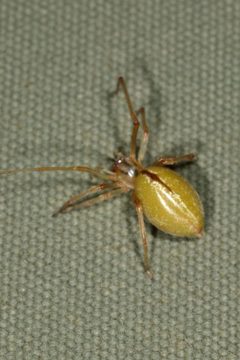
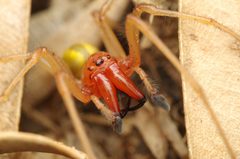
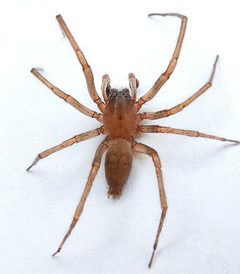
Pronunciation
How to pronounce Cheiracanthiidae: /ˌkaɪrəˈkænθi.aɪdiː/
These audio files are automatically generated. While they are not always 100% accurate, they are a good starting point.
Identification
-level identification requires examination of genitalic and arrangement patterns. Cheiracanthium , the most common representatives, are characterized by long, slender legs and cylindrical , though these traits alone are insufficient for family-level . Accurate identification to family requires reference to established taxonomic keys and comparison with . The family was historically confused with Clubionidae and Miturgidae, and disambiguation relies on detailed morphological study of copulatory organs.
Images
Habitat
are diverse and -dependent. Cheiracanthium approximatum has been documented in subtropical North-West Hindu Kush sub-mountainous foothills. Cheiracanthium mildei occupies habitats and is expanding its range into Central Europe. Several Cheiracanthium are associated with agricultural systems, including rice fields in Bangladesh. The exhibits broad ecological , with species showing to both natural and human-modified environments.
Distribution
Global distribution spanning multiple continents. Documented from Pakistan (Peshawar valley), China (Yunnan, Anhui, Guangxi, Xinjiang), Bangladesh (Jhenaidah), India (Western India), Colombia, Honduras (Francisco Morazán), and Europe (Denmark, Norway, Sweden; expanding in Central Europe). The demonstrates wide geographic range with both tropical and temperate representatives.
Behavior
Cheiracanthium mildei constructs silken retreats in corners, a that has been experimentally manipulated using plant . Zingiber officinale essential oil specifically reduces the tendency to construct these retreats. The includes that actively colonize human dwellings.
Human Relevance
Cheiracanthium mildei is considered an unwanted companion in human dwellings due to silk retreats accumulating dust and triggering arachnophobia. Research has investigated plant as natural repellents, with Syzygium aromaticum, Ananas comosus, Musa sp., and Zingiber officinale showing potential for spider control. The includes associated with agricultural such as rice fields.
Similar Taxa
- ClubionidaeCheiracanthiidae was historically placed in Clubionidae; separation requires detailed examination of genitalic and somatic .
- MiturgidaeCheiracanthiidae was originally described as Eutichurinae of Miturgidae and has been repeatedly associated with this ; molecular place them as close relatives though with conflicting topology.
More Details
Taxonomic History
The group was originally described as Eutichurinae of Miturgidae by Lehtinen in 1967. The synonym Eutichuridae was widely used until Cheiracanthiidae was resurrected in 2011 based on priority. Ramírez's 2014 analysis supported -level status. Monophyly of the group is considered reasonably uncontroversial, though internal relationships remain under study.
Molecular Resources
The mitogenome of Cheiracanthium punctorium has been sequenced, revealing 37 genes with high A+T and derived gene order differing from the ancestral arachnid pattern. This represents only the second sequenced in the hyperdiverse Dionycha clade, providing critical genomic resources for spider phylogenomics.
Phylogenetic Uncertainty
Molecular yield conflicting results: Bayesian analysis places Cheiracanthiidae as sister to Salticidae, while maximum likelihood analysis places it as sister to a clade containing Miturgidae, Viridasiidae, Corinnidae, Selenopidae, Salticidae, and Philodromidae. These conflicting topologies indicate ongoing uncertainty about precise relationships within Dionycha.
Sources and further reading
- BugGuide
- Wikipedia
- GBIF taxonomy match
- iNaturalist taxon
- NCBI Taxonomy
- Catalogue of Life
- A new species of Strotarchus Simon, 1888 from Honduras (Araneae, Cheiracanthiidae)
- New records of spiders: Araneae, Eresidae, Cheiracanthiidae, Scytodidae from Pakistan
- Five new species of the long-legged sac spider genus Cheiracanthium C.L. Koch, 1839 (Araneae: Cheiracanthiidae) from China
- New Distribution Records of Three Species of the Genus Cheiracanthium C. L. Koch, 1839 (Araneae: Cheiracanthiidae) from Western India
- Unveiling the diversity of Eutichurus Simon, 1897 (Araneae: Cheiracanthiidae) in Colombia: new species, records and comments on their distribution
- A new species of rice land sac-spider genus Cheiracanthium CL Koch 1839 (Araneae: Cheiracanthiidae) from Bangladesh
- Comparative mitogenomics of Cheiracanthium species (Araneae: Cheiracanthiidae) with phylogenetic implication and evolutionary insights
- Attraction or Repelling Effects of Commercial Plant Essential Oils on the Synanthropic Cheiracanthium mildei (Araneae: Cheiracanthiidae)
- Three Novel Spider Genomes Unveil Spidroin Diversification and Hox Cluster Architecture: Ryuthela nishihirai (Liphistiidae), Uloborus plumipes (Uloboridae) and Cheiracanthium punctorium (Cheiracanthiidae)