
Badumna
Thorell, 1890
House Spiders, Black House Spider, Grey House Spider
Species Guides
1- Badumna longinqua(Grey House Spider)
Badumna is a of medium to large cribellate spiders in the Desidae, first described by Tamerlan Thorell in 1890. The genus is native to the Indo-Australian region, with most to Australasia. Several species, particularly B. longinqua and B. insignis, have become and have been introduced to multiple continents, establishing in urban environments. The most well-known species, B. insignis, is commonly called the 'black house spider' and has been documented in Japan as an introduced species.
Pronunciation
How to pronounce Badumna: //bəˈdʌmnə//
These audio files are automatically generated. While they are not always 100% accurate, they are a good starting point.
Identification
Distinguished from similar desid spiders by the combination of cribellate silk production, coloration (pale to dark brown with mixed hair types), and the patterned opisthosoma with dark striping or spotting. The B. longinqua and B. insignis are frequently encountered in human structures and can be identified by their web architecture and association. Separation from other cribellate (e.g., Amaurobiidae, Dictynidae) requires examination of arrangement, structure, and genitalic .
Images
Appearance
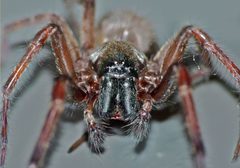
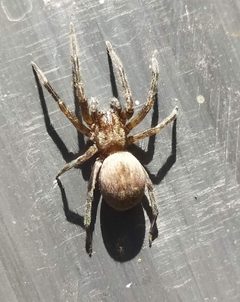
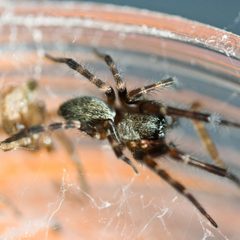
Medium to large cribellate spiders. The ranges from pale brown to darker brown, bearing long or small brown hairs alongside smaller white hairs. The opisthosoma displays dark striping or spotting. As cribellate spiders, they possess a cribellum—a silk-producing plate used to generate hackled silk for prey capture.
Habitat
Native occupy intertidal and terrestrial in the Indo-Australian region. Introduced , particularly B. longinqua and B. insignis, are strongly , occurring in urban environments including public parks, window frames, building exteriors, and cemeteries. In Brazil, B. longinqua has been documented in window frames and artificial structures rather than natural vegetation.
Distribution
Native to the Indo-Australian region, with most to Australasia. Introduced established in: California (USA) along the Pacific coast; Japan; Germany; New Zealand; Uruguay; Argentina (Buenos Aires Province); and southern Brazil (Rio Grande do Sul).
Diet
Active that capture prey in webs. B. longinqua has been documented consuming crickets and fruit flies in feeding experiments. Gut microbiome analysis indicates diet directly influences microbial assembly, with prey-derived microbes transiently colonizing the spider's gut.
Behavior
Nocturnally active sit-and-wait . B. insignis exhibits risk-sensitive foraging : during daylight hours, spiders remain within retreats and take longer to reach prey, reducing foraging success but minimizing risk. At night, spiders position themselves exposed at retreat edges, enabling rapid prey capture and faster escape from predators. Web-building occurs on artificial structures in urban environments.
Ecological Role
in both native and introduced ranges. In invaded regions, B. longinqua functions as an established in urban . The transient, prey-influenced gut microbiome suggests limited of , with microbial shaped primarily by consumed prey rather than -specific .
Human Relevance
Frequently encountered around human structures due to habits. Considered harmless to humans. B. insignis is commonly known as the 'black house spider' or 'black window spider' due to its association with buildings. Introduced have become established in urban areas across multiple continents, sometimes mistaken for medically significant spiders due to dark coloration.
Similar Taxa
- AmaurobiusAlso cribellate spiders that occur in human structures, but differs in geographic distribution (primarily Holarctic) and specific web architecture
- StiphidionMarronoid spider in Stiphidiidae with similar cribellate silk production; distinguished by web structure and preferences
- DesisIntertidal desid spider that shares -level traits, but occupies marine shoreline rather than terrestrial or environments
Misconceptions
The 'black window spider' for B. insignis may cause confusion with the medically significant widow spiders (Latrodectus, Theridiidae), which are unrelated and possess potent neurotoxic venom. Badumna are harmless to humans.
More Details
Invasive Spread
B. longinqua has demonstrated significant capacity, with documented establishment on six continents. The ' facilitates human-mediated through shipping and transportation networks. Despite its presence in multiple countries, it has not been documented along major highway corridors in Brazil, suggesting limited overland dispersal capability.
Gut Microbiome Dynamics
Research on B. longinqua reveals a highly transient gut microbiome without a stable core . Prey identity directly determines microbial assembly: consumption introduces numerous prey-derived bacteria, while fruit fly consumption leads to remodeling by environmental or rare resident . This pattern differs from many animals with stable, vertically transmitted microbiomes.
Predation Risk Trade-offs
B. insignis demonstrates behavioral plasticity in balancing foraging against risk, challenging assumptions that sit-and-wait exhibit inflexible foraging . Reduced foraging success appears offset by increased survival probability.
Sources and further reading
- BugGuide
- Wikipedia
- GBIF taxonomy match
- iNaturalist taxon
- NCBI Taxonomy
- Catalogue of Life
- marronoid phylogram - Entomology Today
- Foraging behaviour and the risk of predation in the black house spider, Badumna insignis (Desidae)
- The invasive spider Badumna longinqua (L. Koch, 1867) (Araneae: Desidae) in Argentina: new distributional records, with notes on its expansion and establishment
- First records of the invasive spider Badumna longinqua (L. Koch) (Desidae) in southern Brazil with notes on the habitats and the species’ dispersion
- Are you what you eat? A highly transient and prey‐influenced gut microbiome in the grey house spider Badumna longinqua
- Introduction, distribution and habitats of the invasive spiderBadumna longinqua(L. Koch, 1867) (Araneae: Desidae) in Uruguay, with notes on its world dispersion