
Priocnemis
Schiødte, 1837
spider wasp
Species Guides
9Priocnemis is a of spider wasps in the Pompilidae, Pepsinae, containing approximately 30 . These solitary are specialized of spiders, with females hunting and paralyzing prey to provision nest for their larvae. The genus has a wide geographic distribution including North America, Europe, and Asia, with species varying in size from small to relatively large among pompilids.
Pronunciation
How to pronounce Priocnemis: //praɪˈɒknɛmɪs//
These audio files are automatically generated. While they are not always 100% accurate, they are a good starting point.
Identification
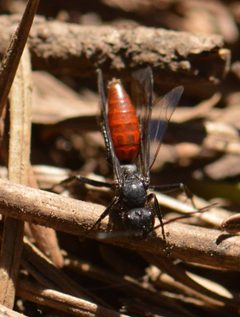
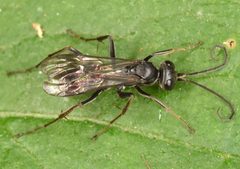
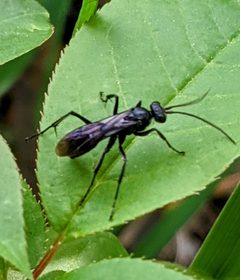
Priocnemis can be distinguished from other black spider wasps by the serrated top surface of the tibia on the hind leg. Members of the vary in size, with forewing lengths ranging from approximately 6-12 mm in smaller species like P. minorata to larger sizes in species such as P. perturbator. Many species exhibit shiny black coloration with smoky or iridescent wings. Species-level identification requires examination of additional morphological characters including genitalia and wing venation patterns.
Images
Habitat
occupy diverse including deciduous forests, open woodland, dry sites, and sandy areas. P. minorata is found in deciduous forests with dappled sunlight through the tree , hunting among leaf litter. P. perturbator occurs in open woodland and other dry sites. Several species are associated with coastal or sandy habitats where their spider prey is abundant.
Distribution
The has a broad distribution spanning the Nearctic, Palearctic, and Oriental regions. P. minorata is abundant in the eastern United States west to the 100th meridian, with additional records from the Pacific Northwest (southeast British Columbia, western Oregon) and eastern Canada (Nova Scotia, Quebec, Ontario). P. perturbator is widespread in Ireland and Britain. The P. hyalinata -group extends into Russia and China, with P. yunnanensis described from Yunnan, China representing the first Oriental Region record for the species-group. P. propinqua has a submediterranean distribution in France.
Seasonality
are active primarily in spring. P. minorata is active from late March to mid-June, with peak activity in April and May. P. perturbator flies from April to July, sometimes later. Activity patterns correspond with the availability of spider prey and suitable temperatures for nesting.
Diet
visit flowers for nectar. P. perturbator has been observed on wood spurge, blackthorn, dandelion, hawthorn, and willow.
Host Associations
- Lycosidae - preywolf spiders; includes Trochosa terricola, Arctosa rubicunda, Gladicosa gulosa, Varacosa avara
- Pisauridae - preynursery web spiders; includes Dolomedes tenebrosus, Pisaurina mira
- Amaurobiidae - preyhacklemesh weavers; includes Coras juvenilis, Wadotes calcaratus, Wadotes hybridus
- Anyphaenidae - preyghost spiders; includes Hibana gracilis
- Clubionidae - preysac spiders; includes Clubiona obesa
- Philodromidae - preyrunning crab spiders; includes Thanatus
- Gnaphosidae - preyground spiders
Life Cycle
Females dig burrows prior to hunting, with entrances usually hidden under dead, dry leaves. The tunnel is vertical or slightly angled, reaching depths up to 27.5 cm in P. minorata. One is constructed at the bottom, with up to six additional cells branching off progressively from the bottom up. Each cell receives one paralyzed spider, placed on its side, with a single laid on the spider's . The egg hatches in approximately two days and the larva matures in about one week. The remainder of the year is spent as a pupa, with emerging the following spring. P. propinqua reproduces by , with females producing only female offspring from unfertilized eggs; no males have been found among 137 specimens examined.
Behavior
Females hunt and paralyze spiders using their sting, then transport prey to nest . P. minorata has been observed carting paralyzed spiders while on the ground. are often seen in spring, flying and visiting flowers. Some are among the first pompilids active in spring, making them conspicuous indicators of seasonal change.
Ecological Role
Priocnemis function as (paralyzing ) of spiders, potentially influencing spider in their . flower visitation may contribute to pollination, though this role has not been quantified. Their spring makes them important seasonal components of forest and woodland .
Human Relevance
These are generally not aggressive toward humans and do not defend nests. They may be observed by naturalists as indicators of spring in temperate regions. P. minorata is notable for being one of the most conspicuous spring wasps in eastern North American deciduous forests. No significant economic impacts, positive or negative, have been documented.
Similar Taxa
- AnopliusAnother of Pompilidae that preys on wolf spiders; distinguished by tibial structure and other morphological characters
- AgeniellaSimilar size and coloration in some ; distinguished by morphological details of legs and body
- Other Pompilidae generaMany black spider wasps appear similar superficially; Priocnemis is distinguished by the serrated hind tibia and other structural characters
More Details
Reproductive biology
P. propinqua is the only known pompilid with confirmed , a remarkable reproductive mode that may be unique within the . This shows a contracting distribution in northern Europe, with apparent retreat from areas north of the Loire in France since 1950.
Taxonomic history
The has undergone taxonomic revision, with the P. hyalinata -group recently reviewed and expanded to include Oriental species. Historical confusion between P. perturbator and P. susterai means older distributional records for these species should be treated with caution.
Sources and further reading
- BugGuide
- Wikipedia
- GBIF taxonomy match
- iNaturalist taxon
- NCBI Taxonomy
- Catalogue of Life
- Bug Eric: Priocnemis minorata
- Bug Eric: Spider Sunday: Beach Wolf Spider
- Bug Eric: City Nature Challenge 2023 Recap
- ID Challenge #20 | Beetles In The Bush
- Sur Priocnemis propinqua (Lepeletier, 1845), Pompilide à reproduction parthénogénétique thélitoque (Hymenoptera, Pompilidae)
- Review of the Priocnemis hyalinata species-group (Hymenoptera: Pompilidae), with description of a new species from China
- The genome sequence of the spider-hunting wasp, Priocnemis perturbator (Harris, 1780) (Hymenoptera: Pompilidae).