
Ageniella
Banks, 1912
mud-nesting spider wasps
Species Guides
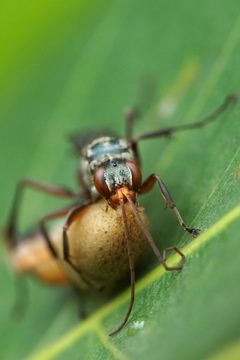
14Ageniella is a of small, slender spider wasps in the Pompilidae, tribe Ageniellini. Members construct mud nests—typically trumpet- or thimble-shaped —each stocked with a single paralyzed spider and provisioned with one . The genus includes at least one documented cave-nesting (Ageniella evansi) and species exhibiting -mimicry. is pronounced: females are often reddish or orange-brown with banded wings, while males are black with reddish leg markings and a white abdominal tip.

Pronunciation
How to pronounce Ageniella: /ˌæɡəˈniːə/
These audio files are automatically generated. While they are not always 100% accurate, they are a good starting point.
Identification
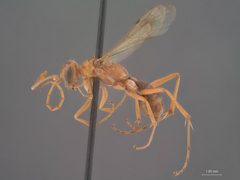
Smaller and more slender than many other pompilid . Females often reddish, pinkish, or orange-brown with dark banding on wings; some have smoky wings with banding, others clear wings lacking bands. Males are black with reddish markings on legs and a white spot at the abdominal tip. Forewing length 4–8 mm (females 5–8 mm, males 4–5 mm). Extremely long legs relative to body size. Wing bands can create an -like silhouette when viewed from certain angles.
Images
Habitat
Open areas including fields, meadows, and sandy ; sometimes near buildings. At least one (A. evansi) nests in deep caves in Arizona.
Distribution
Neotropical and Nearctic realms. Documented from the southern United States through Mexico and into South America (Brazil, Colombia, Peru).
Host Associations
- Arctosa littoralis - prey wolf spider
- Varacosa gosiuta - prey wolf spider
- Varacosa avara - prey wolf spider
- Pardosa valens - prey wolf spider
Life Cycle
Females construct trumpet- or thimble-shaped mud nests, each containing one paralyzed spider and one . Females amputate spider legs to facilitate transport and fitting into narrow nest openings. Nests are dug in pre-existing soil crevices or, in at least one , deep within caves.
Behavior
Females hunt spiders as larval provisions, amputating prey legs for easier transport and nest insertion. Some exhibit -mimicry, possibly as a defensive strategy against . visit flowers for nectar, including sunflowers (Helianthus), Chamaecrista nictitans, Euphorbia marginata, Baccharis salicifolia, and Bifora americana.
Ecological Role
of spiders, particularly wolf spiders (Lycosidae); serves as a agent for spider . contribute to pollination through nectar feeding.
Human Relevance
Minimal direct economic impact. Of interest to entomologists and naturalists; observations of poorly documented may contribute to scientific knowledge.
Similar Taxa
- Ageniellini tribe membersShare slender body proportions; distinguished by -level characters including nest architecture and wing banding patterns
- Ants (Formicidae)Some Ageniella females resemble ants due to wing banding creating 'nodal' appearance; distinguished by long legs, wing presence in females, and -like
Sources and further reading
- BugGuide
- Wikipedia
- GBIF taxonomy match
- iNaturalist taxon
- NCBI Taxonomy
- Catalogue of Life
- Bug Eric: Wasp Wednesday: Ageniella accepta/conflicta
- Bug Eric: Spider Sunday: Beach Wolf Spider
- Biology and ecology of a deep cave nesting spider wasp, Ageniella evansi Townes, (Hymenoptera: Pompilidae), in Arizona
- Addition to the Distributional Record ofAgeniella(Neotumagenia)amazonicaFernández, 1998 (Hymenoptera: Pompilidae) and Establishment of a Neotype