
Ageniella accepta
(Cresson, 1867)
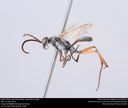
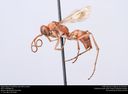
Ageniella accepta is a small spider wasp ( Pompilidae) found across the southern United States and Mexico. Females exhibit striking -mimicry through orange-brown coloration and dark wing bands that resemble the constricted waist of ants. The is part of the 'accepta species group' alongside A. conflicta and A. blaisdelli, with which it shares similar and . Females hunt spiders to provision nests for their larvae.
Pronunciation
How to pronounce Ageniella accepta: /æ.d͡ʒəˈniː.ɛl.lə əkˈsɛp.tə/
These audio files are automatically generated. While they are not always 100% accurate, they are a good starting point.
Identification
Females can be distinguished from similar Ageniella by the combination of small size, orange-brown coloration, and dark wing bands. Separation from A. conflicta often requires examination of specimens rather than field observation. Males are readily identified by their black coloration with white abdominal spot, which differs completely from female appearance. The -mimicry may cause initial confusion with actual ants, but the long legs, wing presence, and single body node (versus two in ants) reveal the identity.
Images
Appearance
Females are small, orange-brown with dark transverse bands across the wings that create the illusion of -like nodes. The forewing length is 5–8 millimeters. Males are distinctly different: black with reddish leg markings and a white spot at the abdominal tip, with forewing length of 4–5 millimeters. Both sexes have notably long legs relative to body size.
Habitat
Occurs in open where spiders and nectar sources are available. Documented visiting sunflowers, Sensitive Partridge Pea (Chamaecrista nictitans), Snow-on-the-Mountain (Euphorbia marginata), Seep Willow (Baccharis salicifolia), and Prairie Bishop (Bifora americana).
Distribution
Ranges across the southern half of the United States and into Mexico.
Diet
feed on nectar from flowers. Larvae are provisioned with spiders captured by females.
Host Associations
- immature wolf spiders (Lycosidae) - prey records include Varacosa gosiuta, V. avara, Arctosa littoralis, and Pardosa valens; jumping spiders have also been recorded but identifications predate separation from A. conflicta
Life Cycle
Females dig short burrows originating in pre-existing soil crevices. They amputate spider legs to facilitate transport and nest provisioning. Specific details of laying, larval development, and are not well documented.
Behavior
Females exhibit -mimicry and appearance, likely as a defense against . They are known to visit flowers for nectar, sometimes remaining oblivious to observers. When hunting, they capture spiders and modify them by removing legs before transport to nests.
Ecological Role
As a of spiders, helps regulate spider . As a nectar visitor, may contribute to pollination of visited plants. Serves as prey for higher .
Similar Taxa
- Ageniella conflictaExtremely similar ; historically confused with A. accepta. Reliable separation often requires specimen examination rather than field identification.
- Ageniella blaisdelliThird member of the accepta group, western in distribution.
- Ants (Formicidae)Convergent -mimicry appearance; distinguished by wing presence, single 'node' versus two, and long legs.
More Details
Taxonomic history
Originally described as Pompilus acceptus by Cresson in 1867. Placed in Ageniella as part of the accepta group defined by Townes (1957).
Research needs
The scarcity of published information on Ageniella means field observations of , associations, and use could contribute meaningfully to knowledge.
Sources and further reading
- BugGuide
- GBIF taxonomy match
- iNaturalist taxon
- NCBI Taxonomy
- Catalogue of Life
- Bug Eric: Wasp Wednesday: Ageniella accepta/conflicta
- Bug Eric: Spider Sunday: Beach Wolf Spider
- Why Modern IPM Should Take a Wider View of Key Influences
- Friday Editor’s Tip: Lose the formatting! | Beetles In The Bush
- Nota Lepidopterologica goes advanced open access with Pensoft Publishers | Blog
- Deciding to harm nature - Buglife Blog - Buglife