
Arctosa littoralis
(Hentz, 1844)
beach wolf spider, shoreline wolf spider
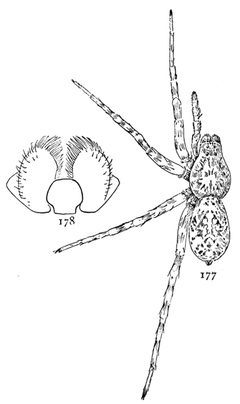
Arctosa littoralis, commonly known as the beach wolf spider or shoreline wolf spider, is a of wolf spider in the Lycosidae. It is a medium-sized spider (11-15 mm body length) with highly effective camouflage coloration adapted to sandy . The species ranges throughout North and Central America, where it inhabits beaches, dunes, stream banks, and other sandy environments. It is primarily and can be located at night by the distinctive blue-green eyeshine produced when light reflects from its tapetum lucidum.
Pronunciation
How to pronounce Arctosa littoralis: //ˌɑrkˈtoʊsə ˌlɪtəˈreɪlɪs//
These audio files are automatically generated. While they are not always 100% accurate, they are a good starting point.
Identification
The combination of (sandy beaches, dunes, stream banks), activity with blue-green eyeshine, and cryptic mottled gray-white coloration distinguishes this from other wolf spiders. It can be separated from the Hogna by its smaller size and more delicate build. It differs from Pardosa species by its larger size and habitat preference for open sand rather than vegetated areas. Geolycosa species construct more prominent burrows and have different body proportions. Definitive identification requires examination of genitalic structures (epigyne in females, in males).
Images
Appearance
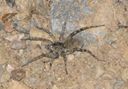
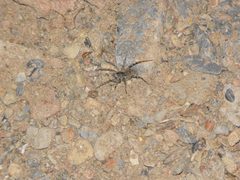
Mature individuals measure 11-15 mm in body length with a sprawling leg span that increases perceived size. Coloration is highly variable and cryptic: mottled gray, brown, or nearly white, matching sandy substrates. The body pattern provides effective camouflage against dry sand. The produce a distinctive blue-green reflection (eyeshine) when illuminated at night due to a tapetum lucidum.
Habitat
Sandy including ocean and lake beaches, coastal dunes, river and stream banks, sand blowouts, and other open sandy areas. Often found near the water's edge on wet sand where the white coloration contrasts with darkened substrate, making detection easier. During daylight hours, individuals shelter under driftwood, debris, or in shallow silk-lined burrows 15-25 cm deep in the sand.
Distribution
North America (United States, southern Canada) and Central America. Records include the Atlantic coast, Great Lakes region, Mississippi River system, and Pacific coast. In the United States, documented from Massachusetts (Cape Cod) to Florida, west to California, and throughout the interior along major river systems.
Seasonality
Active primarily during warmer months. have been observed in July in Massachusetts and September in Missouri. Activity pattern is , with individuals emerging to hunt on sand surfaces at night.
Diet
Active that hunts prey on sand surfaces. Documented prey includes insects such as honeybees. The is swift and muscular, relying on speed and vision to capture prey.
Life Cycle
involves sacs carried by females. Spiderlings emerge and may remain clustered on the mother's before dispersing. Specific details of developmental stages and are poorly documented.
Behavior
Nocturnally active hunter that relies on speed and camouflage. When approached, individuals are wary and quick to flee, making close observation difficult. During daylight, remains concealed under debris or in burrows. The exhibits strong thigmotaxis, pressing close to sand substrates. When photographed, individuals may bolt in response to vibrations transmitted through the ground from camera movement.
Ecological Role
in sandy littoral . Serves as prey for spider wasps (Pompilidae), including Priocnemis cornica, Ageniella conflicta, and Anoplius apiculatus, which paralyze and provision nests with this as larval food.
Human Relevance
Occasionally encountered by beachgoers and naturalists. Not considered dangerous; bites are rare and occur only if the spider is handled roughly. The has been the subject of nature photography due to its cryptic appearance and the challenge of approaching wary individuals. In 2012, a photograph of this species won first place in the entomology category of a local nature photography competition in Missouri.
Similar Taxa
- Geolycosa spp.Also inhabits sandy areas and constructs burrows, but typically larger with more robust body proportions and different burrow architecture (deeper, more vertical shafts).
- Hogna spp.Larger wolf spiders with more robust build and darker, less cryptic coloration; typically found in more vegetated rather than open sand.
- Pardosa spp.Smaller wolf spiders usually associated with vegetated ; more active runners with different arrangement proportions.
More Details
Eyeshine phenomenon
The blue-green reflection from the is caused by a tapetum lucidum, a reflective layer behind the that enhances night vision. This trait is shared with other Lycosidae and makes location with a headlamp highly effective.
Photographic challenges
The is exceptionally wary and sensitive to ground vibrations. Successful photography requires ultra-cautious approach, ground-resting the camera with hand support to dampen vibration, and patience to allow individuals to resume normal activity.
Taxonomic history
Originally described as Lycosa littoralis by Hentz in 1844, later transferred to Arctosa. The genus Arctosa was revised for North and Central America by Dondale & Redner (1983).
Sources and further reading
- BugGuide
- Wikipedia
- GBIF taxonomy match
- iNaturalist taxon
- NCBI Taxonomy
- Catalogue of Life
- Bug Eric: Spider Sunday: Beach Wolf Spider
- ID Challenge #20 | Beetles In The Bush
- Arachnida | Beetles In The Bush | Page 5
- Bug Eric: Wasp Wednesday: Ageniella accepta/conflicta
- And the results are in… | Beetles In The Bush