
Arctosa
C. L. Koch, 1847
Bear Spiders, Beach Wolf Spiders
Species Guides
9- Arctosa alpigena(Hilltop Wolf Spider)
- Arctosa emertoni(Emerton's Wolf Spider)
- Arctosa lama
- Arctosa littoralis(beach wolf spider)
- Arctosa perita(Sand Bear Spider)
- Arctosa raptor(Raptor Wolf Spider)
- Arctosa rubicunda(Redlined Wolf Spider)
- Arctosa sanctaerosae(Santa Rosa Wolf Spider)
- Arctosa virgo
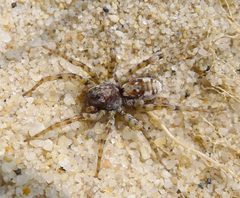
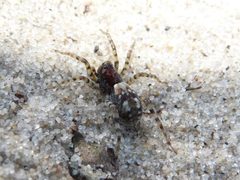
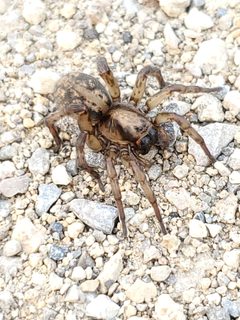
Arctosa is a of wolf spiders (Lycosidae) first described by Carl Ludwig Koch in 1847. The genus contains over 150 described , with most species inhabiting sandy environments such as seashores, riverbanks, and lake shores. These spiders are characterized by swift running ability, keen eyesight, and cryptic coloration matching their substrates. Females typically attend in silk-lined burrows rather than carrying egg sacs, and most species appear to be .
Pronunciation
How to pronounce Arctosa: /ɑrkˈtoʊsə/
These audio files are automatically generated. While they are not always 100% accurate, they are a good starting point.
Identification
Distinguished from other Lycosidae by combination of: broad, low with uniform height; glabrous or nearly glabrous carapace surface; specific tooth arrangement on fang furrow (2-3 promarginal, 3 retromarginal); deeply notched ; and male with bipartite or dimorphic terminal . Epigyne structure (atrium with septum, no hood) confirms female identity. From similar Geolycosa, differs in burrow construction and specific genitalic characters. From Pardosa, differs in body proportions and arrangement details.
Images
Habitat
Most inhabit sandy places including seashores, river banks, and lake shores. Some species occupy heath or lichen in high mountains. Sandy substrates are strongly preferred for burrow construction and .
Distribution
Worldwide distribution with recorded from North America, Central America, Europe, Turkey, and other regions. Arctosa littoralis ranges throughout the United States and southern Canada. Numerous African species require taxonomic revision. GBIF records indicate presence in Denmark, Norway, Sweden, Vermont (USA), and other US locations.
Seasonality
Active primarily at night. Priocnemis minorata preys on Arctosa from late March to mid-June, suggesting spring activity for some species.
Diet
Active hunters of small arthropods. Arctosa littoralis has been observed killing honeybee . Prey selection likely opportunistic based on size and availability in sandy .
Life Cycle
Females attend in silk-lined burrows rather than carrying egg sacs. Egg sacs deposited in burrows. Development includes egg, spiderling, and stages. Specific instar counts not documented for .
Behavior
Swift runners with relatively keen eyesight. activity pattern. Burrow-dwelling; females remain with sacs in burrows. When illuminated at night, reflect bluish-green light (eyeshine), a trait useful for locating individuals. Astronomical orientation has been observed, with navigation patterns varying by characteristics.
Ecological Role
in sandy littoral and riparian . Prey for spider wasps (Pompilidae) including Priocnemis cornica, Ageniella conflicta, Anoplius apiculatus, and Priocnemis minorata. influenced by fragmentation and severe weather events in coastal dune systems.
Human Relevance
Subject of macrophotography due to cryptic coloration and accessible . Arctosa littoralis photographed specimens have won nature photography competitions. Some of conservation concern due to coastal development; Arctosa sanctaerosae is to secondary dunes of Northern Gulf Coast (USA) and threatened by fragmentation and hurricanes.
Similar Taxa
- GeolycosaSimilar burrow-dwelling wolf spiders in sandy , but Geolycosa constructs deeper, more permanent burrows and differs in genitalic .
- PardosaSimilar-sized wolf spiders with overlapping , but Pardosa typically carries sacs attached to rather than depositing in burrows.
- HognaLarger wolf spiders sometimes confused with Arctosa, but Hogna are generally larger, more robust, and lack the specific and genitalic characters of Arctosa.
More Details
Chromosomal characteristics
Arctosa maculata has number 2n♂=28 with system X1X20; all chromosomes telocentric.
Taxonomic status
Numerous African require revision. As of October 2025, includes 165 species and two .
Conservation genetics
Arctosa sanctaerosae show genetic fragmentation due to anthropogenic disturbance, with historic patterns disrupted by coastal development.
Sources and further reading
- BugGuide
- Wikipedia
- GBIF taxonomy match
- iNaturalist taxon
- NCBI Taxonomy
- Catalogue of Life
- Bug Eric: Spider Sunday: Beach Wolf Spider
- ID Challenge #20 | Beetles In The Bush
- Arachnida | Beetles In The Bush | Page 5
- And the results are in… | Beetles In The Bush
- Bug Eric: Priocnemis minorata
- Bug Eric: Wasp Wednesday: Ageniella accepta/conflicta
- Türkiye’de Yayılış Gösteren Arctosa maculata (Hahn, 1822) (Araneae: Lycosidae) Türünün Karyolojik Özelliklerinin Araştırılması Demonstrating Distribution in Turkey Arctosa maculata (Hahn, 1822) (Araneae: Lycosidae) Type of Investigation of Karyological Features
- Reproduction ofArctosa alpigena lamperti(Araneae: Lycosidae) – where, when, how, and how long?
- Sulle relazioni tra habitat ed orientamento astronomico in alcune specie del gen.Arctosa.(Araneae - Lycosidae)
- Wiederfund von Arctosa maculata (Gefleckter Wühlwolf) (Araneae: Lycosidae) in Baden-Württemberg, mit Anmerkungen zum Habitatverlust durch das invasive Indische Springkraut (Impatiens glandulifera)
- Genetic structure as a response to anthropogenic and extreme weather disturbances of a coastal dune dwelling spider, Arctosa sanctaerosae
- Occurrence and Habitat Selection of Arctosa Cinerea (Fabr., 1777) (Araneae, Lycosidae) in Exhausted Opencast Brown Coal Mining Areas in Central Germany