
Geolycosa
Montgomery, 1904
Burrowing Wolf Spiders
Species Guides
14- Geolycosa escambiensis
- Geolycosa fatifera
- Geolycosa gosoga
- Geolycosa hubbelli
- Geolycosa micanopy
- Geolycosa missouriensis(Missouri Burrowing Wolf Spider)
- Geolycosa ornatipes
- Geolycosa patellonigra
- Geolycosa pikei(Pike's Burrowing Wolf Spider)
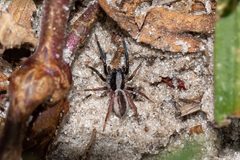
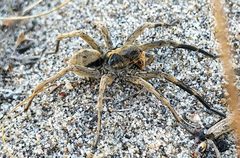
Geolycosa is a of burrowing wolf spiders ( Lycosidae) established by Montgomery in 1904. These spiders are characterized by their obligate burrowing lifestyle, constructing deep cylindrical burrows in sandy or loose soils. Some build distinctive turrets around burrow openings using sticks and debris. The genus includes approximately 70 species distributed across North America, with some species extending into the Levant. Geolycosa species are medium to large spiders with morphological adaptations for digging, including enlarged and stout legs.
Pronunciation
How to pronounce Geolycosa: //dʒiː.oʊˈlaɪk.oʊ.sə//
These audio files are automatically generated. While they are not always 100% accurate, they are a good starting point.
Identification
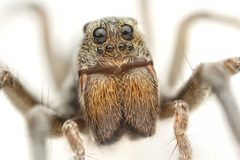
Geolycosa can be distinguished from other wolf spider by several key morphological features: the is anteriorly truncated and highest in the region of the lateral , with steep lateral sides. The are notably large, much longer than the width, with three teeth in the cheliceral furrow. The sternum and are both longer than wide. The legs are strong with the front leg being the thickest and strongest; and bear thick scopulae on the last three leg segments. The epigyne is very small. These spiders are further distinguished behaviorally by their deep burrowing habit and, in some , construction of debris turrets around burrow entrances.
Images
Habitat
Geolycosa are obligate burrowers inhabiting sandy or loose soils in open areas with sparse vegetation. include sand dunes, sandy grasslands, coastal areas, and other well-drained substrates suitable for excavation. Burrows are typically deep cylindrical shafts, often lined with silk, with some species constructing low turrets of sticks and debris around the opening. Juveniles establish burrows after dispersing from maternal burrows, with burrow diameter increasing as spiders grow.
Distribution
Geolycosa is distributed across North America from southern Canada to Texas, east to New York and west to Utah and Arizona. The extends into the Levant, with Geolycosa vultuosa recorded from Israel. show varying distributions, with some having restricted ranges (particularly Florida endemics) while others are widespread across the Great Plains and eastern North America.
Seasonality
activity varies by and geography. In Geolycosa domifex, females mature and reproduce at age 3 years in late summer or early autumn, with laid the following May or June. Geolycosa patellonigra shows distinct seasonal activity patterns that vary geographically across its range. Males are often encountered wandering in search of females during mating periods.
Life Cycle
Geolycosa exhibit extended , with Geolycosa domifex requiring 3 years to reach maturity. Females are , producing a single . Juveniles disperse from maternal burrows during July–August, establish their own burrows, and overwinter. Burrow diameter increases progressively: approximately 1 mm in August of the first year, 2–3 mm by October, 7 mm by the second , and 13 mm by the third overwintering. Spiderlings show prolonged mutual within broods, with chemical communication as the principal mechanism. High mortality occurs during establishment, with approximately 85% dying in the first year.
Behavior
Geolycosa are sit-and-wait that spend most of their lives inside burrows. They exhibit burrow-blocking , using legs and body to push soil and debris into the entrance tunnel when disturbed. Spiderlings engage in ballooning (aerial via silk threads) at frequencies higher than reported for other lycosids, even in stable . are often located at night by the reflective glow of their when illuminated by flashlight or headlamp. Some species show subsocial organization with prolonged mutual among spiderlings.
Ecological Role
Geolycosa serves as important prey for specialized , including acrocerid flies (Pterodontia flavipes) and pompilid wasps (Anoplius relativus), which can cause substantial mortality in . These spiders function as in sandy , with their burrowing activities potentially influencing soil structure. Localized population structure results from limited spiderling , with multiple cohorts coexisting with minimal .
Human Relevance
Geolycosa are subjects of ecological and behavioral research, particularly regarding burrowing , ballooning , and -prey interactions with spider wasps. Some Florida species are of conservation concern due to loss in endangered . The reflective shine of these spiders makes them popular subjects for nature observation and photography.
Similar Taxa
- ArctosaBoth are burrowing wolf spiders with similar , but Arctosa has a different shape (not anteriorly truncated) and lacks the pronounced turret-building of some Geolycosa .
- HognaLarge wolf spiders that may be confused with Geolycosa, but Hogna lack the steep-sided, anteriorly truncated and are not obligate burrowers; they are more active wanderers.
- LycosaHistorically confused with Geolycosa, but Lycosa are generally not obligate burrowers and have different proportions; many species formerly in Lycosa have been moved to other .
Sources and further reading
- BugGuide
- Wikipedia
- GBIF taxonomy match
- iNaturalist taxon
- NCBI Taxonomy
- Catalogue of Life
- Bug Eric: Spider Sunday: Burrowing Wolf Spider
- ID Challenge #20 | Beetles In The Bush
- 2024 New Mexico Insect Collecting Trip iReport: Finale | Beetles In The Bush
- 2018 New Mexico/Texas Insect Collecting Trip “iReport” | Beetles In The Bush
- Ballooning in Geolycosa turricola (Treat) and Geolycosa patellonigra Wallace: high dispersal frequencies in stable habitats
- Burrow-blocking behaviour in Geolycosa wrightii (Araneae: Lycosidae)
- Geographical Variation in the Seasonal Distribution of Geolycosa patellonigra (Araneae, Lycosidae)
- The thermal biology of Geolycosa godeffroyi and other burrow inhabiting Lycosidae (Araneae) in Australia
- Nesting biology of the spider wasps (Hymenoptera: Pompilidae) which prey on burrowing wolf spiders (Araneae: Lycosidae,Geolycosa)
- Subsocial organization and behavior in broods of the obligate burrowing wolf spider Geolycosa turricola (Treat)
- Field studies of growth, reproduction, and mortality in the burrowing wolf spider Geolycosa domifex (Hancock)
- Correlated Morphological, Ecological, and Behavioral Aspects of the Microhabitat Associations inGeolycosaWolf Spiders of Florida (Araneae, Lycosidae)
- Interactions between the pompilid wasp Anoplius relativus (Fox) and the burrowing wolf spider Geolycosa domifex (Hancock)
- The influence of burrowing and thermoregulatory behaviour on the water relations of Geolycosa godeffroyi (Araneae: Lycosidae), an Australian wolf spider
- Mortality patterns for a population of burrowing wolf spiders, Geolycosa domifex (Hancock), living in southern Ontario
- Lycosa Latreille, 1804 (Araneae, Lycosidae) of Israel, with a note on Geolycosa Montgomery, 1904
- Biogeography and conservation biology of Florida's Geolycosa wolf spiders: threatened spiders in endangered ecosystems
- The Influence of Microhabitat and Prey Availability on Burrow Establishment of YoungGeolycosa Turricola (Treat) and G. Micanopy Wallace (Araneae: Lycosidae): A Laboratory Study