
Arctosa perita
(Latreille, 1799)
Sand Bear Spider
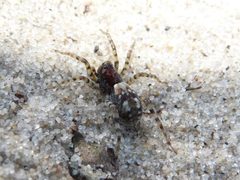
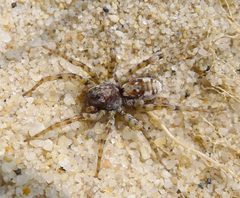
Arctosa perita is a wolf spider in the Lycosidae, commonly known as the sand bear spider. It is native to Europe, North Africa, Turkey, the Caucasus, and Russia, and has been introduced to Canada. The is adapted to dry, sandy where it constructs burrows.

Pronunciation
How to pronounce Arctosa perita: //ɑːrkˈtoʊsə pəˈraɪtə//
These audio files are automatically generated. While they are not always 100% accurate, they are a good starting point.
Identification
Distinguished from other Arctosa by the combination of: -shaped brownish-black sternum; greyish cardiac mark on flanked by pinkish-white patches; with white hair patches; and AME larger than ALE. The overall pale coloration with dark annulations on legs is characteristic of sand-dwelling wolf spiders. Distinguished from Arctosa littoralis (beach wolf spider), a North American species not naturally overlapping in range, by geographic distribution and subtle pattern differences.
Images
Habitat
Dry, sandy soils and coastal dunes. Constructs burrows in these substrates.
Distribution
Native to Europe, North Africa, Turkey, the Caucasus, and Russia. Introduced to Canada (specifically recorded from Faial, Pico, São Miguel, Santa Maria, and Terceira in the Azores, and established in mainland Canada).
Behavior
Creates burrows in sandy substrates. Nocturnally active; like other wolf spiders, shine can be observed when illuminated at night.
Ecological Role
in sandy coastal and inland dune .
Human Relevance
Introduced to Canada, likely through human-mediated transport. No significant documented economic or medical importance.
Similar Taxa
- Arctosa littoralisSimilar preference (sandy shores, beaches) and appearance, but native to North America rather than the Palearctic; A. perita distinguished by native range and subtle pattern differences
More Details
Subspecies
Two recognized: Arctosa perita perita (Latreille, 1799) and Arctosa perita arenicola (Simon, 1937)
Sources and further reading
- BugGuide
- Wikipedia
- GBIF taxonomy match
- iNaturalist taxon
- NCBI Taxonomy
- Catalogue of Life
- Blacklighting at the Bohart: They Saw the Light | Bug Squad
- What Will You See at Bohart Museum Open House | Bug Squad
- Oh, What a (Moth) Night! | Bug Squad
- ID Challenge #20 | Beetles In The Bush
- Bug Eric: Spider Sunday: Beach Wolf Spider
- Arachnida | Beetles In The Bush | Page 5