
Wadotes calcaratus
(Keyserling, 1887)
Wadotes calcaratus is a of funnel-web spider in the Agelenidae. It was originally described as Coelotes calcaratus by Keyserling in 1887. The species occurs in eastern North America, where it constructs funnel-shaped webs in forested . It has been documented as prey for the spider wasp Priocnemis minorata.
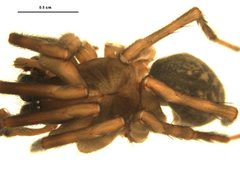
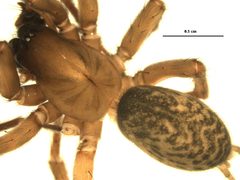
Pronunciation
How to pronounce Wadotes calcaratus: /wəˈdoʊtiːz kælˈkærətəs/
These audio files are automatically generated. While they are not always 100% accurate, they are a good starting point.
Identification
Wadotes calcaratus can be distinguished from other funnel-web spiders by its placement in the Wadotes, which lacks the cribellum (a plate-like silk-spinning organ) characteristic of the related Amaurobiidae. The genus Wadotes was historically moved between Agelenidae and Amaurobiidae due to this morphological consideration, but has been returned to Agelenidae. Specific diagnostic characters for W. calcaratus are not well documented in available sources.
Images
Habitat
Forest floor with leaf litter and dappled sunlight. Webs are constructed in concealed locations such as beneath stones, in rock crevices, and under loose bark on trees and logs. The also occurs in human-modified environments including basements and cellars.
Distribution
United States and Canada. Eastern North America, primarily east of the Mississippi River.
Behavior
Constructs funnel-shaped webs with multiple retreats, typically positioned well off the ground or in concealed locations. Webs are generally smaller than those of other funnel-web spiders, corresponding to the relatively small body size of the spider.
Ecological Role
Serves as prey for spider wasps, particularly Priocnemis minorata, which paralyzes and provisions its nests with this .
Similar Taxa
- Coras medicinalisAlso in Agelenidae with similar funnel-web construction and preferences; historically confused taxonomically with Wadotes
- Wadotes hybridus with similar and ; both are documented for Priocnemis minorata
More Details
Taxonomic History
The Wadotes has undergone repeated -level reclassification. It was originally placed in Agelenidae ( Coelotinae), moved to Amaurobiidae in 1986 by Wunderlich due to perceived morphological similarities, then returned to Agelenidae in 2011. The reclassification was prompted by the absence of a cribellum in Wadotes and Coras, which conflicts with the defining characteristic of Amaurobiidae.
Predation Records
Documented as prey for the spider wasp Priocnemis minorata (Pompilidae), a of spiders that hunts in forest leaf litter during spring.