
Microcentrum retinerve
(Burmeister, 1838)
lesser angle-winged katydid, Lesser Anglewing
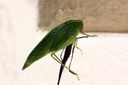
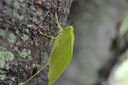
Microcentrum retinerve, commonly known as the lesser angle-winged , is a North American in the Tettigoniidae. range from 44-53 millimeters in length, smaller than the related Greater Angle-wing Katydid (M. rhombifolium). Males produce a calling song consisting of 3-5 rapid pulses repeated about once per second. The species is found in deciduous forest from the eastern United States west to Missouri and extreme east Texas.

Pronunciation
How to pronounce Microcentrum retinerve: /ˌmaɪkroʊˈsɛntrəm rɪˈtɪnɜrvɪ/
These audio files are automatically generated. While they are not always 100% accurate, they are a good starting point.
Identification
are distinguished from the Greater Angle-wing (Microcentrum rhombifolium) by their smaller size (44-53 mm vs. 52-63 mm). Males have a consistently brown stridulatory area (the "shoulders") contrasting with the bright green body, whereas the Greater Angle-wing has green in this area. The front edge of the pronotum is smooth and straight in M. retinerve, while M. rhombifolium has a very small central tooth on this margin. The wing are often more explicitly defined than in the Greater Angle-wing, enhancing the leaf-mimic appearance.
Images
Habitat
Deciduous forest . Found at the tips of tree branches at night.
Distribution
Eastern North America from Long Island and New Jersey south to northern Florida, west to Missouri and extreme east Texas and Oklahoma. Records from Alabama, Arkansas, Delaware, Florida, Georgia.
Seasonality
most commonly encountered between late July and mid-October; may reach maturity as early as May depending on latitude.
Behavior
Males sing to attract females with a calling song of 3-5 rapid pulses too fast to count, repeated about once per second for short periods. Unlike the Greater Angle-wing, males do not produce a courtship song of repeated ticks. are and attracted to lights at night. During daylight they remain motionless and highly cryptic among foliage.
Ecological Role
Prey for sphecid including the Great Black Wasp (Sphex pensylvanicus). are vulnerable to by tiny wasps in the Eupelmidae.
Similar Taxa
- Microcentrum rhombifoliumLarger size (52-63 mm), green stridulatory area in males, small central tooth on front pronotal margin, and presence of a courtship song of repeated ticks.
- Microcentrum californicumSmallest member of (41-52 mm), restricted to Arizona and California west of the Sierras.
- Microcentrum louisianumLouisiana Angle-wing found from Louisiana and Mississippi north to Missouri bootheel.
- Microcentrum minusTexas Angle-wing restricted to extreme south Texas.
- Microcentrum latifronsSouthwestern Angle-wing recorded from Big Bend area of Texas and southeast Arizona.