
Microcentrum
Scudder, 1862
angle-wing katydids, angle-winged katydids
Species Guides
5- Microcentrum californicum(California Angle-winged Katydid)
- Microcentrum latifrons(southwestern angle-wing katydid)
- Microcentrum minus(Texas Angle-wing Katydid)
- Microcentrum retinerve(lesser angle-winged katydid)
- Microcentrum rhombifolium(greater angle-wing katydid)
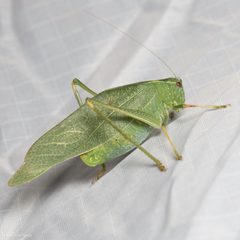
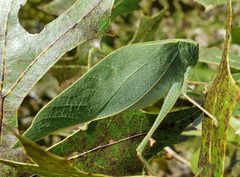
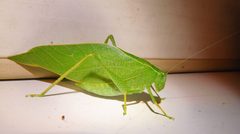
Microcentrum is a of phaneropterid katydids in the Tettigoniidae, commonly known as "angle-wing katydids" due to their distinctive wing shape. The genus contains approximately 40 described distributed across the Americas, from the United States through Central America and South America to the Caribbean. Species vary in size, with ranging from about 41-63 mm in length. They are known for their remarkable leaf-mimicry, with broad, flattened bodies and wings that resemble foliage. Males produce species-specific calling songs through stridulation to attract females.
Pronunciation
How to pronounce Microcentrum: /ˌmaɪ.kroʊˈsɛn.trəm/
These audio files are automatically generated. While they are not always 100% accurate, they are a good starting point.
Identification
Microcentrum are distinguished from other by their broad, angular wings that give them a leaf-like appearance. Key identification features include: broad, flattened bodies with rhomboidal or tegmina (forewings); reticulate wing venation that enhances ; relatively short hind legs compared to other katydids; and males with a brown stridulatory area ("shoulders") contrasting with the green body in some species. Species-level identification requires examination of the pronotum: M. rhombifolium has a small central tooth on the front margin of the pronotum, while M. retinerve has a smooth, straight front margin. M. californicum is the smallest species (41-52 mm) and has a brown stridulatory area like M. retinerve but is geographically isolated in California and Arizona.
Images
Habitat
Deciduous forests and woodlands; forest edges; gardens and yards with trees; open fields with scattered trees. are arboreal, found mostly in trees and shrubs where their leaf-mimicry provides camouflage.
Distribution
Americas: United States (widespread in eastern and central regions, with in California, Arizona, Texas, and the Southwest); Mexico; Central America (Panama, Rica); South America (Brazil, Colombia, Bolivia, Suriname, French Guiana); Caribbean (Caribbean Sea islands).
Seasonality
most commonly encountered from late July through mid-October, though timing varies by latitude and . In southern areas, may reach maturity as early as May.
Diet
Folivorous; nymphs and feed on foliage of trees and shrubs.
Life Cycle
to development includes five nymphal instars. Eggs are deposited single-file along twigs or leaf edges, each overlapping the last like shingles. occurs in the egg stage. Nymphs feed on foliage and four times before reaching adulthood.
Behavior
Males produce calling songs through stridulation (rubbing modified wing structures together) to attract females. The Greater Angle-wing (M. rhombifolium) produces a loud "lisp" repeated every 2-4 seconds, switching to a "courtship song" of ticks when a female approaches. The Lesser Angle-wing (M. retinerve) produces a rapid series of 3-5 pulses repeated about once per second. are and attracted to lights. When disturbed, adults can fly but generally move slowly to avoid detection.
Ecological Role
Herbivore in forest and woodland ; prey for various including sphecid (e.g., Sphex pensylvanicus, the Great Black Wasp, which provisions nests with paralyzed katydids).
Human Relevance
Occasional minor pest in citrus orchards (M. rhombifolium known as "broadwinged "); generally harmless to humans; provide acoustic environment through male songs.
Similar Taxa
- Scudderia (bush katydids)Similar body form and , but Scudderia have more slender bodies, longer hind legs relative to body size, and different wing proportions; males have different song patterns.
- Amblycorypha (round-headed katydids)Similar size and green coloration, but Amblycorypha have more rounded and different wing shapes; songs are distinctly different.
- Pterophylla (true katydids)Both are leaf-mimicking katydids, but Pterophylla are larger with different wing venation and produce the classic "katy-did" song rather than the lisping calls of Microcentrum.
Sources and further reading
- BugGuide
- Wikipedia
- iNaturalist taxon
- NCBI Taxonomy
- Catalogue of Life
- Bug Eric: OrThoptera Thursday: Lesser Angle-wing Katydid
- Bug Eric: OrThoptera Thursday: Greater Angle-wing Katydid
- Bug Eric: Wasp Wednesday: Great Black Wasp
- Bug Eric: Year-end Wrap-up
- Bug Eric: How Insects Sing
- Bug Eric: March 2013
- Citrus Pest Quick Guide: Broadwinged Katydid (Microcentrum rhombifolium)
- Comparative Morphology of Three Orthopteran Species (Microcentrum rhombifolium, Mecopoda elongata, Schistocerca americana) from Kalahandi, Odisha, India
- New species of Microcentrum Scudder, 1862 (Orthoptera: Tettigonioidea: <br />Phaneropteridae) from Amazon rainforest