
Pterophylla
true katydid
Species Guides
1- Pterophylla camellifolia(common true katydid)
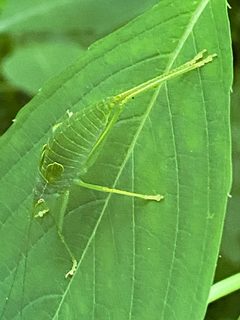
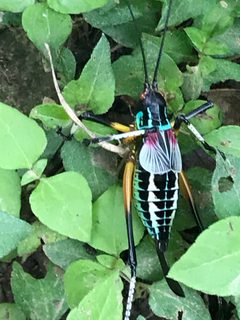
Pterophylla is a of true katydids in the Tettigoniidae, containing approximately five described distributed primarily in North America. The genus is best known for the northern true (P. camellifolia), whose distinctive "katy-did, katy-didn't" call is a familiar sound of late summer evenings in deciduous forests. Males of this genus produce complex acoustic signals including solo calling, alternating calling with neighboring males, aggressive sounds, and disturbance sounds, with well-studied phonoresponse involving reciprocal inhibition and post-inhibitory excitation.
Pronunciation
How to pronounce Pterophylla: //ˌtɛrəˈfɪlə//
These audio files are automatically generated. While they are not always 100% accurate, they are a good starting point.
Images
Habitat
Deciduous forest ; in this are arboreal and associated with broad-leaved trees.
Distribution
North America, with ranging from the eastern and central United States into Mexico; extralimital records from southern Canada (Ottawa, Ontario) attributed to chance introduction.
Seasonality
active in late summer; acoustic calling activity peaks during this period.
Behavior
Males produce three distinct acoustic signal types: calling songs (solo and alternating), aggressive sounds, and disturbance sounds. Alternating calling involves rhythmic chirp exchange between neighboring males at rates slower than solo calling, mediated by acoustic inhibition and post-inhibitory excitation. Females exhibit phonotaxis toward male calling songs. Males produce courtship songs after female contact through forewing vibration.
Human Relevance
The northern true (P. camellifolia) is culturally significant as the namesake of the katydid group; its call is familiar in eastern North American folklore and natural history. The distinctive "katy-did, katy-didn't" rhythm has been the subject of extensive bioacoustic research.
Similar Taxa
- NeobarrettiaBoth are predatory katydids with formidable , but Neobarrettia (spiny bush katydids) are arid-land with prominent spines and different acoustic .
- OrchelimumBoth are green katydids in similar , but Orchelimum (meadow katydids) are smaller, occupy grasslands rather than forest , and have different calling songs.
More Details
Acoustic Research Significance
Pterophylla camellifolia has been a model organism for studies of insect bioacoustics and neuronal mechanisms of phonoresponse, with research demonstrating how relatively simple neuronal circuits can generate complex alternating calling through afferent inhibition and post-inhibitory rebound.
Preservation Artifacts
Green coloration in life fades to yellow or brown after death and pinning, a common preservation artifact in this that can mislead identification attempts based on museum specimens.
Sources and further reading
- BugGuide
- Wikipedia
- iNaturalist taxon
- NCBI Taxonomy
- Catalogue of Life
- ID Challenge #2 | Beetles In The Bush
- An Analysis of the Phonoresponse of Males of the True Katydid, Pterophylla Camellifolia (Fabricius) (Orthoptera: Tettigoniidae)
- Acoustic and Mating Behavior of a Mexican Katydid, Pterophylla beltrani (Orthoptera: Tettigoniidae)
- The Northern True Katydid, <em>Pterophylla camellifolia</em> (Orthoptera: Pseudophyllidae), at Ottawa, Ontario
- Geographic Distribution and Singing Activity of Pterophylla beltrani and P. robertsi (Orthoptera: Tettigoniidae), under Field Conditions
- Variation in Distribution, Morphology andCalling Song of Two Populations ofPterophylla Camellifolia(Orthoptera: Tettigoniidae)