
Pseudophyllinae
Burmeister, 1838
True Katydids
Genus Guides
3- Lea
- Paracyrtophyllus(western true katydids)
- Pterophylla(true katydid)
Pseudophyllinae is a large of katydids (Tettigoniidae) distinguished by exceptional leaf-mimicry. Members typically possess broad, flattened forewings with venation patterns that replicate leaf , blotches, and even simulated herbivore damage. The group contains over 20 tribes distributed across tropical and subtropical regions worldwide, with major radiations in the Neotropics, Afrotropics, and Southeast Asia. Many are and arboreal, inhabiting forest where their provides effective avoidance.
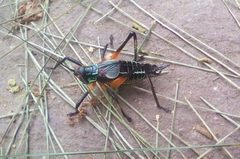
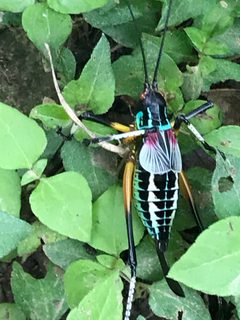
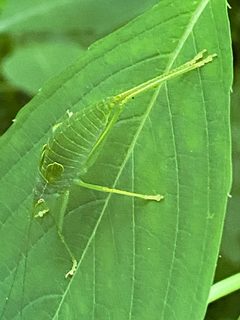
Pronunciation
How to pronounce Pseudophyllinae: /ˌsjuːdoʊˈfɪlɪn.iː/
These audio files are automatically generated. While they are not always 100% accurate, they are a good starting point.
Images
Habitat
Predominantly tropical and subtropical forests, with most occurring in arboreal microhabitats. Several tribes are restricted to specific elevations: Andeophylloides n. gen. occurs in High Andean Forests of Colombia, while most Platyphyllini are found at lower elevations. Some species inhabit forest edges, gardens, and lone trees in open fields.
Distribution
in tropical and subtropical regions. Major centers of diversity include: Neotropics (Central and South America, Caribbean, Lesser Antilles); Afrotropics (West and Central Africa, East African coastal forests and Eastern Arc Mountains); Madagascar; Asia (India, Indo-China, Malesia, Philippines, Papua New Guinea); and Australia. Specific examples: Brachyauchenus restricted to center and north of eastern slope of Colombian Andes; Pseudotomias to Eastern Arc Mountains and coastal forests of East Africa; Simoderini restricted to Madagascar and Australia.
Behavior
activity pattern observed in Andeophylloides zarauzensis, with peak calling activity from 19:00 to 05:00 and highest activity during first rainy season (March to May). Males produce -specific calling songs; six platyphylline species have documented acoustic . generally move slowly to avoid detection; occurs only when pressed. Attracted to lights at night, though not in large numbers.
Similar Taxa
- MecopodinaePhrictini sometimes placed in Mecopodinae; distinguished by morphological characters and geographic distribution in Eastern Australia
- Dasyscelidius atrifrons (Pleminiini)Females superficially similar to Andeophylloides zarauzensis; both share same geographical distribution in Colombian Andes and require careful differentiation
Sources and further reading
- BugGuide
- Wikipedia
- GBIF taxonomy match
- iNaturalist taxon
- NCBI Taxonomy
- Catalogue of Life
- Bug Eric: OrThoptera Thursday: Greater Angle-wing Katydid
- New Pseudophyllinae from the Lesser Antilles (Orthoptera: Ensifera: Tettigoniidae)
- Studies on Neotropical Pseudophyllinae: The status of the genus Brachyauchenus Brunner von Wattenwyl, 1895 and its species (Orthoptera: Tettigoniidae: Pseudophyllinae: Platyphyllini)
- Anti-Predator Defences and Ecology of Neotropical Forest Katydids, Especially the Pseudophyllinae
- UPDATING THE TAXONOMY AND DISTRIBUTION OF LIPAROSCELIS PALLIDISPINA STÅL, 1873 (ORTHOPTERA: TETTIGONIIDAE: PSEUDOPHYLLINAE)
- Panoploscelis scudderi Beier, 1950 and Gnathoclita vorax (Stoll, 1813): two katydids with unusual acoustic, reproductive and defense behaviors (Orthoptera, Pseudophyllinae)
- Observations on the Behavior and Biology of Leaf-Mimicking Katydids (Orthoptera: Tettigoniidae: Pseudophyllinae: Pterochrozini)
- Defensive Behavior and Display of the Leaf-Mimicking Katydid Pterochroza ocellata (L.) (Orthoptera: Tettigoniidae: Pseudophyllinae: Pterochrozini)
- Notes on the Biology and Ecology of the Leaf-Mimicking Katydid Typophyllum bolivari Vignon (Orthoptera: Tettigoniidae: Pseudophyllinae: Pterochrozini)
- The Eastern Arc Mountains and coastal forests of East Africa—an archive to understand large-scale biogeographical patterns: Pseudotomias, a new genus of African Pseudophyllinae (Orthoptera: Tettigoniidae)
- Sylvan katydids (Orthoptera: Tettigoniidae: Pseudophyllinae) of the Guinean Forests of West Africa hotspot: an overview and descriptions of new species
- The tananá [Chlorocoelus hypericifolius (Stoll 1813): Orthoptera, Tettigonioidea, Pseudophyllinae]—re-discovered more than 150 years after the description of the male by Bates and the figuring by Darwin
- New genus of Pleminiini Brunner von Wattenwyl, 1878 (Orthoptera: Tettigoniidae: Pseudophyllinae) from the Colombian Andes
- Studies on Neotropical Pseudophyllinae: A new, short-winged Platyphyllini genus (Orthoptera: Tettigoniidae) from a High Andean Forest in Colombia
- Wing mechanics and acoustic communication of a new genus of sylvan katydid (Orthoptera: Tettigoniidae: Pseudophyllinae) from the Central Cordillera cloud forest of Colombia.