
Pterophylla camellifolia
(Fabricius, 1775)
common true katydid, northern true katydid, rough-winged katydid
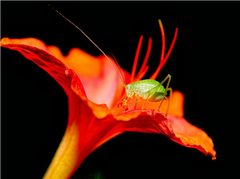
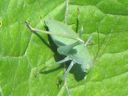
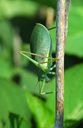
Pterophylla camellifolia is a large, nearly flightless native to eastern North America. Males produce the iconic three-pulsed "ka-ty-did" call that gave katydids their . The inhabits the of deciduous trees and moves primarily by , running, or hopping rather than flying. exhibit geographic variation in song structure, with northern populations producing two- to four-pulsed songs, southeastern populations faster multi-pulsed choruses, southwestern populations one- to two-pulsed songs, and a distinctive 8-15 pulse song restricted to central Iowa. Three are recognized based on morphological and geographic differences.
Pronunciation
How to pronounce Pterophylla camellifolia: /ˌtɛɹ.əˈfɪl.ə kəˌmɛl.ɪˈfoʊ.li.ə/
These audio files are automatically generated. While they are not always 100% accurate, they are a good starting point.
Identification
Large, robust reaching up to 50 mm in length. Nearly flightless with reduced wings relative to body size. Distinguished from other North American katydids by: (1) the male's loud, rasping three-pulsed "ka-ty-did" song; (2) preference for and hopping over leaping or flying; (3) -dwelling habit in deciduous forests rather than shrub or herb layer. Greater angle-wing katydid (Microcentrum rhombifolium) is larger (52-63 mm), more leaf-like in appearance with angular wing margins, and produces a "lisp" call rather than the distinctive three-pulsed song. Meadow katydids (Orchelimum spp.) and coneheads (Neoconocephalus spp.) occupy different and produce different song patterns.
Images
Habitat
of deciduous trees. Specifically associated with mature deciduous forest canopy rather than understory, shrub layer, or herbaceous vegetation.
Distribution
Eastern North America: southeastern Canada (Ontario, Quebec) through eastern United States from Maine south to Florida, west to approximately the Mississippi River valley. Extralimital records from Ottawa, Ontario represent probable chance introductions rather than established .
Diet
Foliage of deciduous trees. Feeds on leaves in the .
Behavior
Males produce three distinct acoustical signals: solo calling, alternating calling (rhythmic alternation with neighboring males at slower rates), and aggressive sounds. Singing rate is temperature-dependent. Acoustical interaction involves entrainment at slower rates through reciprocal inhibition, with intermittent "escape" solos by the faster-calling male. When disturbed, produces arhythmic disturbance sounds. Moves primarily by , running, or hopping; rarely flies even when pressed.
Ecological Role
Folivore in deciduous forest . Specific interactions beyond herbivory are not documented.
Human Relevance
The male's song is the source of the vernacular name "" applied to all members of Tettigoniidae. Frequently heard but rarely seen due to -dwelling habits. Occasionally attracted to lights at night.
Similar Taxa
- Microcentrum rhombifoliumGreater angle-wing katydid is larger (52-63 mm vs. 50 mm), more distinctly leaf-mimicking with angular wing margins, produces a "lisp" call rather than three-pulsed song, and ranges more broadly westward including Texas and southwestern states.
- Orchelimum spp.Meadow katydids inhabit grasslands and wetlands rather than forest , have longer wings relative to body, and produce different song patterns.
- Neoconocephalus spp.Conehead katydids have distinctive conical , occupy open , and produce continuous buzzing songs rather than discrete pulses.
Sources and further reading
- BugGuide
- Wikipedia
- GBIF taxonomy match
- iNaturalist taxon
- NCBI Taxonomy
- Catalogue of Life
- ID Challenge #2 | Beetles In The Bush
- Bug Eric: OrThoptera Thursday: Greater Angle-wing Katydid
- An Analysis of the Phonoresponse of Males of the True Katydid, Pterophylla Camellifolia (Fabricius) (Orthoptera: Tettigoniidae)
- Variation in Distribution, Morphology andCalling Song of Two Populations ofPterophylla Camellifolia(Orthoptera: Tettigoniidae)
- The Northern True Katydid, <em>Pterophylla camellifolia</em> (Orthoptera: Pseudophyllidae), at Ottawa, Ontario