
Microcentrum rhombifolium
(Saussure, 1859)
greater angle-wing katydid, broad-winged katydid, angular-winged katydid
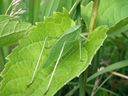
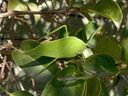
A large, leaf-mimicking native to North America, recognized by its rhombus-shaped green wings and distinctive 'ticking' call. reach 50–65 mm in length and are most active in late summer and autumn. The is among the most convincing leaf mimics in its , with broad, reticulate-veined tegmina that provide excellent in deciduous vegetation. Males produce intermittent calling songs and courtship songs consisting of repeated ticks once a female is attracted.
Pronunciation
How to pronounce Microcentrum rhombifolium: //ˌmaɪ.kroʊˈsɛn.trəm ˌrɒm.bɪˈfoʊ.li.əm//
These audio files are automatically generated. While they are not always 100% accurate, they are a good starting point.
Identification
Distinguished from Microcentrum retinerve (Lesser Angle-wing ) by larger size (50–65 mm vs. 44–53 mm), smooth front margin of pronotum with very small central tooth (vs. smooth and straight in M. retinerve), and male stridulatory area being green rather than brown. The rhomboidal wing shape and heavy body separate it from other North American katydid . Nymphs can be identified by robust body shape, relatively short hind legs, and mottled green appearance. The 'ticking' courtship song and intermittent calling song (lisp repeated every 2–4 seconds) are diagnostic for males.
Images
Appearance
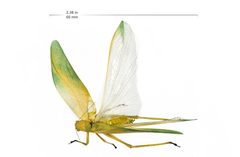
Large, robust with uniformly green coloration throughout, somewhat mottled on legs and . measure 50–65 mm (52–63 mm per detailed sources) from to folded wingtip. The forewings (tegmina) are broad, rhomboidal in shape, with prominent reticulate venation creating a leaf-like texture. Hindwings are membranous with dark patches. Body is heavy and weighty, particularly in females. are and longer than the body. Hind legs are saltatorial (enlarged adapted for jumping). (hearing organ) located on first abdominal tergite. present: males have a notch on the 10th tergite and styli on the subgenital plate; females have an entire 10th tergite, no styli, and a well-developed curved ovipositor.
Habitat
Deciduous trees and shrubs; forest edges, gardens, yards, and lone trees in open fields. Found from ground level to in suitable vegetation.
Distribution
North America: from Pennsylvania and New Jersey south to Florida, west to southeast Minnesota, Iowa, southeast Nebraska, Kansas, and Texas. Range wraps around southern tip of Rockies and Sierras, north to San Francisco Bay, throughout Arizona, and much of Utah. Also recorded from Kalahandi, Odisha, India (possibly introduced or misidentification requiring verification).
Seasonality
active from late summer through autumn; most commonly encountered August through October depending on latitude. May reach maturity as early as May in southern parts of range.
Diet
Herbivorous; feeds on foliage of deciduous trees and shrubs. Has been documented feeding on mullein stalks and is considered a pest of citrus in some regions.
Host Associations
- Citrus - pestDocumented as citrus pest in some agricultural contexts
- Verbascum thapsus - foodObserved feeding on mullein stalk
- Rosa - foodSuccessfully reared on rose foliage in captivity
Life Cycle
Hemimetabolous development with , nymph, and stages. Females deposit eggs single-file along twigs or leaf edges, each overlapping the last like shingles. Eggs vulnerable to by tiny in Eupelmidae. Nymphs undergo four before reaching adulthood. Nymphs feed on foliage. stage not explicitly documented in sources; likely eggs or possibly nymphs depending on latitude.
Behavior
and arboreal; creeps slowly to avoid detection, flying only when pressed. Males produce two types of songs: a loud 'lisp' calling song repeated every 2–4 seconds to attract females, and a 'ticking' courtship song once female is located. Females can answer courtship songs though lack well-developed sound-producing structures. Males and females engage in acoustic duet to locate each other for mating. Attracted to lights at night. After mating, female consumes the male's protein mass. One observed case of female licking male's , function unknown.
Ecological Role
Herbivore in deciduous forest and shrub ; significant prey item for sphecid including Sphex pensylvanicus (Great Black Wasp). serve as for wasps in Eupelmidae. Leaf-mimicking suggests role as model for in -prey dynamics.
Human Relevance
Occasional pest of citrus orchards. Subject of entomological study due to remarkable leaf mimicry and . Popular among naturalists and citizen scientists; frequently photographed and documented on platforms like iNaturalist. Used in comparative morphological studies of orthopteran evolution.
Similar Taxa
- Microcentrum retinerveLesser Angle-wing ; smaller (44–53 mm), male stridulatory area brown (not green), front margin of pronotum smooth and straight without central tooth
- Scudderia furcataFork-tailed Bush Katydid; different wing shape, more slender body, different song pattern; often found in same
- Amblycorypha oblongifoliaOblong-winged Katydid; similar size and but with oblong rather than rhomboidal wings, different song
More Details
Acoustic communication
Male songs are intermittent to reduce localization. The 'lisp' calling song and 'ticking' courtship song are produced by stridulation: a file of peg-like teeth on one forewing and a scraper on the other, with the scraper stroked rapidly over the file. Both sexes hear through slit-like on the front tibiae.
Mating behavior
Males transfer a —a substantial gelatinous protein ball surrounding the sperm sac. The female consumes this protein mass after mating, which may aid development and/or encourage female to reject subsequent suitors, ensuring paternity.
Predation pressure
Paralyzed are commonly preyed upon by Sphex pensylvanicus females, which stock nest with an average of three katydids per cell. One study documented 252 katydids collected by in five days from a single .
Sources and further reading
- BugGuide
- Wikipedia
- GBIF taxonomy match
- iNaturalist taxon
- NCBI Taxonomy
- Catalogue of Life
- Specimen Preparation | Entomology Research Museum
- Bug Eric: OrThoptera Thursday: Greater Angle-wing Katydid
- Bug Eric: OrThoptera Thursday: Lesser Angle-wing Katydid
- Bug Eric: Wasp Wednesday: Great Black Wasp
- Bug Eric: How Insects Sing
- Bug Eric: New Mexico Night Bugs
- Citrus Pest Quick Guide: Broadwinged Katydid (Microcentrum rhombifolium)
- Comparative Morphology of Three Orthopteran Species (Microcentrum rhombifolium, Mecopoda elongata, Schistocerca americana) from Kalahandi, Odisha, India