
Scudderia furcata
Brunner von Wattenwyl, 1878
Fork-tailed Bush Katydid
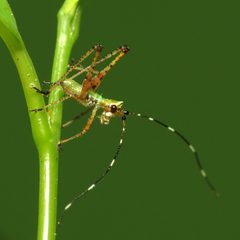
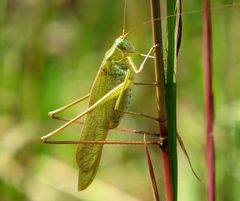
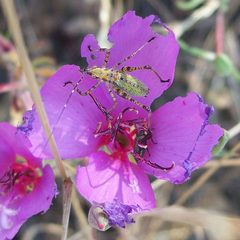
Scudderia furcata, the fork-tailed bush , is a widespread North American in the Tettigoniidae. It is transcontinental in distribution and is the most common Scudderia species in western North America. measure 36–40 mm from to folded wingtip. The species has been documented as a pest of citrus and stone fruits in California, though recent research suggests its impact varies significantly between citrus cultivars.
Pronunciation
How to pronounce Scudderia furcata: /skʌˈdɛɹ.i.ə fɜːrˈkeɪ.tə/
These audio files are automatically generated. While they are not always 100% accurate, they are a good starting point.
Identification
Reliable -level identification of Scudderia requires examination of the male supra-anal plate ( process), which is forked (tuning fork-shaped) in S. furcata. This structure is normally hidden by folded wings in living specimens, making field identification to species difficult. In the western United States and Canada, S. furcata is virtually the only Scudderia species present, simplifying identification in that region. Nymphs are difficult to identify to species. Distinguished from the greater angle-wing katydid (Microcentrum rhombifolium) by smaller size (36–40 mm vs. 52–63 mm), less robust body, and lack of the angular wing shape characteristic of Microcentrum.
Images
Appearance
are 36–40 mm in length from to tips of folded wings. Most specimens are uniformly green, though late-season individuals may appear brownish, reddish, or pinkish. Both sexes fly well. The exhibits excellent leaf-mimicry camouflage. Females possess a curved, knife-like ovipositor. Males have a distinctive fork-like process (supra-anal plate) that resembles a miniature tuning fork; this structure is concealed by folded wings in living specimens.
Habitat
Found in shrubby vegetation, gardens, yards, forest edges, and orchards. Occupies both woodland margins and open areas with scattered trees. In the western United States, associated with rhododendron and other broadleaf shrubs. Attracted to outdoor lights at night.
Distribution
Transcontinental in North America, ranging from southern Canada through the United States to Mexico. Present in British Columbia, Washington, Oregon, California, and across the eastern and central United States. The most widespread Scudderia in North America.
Seasonality
active primarily in late summer and autumn. Seasonal color change occurs in late season, with green individuals becoming brownish, reddish, or pinkish. Present year-round in warmer parts of range as ; nymphs emerge in spring.
Diet
Nymphs and feed on foliage of shrubs and trees. Documented feeding on citrus (oranges and mandarins), stone fruits, and rose plants. folivore.
Host Associations
- Citrus spp. - pestNymphs can cause significant damage to citrus fruit; less damaging to some mandarin cultivars than to navel oranges
- Rosaceae - food plantSuccessfully reared on rose foliage including roses and blackberries
- Prunus spp. - pestDocumented pest of stone fruits in California
Life Cycle
Females deposit singly in rows between leaf layers using their curved ovipositor, creating kidney bean-shaped bulges in leaves. Up to 175 eggs may be laid in small batches at multiple locations. Eggs overwinter and hatch in spring. Nymphs pass through six instars, gradually developing wing pads and reproductive structures. Nymphs feed on shrub foliage before reaching adulthood in late summer.
Behavior
Males produce an intermittent rasping call described as "s-s-s-s-s-S-S-S-T" by rubbing forewing stridulatory structures together. The discontinuous song likely reduces risk by making location difficult. Males switch to a softer "" courtship song when females approach. Both sexes communicate using soft ticks when in close proximity. are and fly well. Males transfer a protein-rich to females during mating, which the female consumes while sperm enter her .
Ecological Role
Herbivore in shrub and orchard . Serves as prey for sphecid and other . are parasitized by tiny wasps in Eupelmidae.
Human Relevance
Considered a pest in California citrus groves and stone fruit orchards when are high. Nymphs cause direct damage to developing fruit. Subject of ongoing research to update guidelines for mandarin . Sometimes enters homes, attracted to lights.
Similar Taxa
- Scudderia spp.Other bush katydids in the require examination of male supra-anal plate shape for reliable identification; S. furcata is the only in most of western North America
- Microcentrum rhombifoliumGreater angle-wing katydid is larger (52–63 mm), more robust, with more angular wings and different song; lacks the forked supra-anal plate of S. furcata
- Microcentrum retinerveLesser angle-wing overlaps in range and ; distinguished by size and wing venation
More Details
Research on citrus pest status
Recent ecoinformatics research by Bodil Cass (UC Davis) indicates that S. furcata, a key pest in navel oranges, very rarely damages some mandarin . Field experiments are investigating whether katydids are pests at all in certain mandarin cultivars, potentially requiring modification of guidelines.
Color variation
Autumn specimens may appear dull brown, reddish, or with purple or pink tones, contrasting with the vivid green of summer individuals. This seasonal is not fully understood.
Sources and further reading
- BugGuide
- Wikipedia
- GBIF taxonomy match
- iNaturalist taxon
- NCBI Taxonomy
- Catalogue of Life
- Bodil Cass and 'The Curious Case of Katydids in California Citrus' | Bug Squad
- Bug Eric: Fork-tailed Bush Katydid
- 🪲 Entomologizing w/ the WGNSS Entomology Group at Hughes Mountain Natural Area — 11 Oct 2025 | Beetles In The Bush
- Bug Eric: Grand Finale
- Bug Eric: November 2024
- Bug Eric: OrThoptera Thursday: Greater Angle-wing Katydid