
Amblycorypha
Stål, 1873
Round-headed Katydids, False Katydids, Bush-crickets
Species Guides
14- Amblycorypha alexanderi(Clicker Round-winged Katydid)
- Amblycorypha arenicola(Sandhill Virtuoso Katydid)
- Amblycorypha bartrami(Bartram's round-winged katydid)
- Amblycorypha cajuni(Cajun round-headed katydid)
- Amblycorypha carinata(Carinate Katydid)
- Amblycorypha floridana(Florida oblong-winged katydid)
- Amblycorypha huasteca(Texas false katydid)
- Amblycorypha insolita(Big Bend Oblong-winged Katydid)
- Amblycorypha longinicta(Common Virtuoso Katydid)
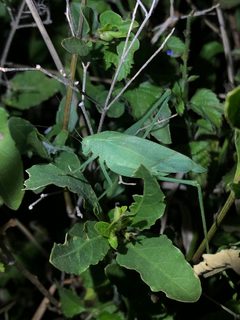
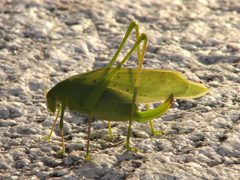
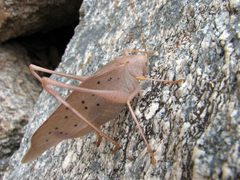
Amblycorypha is a of North American round-headed katydids in the Tettigoniidae, containing approximately 14 described . These insects are renowned for their exceptional leaf-mimicry, with wing venation closely matching the patterns of leaves. They are known for their , with males producing songs via stridulation to attract females. Some species reach prodigious sizes in tropical regions, and males provide to females during mating.
Pronunciation
How to pronounce Amblycorypha: //ˌæmblɪˈkɔːrɪfə//
These audio files are automatically generated. While they are not always 100% accurate, they are a good starting point.
Identification
Distinguished from other by the rounded shape and the specific pattern of wing venation that closely mimics leaf . The oblong-winged katydid (Amblycorypha oblongifolia) is a widespread representative . Species within the genus can be difficult to distinguish and may require examination of male calling songs or genitalia. The 'round-headed katydid' refers to the characteristic head profile.
Images
Habitat
Found in diverse ranging from tropical rainforests of Central America to temperate landscapes of North America. Occurs in vegetation from Texas to Vermont in the United States. Inhabits areas with abundant leafy vegetation that provides both food and camouflage.
Distribution
North America (United States from Texas to Vermont, and throughout eastern and central regions) and Central America (tropical rainforests of Rica and likely other countries). Distribution records include Alabama, Arizona, Arkansas, Colorado, and Connecticut.
Diet
Herbivorous; feeds on plant material including leaves.
Behavior
activity pattern, becoming more visible at night. Males produce -specific calling songs through stridulation (scraping a file on one forewing against a scraper on the other). Females detect these songs via tympanal organs on their forelegs. Males provide () to females during mating—protein-rich food packets that accompany sperm. Larger males with louder songs typically provide larger nuptial gifts.
Ecological Role
Herbivore in forest and meadow . Serves as prey for birds, reptiles, and other . Subject to by digger wasps (Sphex ichneumoneus), which paralyze katydids to provision nests for their larvae.
Human Relevance
Subject of ecological and behavioral research, particularly regarding and mating systems. Some are common enough to be familiar components of summer soundscapes in eastern North America.
Similar Taxa
- Scudderia (bush katydids)Similar body form and , but Scudderia have more pointed and different wing venation patterns
- Neoconocephalus (conehead katydids)Larger, more robust with cone-shaped ; different stridulatory apparatus and song characteristics
- Conocephalus (meadow katydids)Generally smaller, more slender with different shapes and preferences
More Details
Acoustic Communication
The hearing organs () on the forelegs contain a hornlike chamber that amplifies sound, with a functioning analogously to a human eardrum. This sophisticated auditory system allows females to evaluate male song quality.
Sexual Selection
Research has demonstrated that female katydids prefer larger males with louder songs, as these males provide larger (spermatophylaxes). This protein-rich gift enables females to produce more or larger , creating direct benefits for mate choice.
Predator Avoidance
The remarkable leaf mimicry extends beyond color to include the precise replication of leaf venation patterns, making these insects exceptionally difficult to detect when at rest on vegetation.