
Podalonia robusta
(Cresson, 1865)
cutworm wasp, cutworm hunter wasp
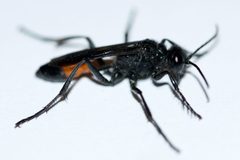
Podalonia robusta is a solitary, thread-waisted wasp in the Sphecidae, Ammophilinae. Females hunt soil-dwelling caterpillars (cutworms), paralyze them with venom, and provision underground burrows as food for their larvae. Unlike most sphecid , this digs the burrow after capturing prey rather than before. The species has been observed in aggressive nest usurpation, where one female steals a paralyzed caterpillar from another's burrow. Both sexes aggregate in sheltered spaces, with hundreds of individuals sometimes clustering together.
Pronunciation
How to pronounce Podalonia robusta: /poʊˈdæloʊniə roʊˈbʌstə/
These audio files are automatically generated. While they are not always 100% accurate, they are a good starting point.
Identification
Easily confused with other sphecid : females resemble small Sphex , males resemble Ammophila wasps. Definitive species identification requires examination of minute characters including (tiny pads between claws on each foot), which are not visible in images of live, wild wasps. Distinguished from Ammophila by subtle morphological features and ; genetic or detailed morphological analysis typically required for certainty.
Images
Appearance
Slender, thread-waisted wasp with elongated petiole connecting and . Females resemble small Sphex ; males resemble Ammophila . Minute diagnostic characters such as presence or absence of (tiny pads between tarsal claws) are required for definitive species identification. Overall coloration typical of sphecid wasps, with wasp-waisted profile characteristic of .
Habitat
Open, sandy including degraded shortgrass prairie, urban trails, and areas with exposed soil suitable for burrowing. Has been observed in Colorado Springs urban trail systems and degraded prairie habitats. Requires access to soil for burrow excavation and presence of soil-dwelling caterpillar prey.
Distribution
North America and Middle America (Central America). Documented from Colorado, USA, with observations in western United States. GBIF records indicate presence in North America and Middle America.
Seasonality
Active in early spring; observed flying at temperatures of 58°F (14°C) in late February. Females have been observed hunting and digging in March. Activity correlates with availability of caterpillars and suitable temperatures for .
Diet
feed on flower nectar. Females provision nests exclusively with paralyzed caterpillars (cutworms—soil-dwelling larvae) as food for larvae. Prey includes caterpillars (Euxoa messoria) and other soil-dwelling lepidopteran larvae.
Host Associations
- Euxoa messoria - prey caterpillar, paralyzed and stored as larval food
- Lepidoptera larvae - preySoil-dwelling caterpillars (cutworms) generally
Life Cycle
Solitary nesting: female captures caterpillar, paralyzes it with sting, then excavates burrow (reverse of typical sphecid sequence). Single caterpillar placed at bottom of burrow; single laid upon it. Burrow sealed after provisioning. Larva feeds on paralyzed caterpillar. Developmental timing from egg to not explicitly documented for this . Adults observed in early spring suggest possible as adults or .
Behavior
Females are "pullers" when excavating burrows—carry armloads of soil out of nest rather than scratching soil backward in fountain pattern like sand wasps. Documented nest usurpation: females engage in physical combat to steal paralyzed caterpillars from other females' burrows. Both sexes aggregate in sheltered spaces (under bark, in cavities) with hundreds of individuals sometimes clustering together; correlated with inclement weather and possibly . Males and females frequently observed mating, including while feeding at flowers.
Ecological Role
of soil-dwelling caterpillars, providing of in agricultural and natural settings. Potential competitor with conspecifics through nest usurpation . through nectar feeding.
Human Relevance
Beneficial insect in gardens and agricultural fields, preying on pest caterpillars including cutworms that damage crops. Subject of behavioral research due to unusual nest-provisioning sequence and documented theft . Observed readily in urban and suburban environments, providing accessible wildlife observation opportunities.
Similar Taxa
- Sphex speciesFemales resemble small Sphex in general appearance; distinguished by subtle morphological features and burrow-digging sequence
- Ammophila speciesMales resemble Ammophila ; both in Ammophilinae. Distinguished by minute characters including structure and detailed burrow-provisioning
- Podalonia luctuosaCongeneric with similar and ; distinguished by subtle morphological characters requiring expert examination
More Details
Unusual provisioning sequence
Unlike most sphecid that dig burrows before hunting, Podalonia robusta females capture prey first, then excavate the burrow. This reverse sequence is relatively uncommon among solitary wasps.
Documented nest usurpation
A remarkable observation by Eric Eaton ( Eric) documented a female stealing a paralyzed caterpillar from another female's burrow after physical combat. The thief then repeatedly stung the already-paralyzed caterpillar—following the instinctive behavioral sequence despite not having hunted the prey herself.
Aggregation behavior
Hundreds of individuals of both sexes have been observed aggregating in sheltered spaces such as under bark on stumps. This appears correlated with weather conditions and may relate to in females.