
Chalybion zimmermanni
Dahlbom, 1843
Zimmerman's Mud-dauber Wasp, Zimmermann's Mud Wasp
Species Guides
2- Chalybion zimmermanni aztecum(Aztec Mud-dauber Wasp)
- Chalybion zimmermanni zimmermanni(Zimmerman's Mud-dauber Wasp)
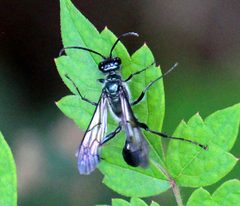
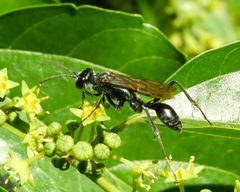
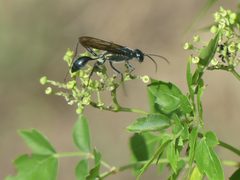
Chalybion zimmermanni is a solitary thread-waisted wasp in the Sphecidae. It is one of two Chalybion found north of Mexico, distinguished from the widespread C. californicum by its more restricted southeastern and southwestern U.S. distribution, white thoracic hairs, and smoky rather than violaceous wing coloration. Like its , it is a spider-hunting that repurposes existing mud nests rather than constructing its own.
Pronunciation
How to pronounce Chalybion zimmermanni: //kəˈlɪbiən zɪˈmɛrməni//
These audio files are automatically generated. While they are not always 100% accurate, they are a good starting point.
Identification
Distinguished from the similar Chalybion californicum by white hairs on the (versus dark hairs in C. californicum) and smoky wing coloration rather than violaceous. Males lack stingers and may be found in . The is generally smaller and less brightly metallic than the superficially similar Chlorion aerarium (Steel Blue Cricket Hunter), which has originating lower on the and a toothed .
Images
Habitat
Utilizes pre-existing cavities for nesting, including abandoned mud nests of Sceliphron caementarium (Black and Yellow Mud Dauber) and other sheltered locations on buildings. Often found in proximity to human structures where suitable nest substrates occur.
Distribution
Ranges from Tennessee and North Carolina south to Florida, west to Texas, Arizona, and into Utah. Present in Middle America and North America. More restricted in range than the transcontinental C. californicum.
Diet
feed on nectar from flowers and extrafloral , oozing sap from wounded trees, and honeydew secreted by aphids and scale insects. Females provision nests with paralyzed spiders, including black widows (Latrodectus mactans), other cobweb weavers (Theridiidae), small orb weavers (Araneidae), and occasionally lynx spiders (Oxyopidae), crab spiders (Thomisidae), or jumping spiders (Salticidae).
Host Associations
- Latrodectus mactans - preySouthern Black Widow, among known spider
Life Cycle
Females lay a single on the first spider placed in a mud . The larva hatches and consumes the provisioned spiders, spins a papery silken cocoon, and pupates. emerge by chewing a round exit hole at the end of the cell; holes in other parts of the nest indicate .
Behavior
Females are solitary nesters that take over or remodel abandoned mud nests by carrying water to soften and reshape the mud. They hunt spiders by landing on webs without entanglement, vibrating the web to simulate struggling prey, and stinging the spider into paralysis when it approaches. Males gather in ('bachelor parties') to roost. Neither sex is aggressive toward humans.
Ecological Role
of spiders, including medically significant like black widows. May provide incidental of spider around human habitation. Serves as for that emerge from anomalous holes in mud nests.
Human Relevance
Often nests on exterior building surfaces. Non-aggressive; stings only occur if females are physically grabbed. Presence sometimes causes concern due to resemblance to more aggressive , but no control measures are warranted. Males in roosting may alarm residents but cannot sting.
Similar Taxa
- Chalybion californicumNearly identical with dark thoracic hairs, violaceous wings, and transcontinental distribution; both repurpose Sceliphron nests and hunt spiders using web-vibration tactics
- Chlorion aerariumLarger size, brighter metallic coloration, lower antennal insertion, toothed , and -hunting rather than spider ; males similarly non-aggressive
Sources and further reading
- BugGuide
- Wikipedia
- GBIF taxonomy match
- iNaturalist taxon
- NCBI Taxonomy
- Catalogue of Life
- Bug Eric: Wasp Wednesday: Blue Mud Dauber, Chalybion californicum
- Bug Eric: Wasp Wednesday: Blue Mud Dauber
- Bug Eric: Wasp Wednesday: Chlorion aerarium
- Bug Eric: Mud Masterpieces
- Bug Eric: Tiny Wasp Hero Slays Redback Spiders in Australia
- Bug Eric: Spider Sunday: Spider Enemies