
Latrodectus geometricus
C. L. Koch, 1841
Brown Widow, Brown Button Spider, Grey Widow, Brown Black Widow, House Button Spider, Geometric Button Spider
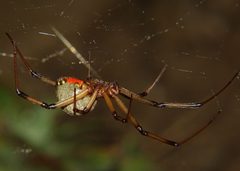
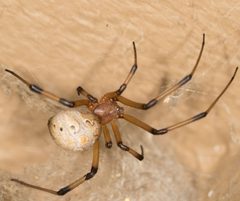
Latrodectus geometricus, commonly known as the brown widow, is a widow spider in the Theridiidae native to Africa with a distribution due to human-mediated introduction. It is smaller and lighter in color than black widow , with distinctive black-and-white geometric patterns on the and an orange-yellow hourglass marking ventrally. The species is notable for its highly aggressive toward native black widow spiders in invaded ranges, actively seeking out and killing them rather than competing for resources. While possessing neurotoxic venom, its bites are significantly less dangerous to humans than those of black widows due to lower venom delivery.
Pronunciation
How to pronounce Latrodectus geometricus: /ˌlætrəˈdɛktəs ˌdʒiːəˈmɛtrɪkəs/
These audio files are automatically generated. While they are not always 100% accurate, they are a good starting point.
Identification
Distinguished from black widow (L. mactans, L. hesperus, L. variolus) by orange-yellow hourglass marking versus red; presence of black-and-white geometric abdominal pattern absent in black widows; and distinctly spiky sacs with pointed projections covering the surface. From L. rhodesiensis (native to Zimbabwe) by distribution and subtle morphological differences in genitalia. Egg sacs are diagnostic: brown widow sacs are 'tufted', 'fluffy', or 'spiky' with projections all over, unlike the smooth egg sacs of black widows.
Images
Habitat
Constructs three-dimensional webs in dark corners of various microhabitats. Strongly associated with urban and anthropogenic environments including buildings, barns, garages, and sheds. Builds webs at varying heights above ground in vegetation and around structures. Web structure includes a retreat with one or two openings, with delaying retreats radiating from it; sticky threads extend from delaying threads to the ground. In South Africa, occurs from sea level to 1941 m elevation across all floral biomes. Commonly found in agricultural crops including avocado, citrus, cotton, maize, pistachio, prickly pear, and vineyards.
Distribution
Native to Africa, possibly originating in South Africa (uncertain; specimens also discovered in South America). distribution due to human introduction: established in North, Central, and South America, the Caribbean, Hawaii, Poland, the Middle East, Pakistan, India, Thailand, Japan, China, Papua New Guinea, Australia, French Polynesia (Tahiti, Moorea, Cook Islands), and Cyprus. In the United States, established in southern states and California. In North America, distribution is strongly constrained to urban environments.
Life Cycle
Females lay approximately 120–150 per sac and can produce up to 20 egg sacs over a lifetime. Eggs hatch in approximately 20 days. Spiderlings exhibit that increases life expectancy and longevity; grouped spiderlings show higher survival than isolated individuals. among spiderlings appears to function as a strategy to acquire food reserves, contributing to survival of a small number of individuals.
Behavior
Highly aggressive toward native black widow spiders (L. mactans, L. hesperus) in invaded ranges, actively seeking out and killing them rather than competing for resources. In experimental pairings, sub- brown widow females killed and consumed black widows in 80% of trials; adult brown widows killed black widows in 40% of trials. Brown widows regularly venture into black widow webs. Toward humans and non-prey animals, is shy and non-aggressive; when disturbed, individuals retreat quickly into web chambers or feign death by falling and clamping legs to the body. Males exhibit somersault behavior during copulation, placing the in front of the female's mouthparts, facilitating sexual .
Ecological Role
in many regions, where it may displace native black widow through direct rather than resource competition. In urban of invaded ranges, occupies similar to native widow spiders. Serves as for Philolema latrodecti, which has been used for .
Human Relevance
Bites are painful but not considered medically dangerous; venom is neurotoxic but bite effects are usually confined to bite area and surrounding tissue, with less venom delivered than by black widows. Bites to humans are rare due to shy, non-aggressive . Listed as Least Concern by South African National Biodiversity Institute. Used in research on sexual , dynamics, and spider behavior. Occasionally kept in museum petting zoos for educational display.
Similar Taxa
- Latrodectus mactans (Southern Black Widow)Overlapping distribution in North America; distinguished by red hourglass marking, absence of geometric pattern, smooth sacs, and smaller size relative to females.
- Latrodectus hesperus (Western Black Widow)Overlapping distribution in western North America; distinguished by red hourglass marking, absence of geometric pattern, and smooth sacs.
- Latrodectus rhodesiensisAlso called brown button spider in southern Africa; native to Zimbabwe; distinguished by distribution and subtle genitalic ; both collectively known as brown button spiders.
More Details
Invasive Success Mechanism
Research indicates brown widow displacement of black widows is driven by direct predatory aggression rather than superior competitive ability for food or . Mathematical modeling shows both are far more likely to die by than starvation, suggesting resource competition is not a significant mortality factor. Brown widows reach reproductive maturity 16% sooner than black widows and are approximately twice as fertile, often producing multiple sacs simultaneously versus single sacs in black widows.
Sexual Cannibalism
Sexual is frequent and occurs during copulation. Males initiate cannibalism through somersault , placing the in front of female mouthparts. This behavior was previously known only from Latrodectus hasselti (redback spider). Cannibalism events are more frequent with virgin females than previously mated females, supporting the hypothesis that sexual cannibalism functions as a male reproductive strategy in this .
Parasitoid Control
The Philolema latrodecti infests brown widow sacs and has been found in 31% of egg sacs in some . This wasp has been used for of southern black widows in Hawaii and may serve as a natural limiting factor for brown widow populations in invaded ranges.
Aggregation Behavior in Spiderlings
Spiderling significantly increases life expectancy and longevity. Under light conditions, grouped spiderlings showed 14.3 days life expectancy versus 14.8 days when isolated; under dark conditions, grouped spiderlings showed 29.8 days life expectancy versus 19.3 days when isolated. Maximum longevity was 85 days for grouped spiderlings in darkness versus 26 days for isolated individuals.
Sources and further reading
- BugGuide
- Wikipedia
- GBIF taxonomy match
- iNaturalist taxon
- NCBI Taxonomy
- Catalogue of Life
- Hissers: Big, Bold and Beautiful | Bug Squad
- Bohart Museum Open House on 'Many Legged Wonders': How Many Legs Does an Isopod Have? | Bug Squad
- UC Davis Picnic Day: Let's Go on an Insect Scavenger Hunt! | Bug Squad
- A Birthday Visit to the Bohart | Bug Squad
- Brown Widow Spider Reported for the First Time in Tahiti
- Brown Widow Spiders' Aggression Likely Driver of Black Widow Decline
- B28 Distribution of Latrodectus geometricus in japan
- B09 Distribution of Latrodectus geometricus in Japan (2002)
- Sexual Cannibalism in the Brown Widow Spider (Latrodectus geometricus)
- Habitat, redescription and distribution of Latrodectus geometricus in Uruguay (Araneae: Theridiidae)
- New Record of Brown Widow Spider (Latrodectus geometricus Koch, 1841) in Ha’il Region, Saudi Arabia
- Review for "Maternal care thwarts parasitoids in the invasive brown widow spider ( <i>Latrodectus geometricus</i> )"
- Decision letter for "Maternal care thwarts parasitoids in the invasive brown widow spider ( <i>Latrodectus geometricus</i> )"
- Decision letter for "Maternal care thwarts parasitoids in the invasive brown widow spider ( <i>Latrodectus geometricus</i> )"
- Review for "Maternal care thwarts parasitoids in the invasive brown widow spider ( <i>Latrodectus geometricus</i> )"
- First report of the brown widow spider, Latrodectus geometricus Koch, 1841 (Araneae, Theridiidae) from southern India
- Decision letter for "Maternal care thwarts parasitoids in the invasive brown widow spider ( <i>Latrodectus geometricus</i> )"
- Aggregation Behavior in Spiderlings: a Strategy for Increasing Life Expectancy in Latrodectus geometricus (Araneae: Theridiidae)
- A history of accidental widow spider (genus Latrodectus ) introductions on the island of Ireland with a new irish record for Latrodectus hesperus (Chamberlin and Ivie, 1935), and additional records of Latrodectus geometricus (C.L. Koch, 1841).
- Additions to the Known U.S. Distribution ofLatrodectus geometricus(Araneae: Theridiidae)
- Urban Environments Aid Invasion of Brown Widows (Theridiidae: Latrodectus geometricus) in North America, Constraining Regions of Overlap and Mitigating Potential Impact on Native Widows