
Steatoda borealis
(Hentz, 1850)
Boreal Combfoot
Steatoda borealis is a cobweb spider native to North America, belonging to the Theridiidae. The has been documented in the United States and Canada. Research indicates it competitive displacement from the introduced European Steatoda bipunctata in human-modified , though it persists in forested areas with minimal human disturbance.
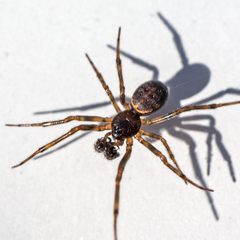
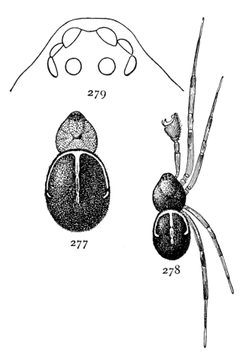
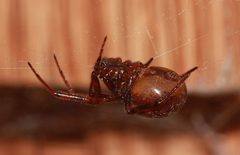
Pronunciation
How to pronounce Steatoda borealis: /stiːəˈtoʊdə bɔːˈriːælɪs/
These audio files are automatically generated. While they are not always 100% accurate, they are a good starting point.
Identification
Closely resembles the introduced European Steatoda bipunctata in size and coloration. The two species share similar microhabitat preferences, diel activity patterns, and general , making field identification challenging without close examination.
Images
Habitat
Inhabits forested where human influence is minimal. Also found in buildings, bridges, piles of lumber and firewood, and crevices on tree trunks or among rocks—though these latter habitats are increasingly dominated by the introduced S. bipunctata.
Distribution
Native to North America. Documented in the United States and Canada, specifically including Alberta and British Columbia. The ' range overlaps with areas where the introduced S. bipunctata has established.
Behavior
Exhibits diel activity patterns and prey selection similar to those of the introduced S. bipunctata. Has been observed to persist in forest despite competitive pressure from S. bipunctata in more disturbed environments.
Human Relevance
Subject of ecological study regarding competitive displacement by introduced . No documented medical or agricultural significance distinct from other Steatoda species.
Similar Taxa
- Steatoda bipunctataEuropean introduced that closely resembles S. borealis in size, color, microhabitat, diel activity, prey selection, , and sexual ; documented to competitively displace S. borealis in human-modified
More Details
Competitive Displacement
A study published in the Canadian Journal of Zoology (1986) documented that S. borealis declined as S. bipunctata increased at study sites over time. Displacement is partial rather than complete, with S. borealis persisting in forest where human influence is minimal. Laboratory tests failed to demonstrate the specific mechanism of displacement through reproductive potential or interspecific aggression differences.
Sources and further reading
- BugGuide
- Wikipedia
- GBIF taxonomy match
- iNaturalist taxon
- NCBI Taxonomy
- Catalogue of Life
- Bugs for All, All for Bugs | Bug Squad
- Grasshoppers of Wyoming and the West
- Zombie bees, Apis mellifera, and their tormentor the humpbacked fly, Apocephalus borealis — Bug of the Week
- Did One Praying Mantis Give Rise to an All-Female Species?
- Back-Seat Driver: The Parasite That Makes Bees Drop Off Its Babies
- Where is the Noble False Widow settling next? | Blog
- Evidence for displacement of a North American spider, Steatoda borealis (Hentz), by the European species S. bipunctata (Linnaeus) (Araneae: Theridiidae)