
Steatoda bipunctata
(Linnaeus, 1758)
Rabbit Hutch Spider
Steatoda bipunctata is a small cobweb spider in the Theridiidae, commonly known as the Rabbit Hutch Spider due to its frequent association with human structures. Native to Europe, it has been introduced to North America and is now established across the Atlantic provinces, northern New England, and southern Québec and Ontario. It closely resembles the native North American Steatoda borealis and has been documented to competitively displace it in disturbed . The species poses minimal medical risk to humans.
Pronunciation
How to pronounce Steatoda bipunctata: //stiːəˈtoʊdə baɪˌpʌŋkˈteɪtə//
These audio files are automatically generated. While they are not always 100% accurate, they are a good starting point.
Identification
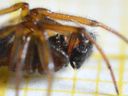
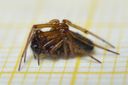
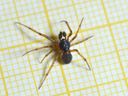
Distinguished from similar Steatoda by the paired dark dimples on the and the distinctive infinity-sign pattern on the surface. Differs from black widow spiders (Latrodectus) by smaller size, less robust build, and less dangerous venom. Can be separated from the native Steatoda borealis by subtle morphological differences and preference; S. bipunctata is more strongly associated with human structures.
Images
Habitat
Strongly . Found in proximity to human structures including basements, sheds, rabbit hutches, buildings, bridges, piles of lumber and firewood, and crevices on tree trunks or among rocks. Also occurs in forest where human influence is minimal, though less abundant than in disturbed areas.
Distribution
Native to Europe, North Africa, Turkey, Israel, Caucasus, Russia (Europe to Far East), Kazakhstan, Iran, Central Asia, and China. Introduced to North America: established in Atlantic provinces of Canada, northernmost New England, southern Québec and Ontario. Also introduced to South America (Brazil). Holarctic distribution overall.
Diet
of small insects. Prey selection similar to Steatoda borealis, including various small arthropods that become entangled in its cobweb.
Life Cycle
Development from to takes approximately 77 days at 25°C. Females produce 2-5 egg sacs containing approximately 65 eggs each. Spiderlings emerge after approximately 26 days of incubation. Adult females live approximately 165 days on average; males approximately 74 days.
Behavior
Constructs irregular cobweb with tangled threads. Builds stronger, more efficient webs than the native Steatoda borealis, contributing to its competitive success. Captures more prey than S. borealis under comparable conditions. Occupies preferred web sites of S. borealis in areas of overlap.
Ecological Role
in environments. Documented competitor causing partial displacement of native Steatoda borealis in North America. Displacement is -dependent; S. borealis persists in forest habitats with minimal human disturbance.
Human Relevance
Common household spider that poses minimal medical risk. No known instances of envenomation; fangs likely too small to penetrate human skin. Sometimes mistaken for black widow spiders due to similar body shape, causing unnecessary concern. derives from frequent occurrence in rabbit hutches.
Similar Taxa
- Steatoda borealisNative North American of similar size, color, microhabitat preference, diel activity, prey selection, , and sexual . Distinguished by subtle morphological differences and less efficient web construction; competitively inferior to S. bipunctata.
- Latrodectus spp. (black widows)Similar body shape and web type; S. bipunctata often mistaken for black widows but distinguished by smaller size, different abdominal markings, and significantly less dangerous venom.
Misconceptions
Despite resemblance to black widow spiders, S. bipunctata is not dangerously venomous to humans and its bite is considered medically insignificant.
More Details
Competitive Displacement
Field and laboratory studies demonstrate that S. bipunctata constructs stronger webs, captures more prey, and produces more offspring than the native S. borealis. The mechanism of competitive displacement appears to be superior resource acquisition rather than direct aggression.
Introduction History
Earliest North American collections from Nova Scotia in 1913. Range expanded from Atlantic coast and St. Lawrence River corridor to widespread distribution in northeastern North America by present day.
Sources and further reading
- BugGuide
- Wikipedia
- GBIF taxonomy match
- iNaturalist taxon
- NCBI Taxonomy
- Catalogue of Life
- Bembicid Holdings | Entomology Research Museum
- Where is the Noble False Widow settling next? | Blog
- Bug Eric: Spider Sunday: Triangulate Cobweb Weaver
- Do Chestnut, Lemon, or Peppermint Scents Repel Spiders?
- Bug Eric: January 2012
- Bug Eric: Spider Sunday: Hammock Spiders
- Development and reproduction in the synanthropic spiders Steatoda bipunctata and S. triangulosa (Araneae: Theridiidae)
- Evidence for displacement of a North American spider, Steatoda borealis (Hentz), by the European species S. bipunctata (Linnaeus) (Araneae: Theridiidae)