
Araneus diadematus
Clerck, 1757
European garden spider, cross orbweaver, diadem spider, cross spider, crowned orb weaver, pumpkin spider
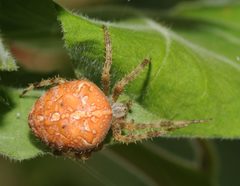
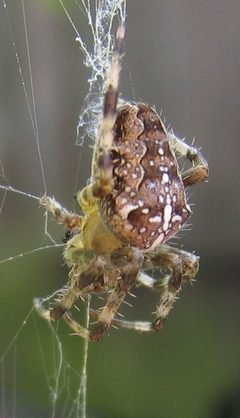
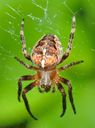
Araneus diadematus is a medium-sized orb-weaving spider native to Europe, now naturalized across North America. females reach 6.5–20 mm in body length, males 5.5–13 mm. The is named for the distinctive white cross-shaped pattern on its , formed by guanine deposits. It constructs classic spiral orb webs with 25–30 radial threads at approximately 15° angles, often positioned in gardens, porches, and other human-modified . The spider is , typically hanging -down at the web hub, and exhibits a defensive vibrating when disturbed.
Pronunciation
How to pronounce Araneus diadematus: /ˌærəˈniːəs ˌdaɪəˈdeɪmətəs/
These audio files are automatically generated. While they are not always 100% accurate, they are a good starting point.
Identification
Distinguished from other Araneus by the consistent white cross-shaped markings on the , formed by four or more segments of guanine-filled . Coloration varies from pale yellow to dark grey, but the cross pattern remains diagnostic. females have a rounded, somewhat bulbous abdomen; males are smaller with more slender bodies and longer legs. The web architecture is characteristic: a planar orb with precise radial spacing and a spiral capture thread. Similar species include Araneus marmoreus (also called 'pumpkin spider,' with marbled rather than cross-shaped markings) and Araneus gemmoides (cat-faced spider, with paired humps on the abdomen rather than a cross pattern).
Images
Habitat
Vegetated areas with structure for web attachment, including gardens, yards, orchards, forest edges, and meadows. Shows strong association with human-modified environments in its introduced North American range. Prefers locations with adequate space between vegetation or structures to span orb webs, and often utilizes nearby retreats such as curled leaves or debris connected to the web hub by signal threads. Web placement influenced by structure and prey availability.
Distribution
Native to the Palearctic: throughout Europe, extending eastward through Russia, Iran, Central Asia, China, and Japan. Introduced to North America with established across southern Canada, the contiguous United States, and Mexico. Western North American records span from British Columbia to northern California; eastern records from Newfoundland to Nova Scotia and southward.
Seasonality
with most conspicuous in late summer and autumn (August–October in temperate regions). Spiderlings emerge from sacs in spring, develop through summer, and reach maturity by early fall. Adults do not survive winter; females may persist until first hard frost. Male wandering for mates occurs primarily in autumn.
Diet
Active that capture flying insects in orb webs. Prey is detected through vibrations transmitted via signal threads, then rapidly wrapped in silk, bitten to inject venom and digestive , and may be stored on the web for later consumption. Laboratory rearing has used Drosophila and Acheta domesticus, but natural prey includes various small flying insects.
Life Cycle
cycle. overwinter in silk cocoons (egg sacs). Spiderlings emerge in spring, undergo development through summer with multiple , and reach sexual maturity in late summer or early fall. Males cease web-building upon maturity and wander in search of females. Females may consume males after mating. Females construct egg sacs in autumn before dying; the cycle repeats with spring .
Behavior
Constructs planar orb webs, typically sitting -down at the hub during daylight hours. When disturbed, performs rapid web-vibrating that blurs the spider's image, presumed to confuse . At night or when inactive, may retreat to a sheltered location connected to the web by signal threads. Web construction occurs primarily at night. Shows plasticity in web orientation and size in response to wind, reducing surface area to avoid damage. Males are attracted to female ; adult females avoid odors of females, possibly to reduce reproductive competition. Demonstrates sleep-like states with increased arousal threshold during nighttime immobility.
Ecological Role
of flying insects, contributing to natural pest suppression in gardens and agricultural settings. Webs may capture significant numbers of small insects, potentially including pest . Serves as prey for birds, , and other predators. Silk and web structure contribute to nutrient cycling through discarded or damaged web material.
Human Relevance
Beneficial presence in gardens and agricultural orchards due to insect . Occasionally considered a nuisance when webs span doorways or walkways. Subject of extensive scientific research including web-building , silk biomechanics, and sleep physiology. Two individuals ('Anita' and 'Arabella') were flown on Skylab 3 in 1973 to study web construction in zero gravity. Used in studies of psychoactive drug effects on web geometry beginning in 1948. Not medically significant; bites are rare and occur only if the spider is cornered or provoked.
Similar Taxa
- Araneus marmoreusAlso called 'pumpkin spider'; has marbled or mottled abdominal pattern rather than distinct cross, and more variable coloration including orange and yellow morphs.
- Araneus gemmoidesCat-faced spider; has paired humps on creating a faceted appearance, lacks cross-shaped markings, and is native to western North America.
- Neoscona species orb-weavers that construct webs only at night and dismantle them by morning; often found in similar but with different activity patterns and abdominal markings.
Sources and further reading
- BugGuide
- Wikipedia
- GBIF taxonomy match
- iNaturalist taxon
- NCBI Taxonomy
- Catalogue of Life
- Bug Eric: Spider Sunday: The Cross Spider
- Bug Eric: Spider Season
- Do Chestnut, Lemon, or Peppermint Scents Repel Spiders?
- Bug Eric: The Changing Conversation Around Invasive Species
- French mathematician and spider aficionado Cédric Villani honoured with a new orb-weaver | Blog
- biodiversity association | Blog
- PERILAKU LABA-LABA (Araneus diadematus) DALAM PERSPEKTIF ISLAM DAN SAINS
- Pheromone communication among sexes of the garden cross spider Araneus diadematus
- The Influence of Habitat Structure on the Distribution of Araneus diadematus Clerck
- Orb‐web Orientation and Modification by the Spiders Araneus diadematus and Araneus gemmoides (Araneae: Araneidae) in Response to Wind and Light
- Behavioral Consequences of Laser Lesions in the Central Nervous System ofAraneus diadematusCl.
- The effects of neurotoxins on web-geometry and web-building behaviour in Araneus diadematus Cl.
- A state with increased arousal threshold in Araneus diadematus (Araneidae) measured in the wild: new evidence for sleep in spiders
- The Tensile Properties of Cocoon Silk of the SpiderAraneus diadematus
- Spinosad application in an apple orchard affects both the abundance of the spider Araneus diadematus and its web construction behaviour
- MODELING OF THE STRESS-STRAIN BEHAVIOR OF EGG SAC SILK OF THE SPIDER ARANEUS DIADEMATUS