
Acheta domesticus
(Linnaeus, 1758)
House Cricket, European House Cricket
Acheta domesticus, the house , is a widely distributed cricket likely native to Southwestern Asia but now found globally through human commerce. The species has been kept in captivity since at least the 1700s and is considered highly domesticated. It serves as the primary cricket species in the global pet food industry, raised as feed for reptiles, amphibians, birds, and arthropods. The species has been severely impacted by Acheta domesticus Densovirus (AdDNV), a highly virulent and environmentally that has caused widespread mortality in commercial breeding facilities and driven industry shifts toward alternative cricket species.

Pronunciation
How to pronounce Acheta domesticus: //əˈkiːtə dəˈmɛstɪkəs//
These audio files are automatically generated. While they are not always 100% accurate, they are a good starting point.
Identification
Distinguished from field crickets (Gryllus spp.) by lighter coloration, more slender build, and wings that extend well beyond tip in . Females identified by long, prominent ovipositor. Song differs from Gryllus in syllable period and pattern. In peninsular Florida, A. domesticus cannot survive in the wild, so any free-living crickets in that region are likely Gryllus field crickets. Commercial specimens may be misidentified or substituted with other species, particularly Gryllus assimilis, Gryllus bimaculatus, Gryllus locorojo, or Gryllodes sigillatus.
Images
Appearance
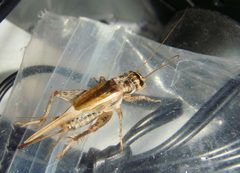
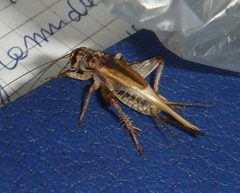
are typically pale yellowish-brown to tan in coloration. Females possess long, needle-like ovipositors extending beyond the tip. Both sexes have wings that extend past the end of the abdomen. Body is cylindrical and somewhat flattened. are long and filamentous, exceeding body length. Hind legs are enlarged and adapted for jumping.
Habitat
In its native range and established , occurs in human-modified environments including buildings, greenhouses, and refuse areas. Commercially reared in controlled indoor facilities with temperatures around 26-32°C, requiring substrate for -laying, water source, and shelter such as crumpled paper. Cannot survive outdoors in humid subtropical climates such as peninsular Florida. Feral populations established in southern California and other Mediterranean-type climates.
Distribution
Likely native to Southwestern Asia; now through human commerce. Established in southern California and other regions with suitable climates. Absent from wild populations in peninsular Florida due to climatic limitations. Commercially produced in large- facilities across North America, Europe, and Asia.
Seasonality
Continuous breeding in commercial facilities with controlled conditions. In , activity likely year-round in suitable climates, with dependent on temperature and moisture availability.
Diet
with broad dietary . In captivity, consumes commercial diets, grains, vegetables, and organic waste products. Has been demonstrated to consume corn contaminated with fumonisin mycotoxin without absorption or ill effects, excreting toxin in . Diet quality significantly influences growth and survival; high nitrogen content and favorable nitrogen-to-fiber ratios support better accumulation.
Life Cycle
Hemimetabolous development with , nymph, and stages. Females deposit eggs in moist substrate using elongated ovipositor. Nymphs undergo multiple instars before reaching adulthood. Development rate and survival highly dependent on diet quality, temperature, and . In commercial settings, complete cycle from egg to adult approximately 6-8 weeks under optimal conditions.
Behavior
Males produce calling songs via stridulation of forewings to attract females. Females exhibit positive phonotaxis toward male calls with specific carrier frequencies (4-5 kHz) and syllable periods (50-70 ms). III increases selectivity of female phonotactic , narrowing response to syllable periods most similar to natural male calls. Males also exhibit phonotaxis toward male calls, with responsiveness to syllable periods widening with age. Same-sex sexual signaling has been observed in laboratory conditions. Generally characterized as curious and relatively defenseless, often investigating rather than avoiding .
Ecological Role
Serves as prey item for various vertebrates and in where established. In commercial contexts, functions as conversion agent for agricultural byproducts and waste streams into protein for animal feed. Potential role in circular economy through upcycling of contaminated grain unsuitable for vertebrate livestock.
Human Relevance
Primary used in global pet food industry; raised commercially as feed for reptiles, amphibians, birds, and arthropods. Also consumed by humans in some cultures and promoted as sustainable protein source, though sustainability claims depend heavily on feed source and production . Subject of research on alternative protein production, waste upcycling, and . Severe economic impacts from AdDNV have caused industry-wide disruptions, facility bankruptcies, and regulatory challenges regarding importation of replacement species.
Similar Taxa
- Gryllus assimilisNative U.S. field cricket imported as AdDNV- replacement; USDA-approved for sale. Darker coloration, different song pattern.
- Gryllus bimaculatusEuropean widely used as feeder in Europe; illegal in U.S. due to potential. Two dark spots on , more robust build.
- Gryllus locorojoUndescribed species discovered in pet trade; 'crazy red ' with reddish coloration and aggressive , distinct song.
- Gryllodes sigillatusTropical imported as replacement; adapted to human habitations, narrower reduces risk.
Misconceptions
Often assumed to be automatically sustainable as human food source; research demonstrates protein conversion depends critically on diet quality and competes with conventional livestock when grain-fed. Claims of superior feed conversion efficiency compared to broiler chickens are context-dependent and not universally supported at commercial . Misidentification in pet trade is common, with suppliers sometimes incorrectly labeling stock as A. domesticus.
More Details
AdDNV Vulnerability
Highly susceptible to Acheta domesticus Densovirus, an -specific parvovirus transmitted through fecal-oral route and of infected corpses. Virus causes paralysis and death in , is extremely to heat and pH extremes, and persists in facility dust and surfaces. No resistant breeding lines successfully developed; industry shift to alternative has created regulatory and concerns.
Commercial Production Scale
Individual facilities may exceed 10,000 square meters and house over 50 million crickets, shipping to thousands of pet stores. Industry represents multimillion-dollar business in U.S. alone due to reptile breeding industry demand.
Acoustic Communication Research
Extensively studied model for insect hearing and phonotaxis. L3 auditory in prothoracic ganglion identified as critical for syllable-period selective phonotaxis. Octopamine injection decreases phonotactic responsiveness in females. Neuromodulator effects on selective well-characterized at neuronal and behavioral levels.
Sources and further reading
- BugGuide
- GBIF taxonomy match
- iNaturalist taxon
- NCBI Taxonomy
- Catalogue of Life
- What's Wrong With This Picture? | Bug Squad
- You Can Make a Meal Out of Mealworms | Bug Squad
- UC Davis-Based Symposium to Celebrate Life and Legacy of Wittko Francke, 'Mozart of Molecules' | Bug Squad
- Global Symposium: Chemical Ecologists Celebrate 'Life and Legacy of Wittko Francke' | Bug Squad
- Cricket Virus Leads to Illegal Importation of Foreign Species for Pet Food
- How Crickets Can "Upcycle" Bad Grain Into Useful Animal Feed
- House Cricket, Acheta domesticus (Linnaeus)
- Factors Affecting Phonotaxis in Male House Crickets, Acheta domesticus
- Neuronal and Behavioral Response Relationships in Virgin Females of Acheta Domesticus
- The Biology of Egg Production in the House Cricket, Acheta Domesticus L.
- Evaluation of Phonotactic Behavior in Male-Exposed Female Cricket Acheta domesticus
- Chelerythrine Chloride And Its Effects On Phonotactic Behavior In Female Crickets Acheta Domesticus
- The Role Of Octopamine In Syllable-Period Selective Phonotaxis In Female Cricket Acheta Domesticus
- L3 Auditory Interneuron Responses to Dual-frequency Calling Songs in Female Crickets (Acheta Domesticus)
- Selective Processing by the L3 Auditory Interneuron in Acheta Domesticus : Juvenile Hormone III and Protein Kinase C
- Anecdote: When courtship blurs: a case of male-directed sexual signaling in house crickets (Acheta domesticus)