
Araneus gemmoides
Chamberlin & Ivie, 1935
cat-faced spider, jewel spider
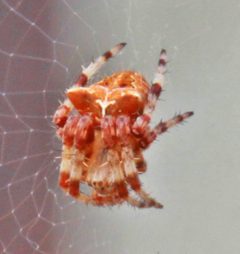
Araneus gemmoides is a common North American orb-weaver spider found in Canada and the United States. are recognized by two prominent horn-shaped projections on the that create a cat-faced appearance. Females are considerably larger than males and die shortly after producing a single sac. The builds vertical orb-webs near artificial lights and building exteriors, where it captures flying insects at night while hiding in a retreat during the day.
Pronunciation
How to pronounce Araneus gemmoides: //ˌæɹəˈniːəs ˈdʒɛˌmoʊ.aɪdz//
These audio files are automatically generated. While they are not always 100% accurate, they are a good starting point.
Identification
Distinguished from other Araneus by the paired horn-like projections on the . Differs from Araneus gemma (also called cat-faced spider) by geographic range and subtle morphological details. Separated from Araneus diadematus (cross spider) by the presence of abdominal humps rather than a cross-shaped pattern. The white vertical stripe with chevrons helps distinguish it from similarly colored orb-weavers. Males are identified by their smaller size, longer legs relative to body, and modified .
Images
Appearance
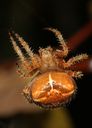
Medium to large orb-weaver with two distinct conical humps on the , creating a cat-faced silhouette. Coloration varies from tan and brown to orange and gray, with markings that reinforce the feline appearance. A short white vertical stripe on the front edge of the abdomen, crossed by two white chevrons, is a reasonably consistent mark. Gravid females have greatly enlarged abdomens. Mature females measure 13–25 mm in body length; males are 5–8 mm. Young spiderlings have exaggerated abdominal humps relative to body size.
Habitat
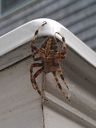
Builds webs near outdoor lights, building sides, under overhangs, and in protected spaces such as animal burrows. Occupies edge where artificial lighting attracts insect prey. Uses a curled leaf or other retreat connected to the web hub by signal threads. Found in both natural and human-modified environments, including porches, decks, and window frames.
Distribution
North America: Canada (British Columbia, Saskatchewan, Alberta, Manitoba) and United States (Michigan, Dakotas, Rocky Mountain states, Pacific states, Arizona). Occurs from British Columbia and Saskatchewan east to Michigan, and south through the Rocky Mountains and Pacific states to Arizona.
Seasonality
mature in late summer and are active through fall. Mature individuals observed from August through first hard frost. sacs overwinter, with spiderlings emerging the following spring (typically May–June). Females die within days of laying eggs in late autumn.
Diet
Captures flying insects in orb-webs, including fish flies, house flies, mosquitoes, , and other small arthropods. Has been observed capturing and consuming other small spiders. Does not prey on ants.
Life Cycle
. Females produce a single sac containing hundreds of eggs in late autumn. Spiderlings emerge in spring, initially remaining clustered near the egg sac. After molting, they disperse by ballooning on silk strands carried by air currents. among sibling spiderlings has been observed. do not survive winter; only egg sacs overwinter.
Behavior
web-builder that repairs or rebuilds webs at night, then occupies the hub -down to await prey. By day, hides in a retreat connected to the web by signal threads to detect vibrations. Vibrates web when disturbed by large animals; drops from web on dragline if disturbance persists. Modifies web orientation perpendicular to light sources to increase prey capture, and orients webs parallel to wind to reduce damage. Mature males cease web-building and become nomadic, searching for females. Females may relocate webs periodically, consuming old web material before rebuilding.
Ecological Role
of flying insects, contributing to natural pest control in urban and suburban environments. Prey for mud dauber (Sceliphron caementarium), which paralyze spiders and provision nests for larvae. Spiderlings serve as food for various predators and are subject to .
Human Relevance
Considered harmless with low- venom. Valued as a natural of nuisance insects around homes. Frequently observed and fed by homeowners, inspiring public appreciation for spiders. Occasionally brought indoors during cold weather, though this is not recommended. sacs may be inadvertently transported when attached to objects.
Similar Taxa
- Araneus gemmaShares the 'cat-faced spider' and similar abdominal projections, but differs in distribution and specific markings
- Araneus diadematusSimilar orb-web architecture and preference, but distinguished by cross-shaped abdominal pattern rather than paired humps
- Neoscona speciesSimilar web-building and habits, but lack distinctive abdominal humps and have different abdominal patterns
Misconceptions
The name 'jewel spider' is also applied to Austracantha minax, an unrelated Australian . Despite intimidating size of mature females, the species poses no medical threat to humans. The 'cat-faced spider' leads to confusion with Araneus gemma.
More Details
Web Characteristics
Builds relatively small webs in proportion to body size, with prey-catching zone spanning approximately one foot. Foundation lines may stretch several feet between anchor points. Web structure is modified in response to wind and light conditions.
Sexual Dimorphism
Females have larger and ; males have much smaller abdomens, longer bodies, and modified for sperm transfer. Mature males lose the ability to spin webs.
Regional Names
Known as 'cookie spider' in parts of Montana.
Sources and further reading
- BugGuide
- Wikipedia
- GBIF taxonomy match
- iNaturalist taxon
- NCBI Taxonomy
- Catalogue of Life
- Bug Eric: Spider Sunday: Cat-faced Spider
- Bug Eric: Spider Sunday: The Cross Spider
- Arachnida | Beetles In The Bush | Page 5
- Bug Eric: Spider Sunday: Butterfly Orbweaver
- Answer to Super Crop Challenge #2 | Beetles In The Bush
- Do Chestnut, Lemon, or Peppermint Scents Repel Spiders?
- Orb‐web Orientation and Modification by the Spiders Araneus diadematus and Araneus gemmoides (Araneae: Araneidae) in Response to Wind and Light