
Araneus gemma
(McCook, 1888)
Gem-shaped Orbweaver, cat-faced spider, jeweled orbweaver spider
Araneus gemma is a common outdoor orb-weaver spider native to western North America. It is one of several commonly called the "cat-faced spider" due to abdominal markings resembling feline features. The species is harmless to humans despite possessing venom containing argiotoxin, a that antagonizes glutamate. It constructs typical circular orb webs and is frequently encountered in residential areas during autumn when mature females become conspicuous.
Pronunciation
How to pronounce Araneus gemma: /əˈreɪniəs ˈdʒɛmə/
These audio files are automatically generated. While they are not always 100% accurate, they are a good starting point.
Identification
Araneus gemma is distinguished from the sympatric and morphologically similar Araneus gemmoides (also called cat-faced spider) by subtle differences in abdominal shape and arrangement, though definitive identification often requires examination of genitalic structures. The can be separated from other western Araneus by the specific configuration of the cat-faced abdominal pattern combined with geographic range. It lacks the bright coloration of Araneus marmoreus and the cross-shaped pattern of Araneus diadematus.
Images
Appearance
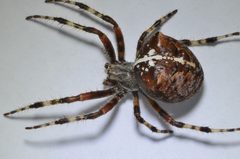
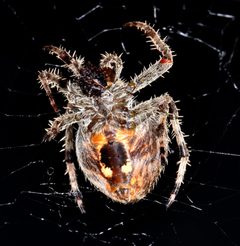
display the characteristic "cat-faced" abdominal pattern shared with the closely related Araneus gemmoides, featuring paired raised projections or dimples on the that suggest feline ears and facial structure. The abdomen is typically rounded and may show variable coloration including brown, tan, or gray tones with contrasting darker markings. Females are substantially larger than males, a common in the . The web silk ranges from 1 to 4 μm in diameter.
Habitat
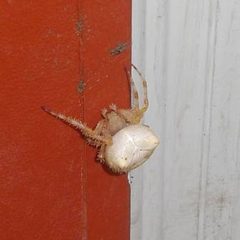
Common in outdoor environments throughout its range, frequently encountered in residential areas, gardens, and near human structures. Mature females often construct webs on buildings, porches, and other artificial substrates during autumn. Natural include woodland edges, shrublands, and open areas with adequate structure for web attachment.
Distribution
Western United States and adjacent Canada, including states and provinces such as California, Oregon, Washington, Idaho, Montana, Wyoming, Colorado, Utah, Nevada, Arizona, New Mexico, Alberta, and British Columbia. Records indicate presence throughout the western cordillera and intermountain regions.
Seasonality
are most conspicuous during late summer and autumn (August through October in most of range), when mature females reach maximum size and construct prominent webs. This seasonal peak in visibility corresponds with the mating period and -laying season.
Diet
Feeds on flying insects captured in its orb web. Prey items have not been specifically documented for this but likely include , flies, beetles, and other small insects common in its .
Life Cycle
Typical of orb-weaving spiders: deposited in silk-wrapped egg sacs, spiderlings emerge and disperse by ballooning on silk threads. Juveniles construct webs and progress through multiple before reaching maturity. Females may produce multiple egg sacs. stage not explicitly documented but likely as eggs or juveniles.
Behavior
Constructs circular orb webs, typically renewed nightly. Females occupy the web center or a nearby retreat connected by a signal thread. When disturbed, may exhibit defensive shaking in the web. Males abandon web-building in maturity to wander in search of females. Has been observed utilizing artificial lighting to increase prey capture success.
Ecological Role
Serves as a of flying insects, contributing to natural pest suppression. Provides food source for spider wasps and other predators. Webs may incidentally capture pollen, potentially contributing to nutrient cycling.
Human Relevance
Generally beneficial due to insect . Harmless to humans despite venomous bite; no significant medical importance. Frequently noticed by residents during autumn web-building, sometimes causing concern due to size of mature females. "cat-faced spider" and "jeweled orbweaver" reflect its appeal to naturalists and photographers. Venom contains argiotoxin and dopamine, studied for neurobiological research rather than medical concern.
Similar Taxa
- Araneus gemmoidesShares "cat-faced spider" and nearly identical abdominal ; distinguished by subtle differences in arrangement and genitalic structure
- Araneus marmoreusAnother variable Araneus with striking coloration, but lacks cat-faced abdominal projections and occurs in different geographic range (eastern and central North America)
- Araneus diadematusEuropean cross spider introduced to North America; distinguished by cross-shaped abdominal pattern rather than cat-faced projections
Misconceptions
The "cat-faced spider" is shared with Araneus gemmoides, leading to potential confusion between these two valid . Despite venom containing , the species is harmless to humans and should not be considered medically significant.
More Details
Venom Composition
Venom contains argiotoxin, a low molecular weight compound that antagonizes glutamate neurotransmission, and dopamine at a concentration of 4.3 nM. These compounds have been subject of neurobiological research but do not pose risk to human health given the spider's size and non-aggressive nature.
Silk Properties
Web silk diameter ranges from 1 to 4 μm, typical for the Araneidae.
Sources and further reading
- BugGuide
- Wikipedia
- GBIF taxonomy match
- iNaturalist taxon
- Catalogue of Life
- Bug Eric: January 2014
- Araneus marmoreus encore | Beetles In The Bush
- Bug Eric: Spider Sunday: Butterfly Orbweaver
- Answer to Super Crop Challenge #2 | Beetles In The Bush
- Do Chestnut, Lemon, or Peppermint Scents Repel Spiders?
- Bug Eric: Spider Season