
Araneus illaudatus
(Gertsch & Mulaik, 1936)
Texas Orbweaver, Texas orb-weaver
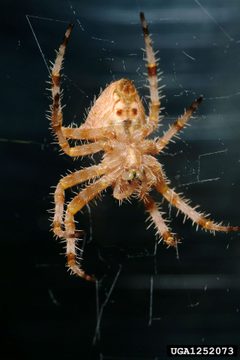
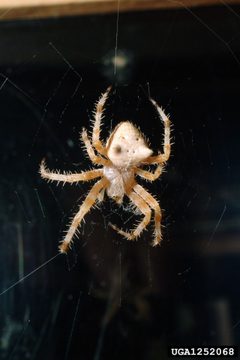
Araneus illaudatus is a large orb-weaving spider to the southwestern United States. Females are among the largest North American Araneus, reaching 25 mm in body length with a distinctive dirty white coloration and two triangular dark patches on the . Males are substantially smaller at 9 mm. The constructs typical orb webs and exhibits pronounced in size.
Pronunciation
How to pronounce Araneus illaudatus: /ˌærəˈniːəs ɪˌlɔːˈdeɪtəs/
These audio files are automatically generated. While they are not always 100% accurate, they are a good starting point.
Identification
Females distinguished from other Araneus by combination of very large size (up to 25 mm), dirty white ground color with occasional pinkish tinge, and two roughly triangular dark patches on the each containing a small white spot. Males identifiable by small size (9 mm) relative to females and presumably similar color pattern, though male description is less detailed in literature. Differs from Araneus marmoreus (marbled orb-weaver) which shows highly variable coloration including orange and yellow patterns but lacks the consistent paired triangular patches. Differs from Araneus cavaticus (barn spider) by coloration and geographic range.
Images
Habitat
Specific associations are poorly documented; presumably occupies typical environments for large Araneus orb-weavers in its range, likely including woodland edges, riparian areas, and human-modified landscapes with suitable web support structures.
Distribution
Restricted range in western Texas and eastern Arizona, United States. GBIF records indicate presence in USA and Mexico, though specific Mexican localities are not detailed in available sources.
Seasonality
females observed in autumn (October) in at least one record; likely follows typical temperate orb-weaver pattern with maturity in late summer through fall.
Diet
Presumably feeds on flying insects captured in orb web, as typical for the ; specific prey records are not documented.
Life Cycle
sacs produced by females; details of developmental stages, number of instars, and strategy are not documented. Male-female size disparity suggests typical araneid mating system with male searching .
Behavior
Constructs orb webs; females observed to retreat to curled leaves when disturbed, returning to web hub after disturbance ceases. web-building activity inferred from related and single observation of daytime retreat .
Ecological Role
of flying insects; specific ecological impacts or prey effects are not documented. May serve as prey for spider wasps and other natural enemies, though direct records are lacking.
Human Relevance
"Texas orb-weaver" reflects regional association; large female size may cause alarm but no documentation of medical significance. No specific records of synanthropy or pest status.
Similar Taxa
- Araneus marmoreusSimilar large size and orb-weaving habit, but highly variable coloration (orange, yellow, marbled patterns) differs from consistent dirty white with dark triangular patches of A. illaudatus; also occurs in more eastern and northern range.
- Araneus cavaticusSimilar "barn spider" and large female size, but associated with human structures throughout eastern North America, outside range of A. illaudatus; coloration differs.
- Araneus diadematusEuropean and introduced North American orb-weaver with cross-shaped abdominal pattern, smaller size, and different coloration; some behavioral studies include this but not A. illaudatus.
Sources and further reading
- BugGuide
- Wikipedia
- GBIF taxonomy match
- iNaturalist taxon
- Catalogue of Life
- Arachnida | Beetles In The Bush | Page 5
- Bug Eric: Spider Sunday: Butterfly Orbweaver
- Answer to Super Crop Challenge #2 | Beetles In The Bush
- Do Chestnut, Lemon, or Peppermint Scents Repel Spiders?
- Bug Eric: Spider Season
- new spider | Blog