
Araneus marmoreus
Clerck, 1757
marbled orb-weaver, pumpkin spider
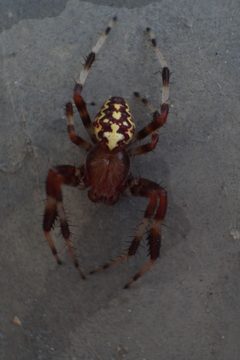
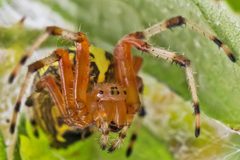
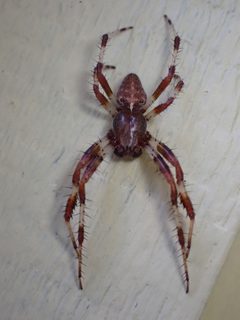
Araneus marmoreus is a medium-sized orb-weaving spider notable for the female's highly variable and often vividly colored , ranging from orange and yellow to pale cream with dark marbling or patterning. The exhibits two main color forms: var. marmoreus with orange abdomen and brown to black marbling, and var. pyramidatus with paler abdomen and a single dark mark at the rear. Females construct large vertical orb webs in moist wooded settings, often near streams, and hide in silken retreats during the day. The species has a Holarctic distribution spanning North America, Europe, and Asia, with recent records extending its known range to the Indian Himalayas.
Pronunciation
How to pronounce Araneus marmoreus: /ˈa.ra.ne.us marˈmɔː.re.us/
These audio files are automatically generated. While they are not always 100% accurate, they are a good starting point.
Images
Appearance
females reach 14 mm or more in body length with a very large, oval, sub-spherical that gives the its 'pumpkin spider' . Adult males are smaller, up to 7 mm. The is yellow to burnt-orange with a central dark line and dark lines down each side. are often red with black and white banding beginning on the tibia, , and ; legs may alternatively show light brown banding. The venter displays a black band enclosed by white brackets. Coloration is extraordinarily variable, with the abdominal folium pattern ranging from distinct dark-edged markings to reduced or absent patterns.
Sources and further reading
- BugGuide
- Wikipedia
- GBIF taxonomy match
- iNaturalist taxon
- NCBI Taxonomy
- Catalogue of Life
- Araneus marmoreus encore | Beetles In The Bush
- Bug Eric: Spider Sunday: Hentz's Orbweaver
- Araneae | Beetles In The Bush | Page 5
- Answer to Super Crop Challenge #2 | Beetles In The Bush
- Bug Eric: Wasp Wednesday: Caliadurgus hyalinatus
- Bug Eric: September 2017
- First report of Araneus marmoreus Clerck, 1757 from India (Araneae, Araneidae)
- A chromosomal-level genome assembly of Araneus marmoreus Schenkel, 1953 (Araneae: Araneidae)
- Proies capturées et stratégies prédatrices chez deux espèces d'araignées orbitèles: Argiope bruennichi et Araneus marmoreus: [Prey and predatory strategies of two orb‐weaving spiders: Argiope bruennichi and Araneus marmoreus]