
Steatoda nobilis
(Thorell, 1875)
Noble False Widow
Steatoda nobilis is a large theridiid spider native to Madeira and the Canary Islands, now established as one of the world's most spider . It has spread across Europe, North and South America, and other temperate regions, often becoming the spider in urban environments. The species is of moderate medical significance: bites typically cause similar to or stings, though some cases involve more severe reactions including bacterial from pathogenic bacteria carried on the spider's body. It constructs strong, irregular cobwebs with concealed tubular retreats and employs an 'attack wrap' hunting strategy to subdue prey.
Pronunciation
How to pronounce Steatoda nobilis: //stiˈætədə noʊˈbɪlɪs//
These audio files are automatically generated. While they are not always 100% accurate, they are a good starting point.
Identification
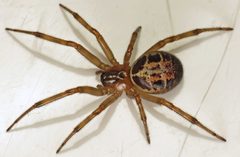
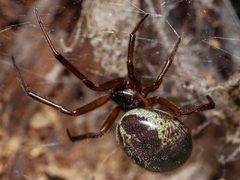
Distinguished from other Steatoda by larger body size and typical coloration pattern. Males identified by palp structure and abdominal markings; females by epigyne . Superficially resembles Latrodectus (black widows) but lacks the distinctive hourglass marking on the ventral . The 'skull' pattern on the abdomen is diagnostic when present, though markings are variable. Juveniles require microscopic examination for definitive identification.
Images
Habitat
Highly ; found year-round in urban and suburban environments including buildings, fences, telegraph poles, concrete structures, and vegetation such as ivy, cacti, and agave. In Ireland, are predominantly associated with steel, concrete, or timber structures in urbanized areas; juveniles occupy small crevices and holes, making difficult. Seaside cities and villages with temperate oceanic or Mediterranean climates are especially favorable. Has been observed spreading into natural in some regions (e.g., California, Atacama Desert in Chile).
Distribution
Native: Madeira and Canary Islands (Spain, Portugal). Introduced and established: Western Europe (including England, Ireland, France, Germany), Mediterranean region, United States (California, established 2011), Chile (first southern hemisphere record 2016), Colombia, Ecuador (first recorded 2014, established to 2800 m elevation), New Zealand (since at least 2023). Undergoing rapid northward expansion in Great Britain and Ireland. Predicted vulnerable regions for future invasion include South Africa, southern Australia, and much of New Zealand.
Seasonality
Active year-round regardless of climate; no seasonal dormancy observed. and reproductive activity may vary with temperature.
Diet
capturing both and small vertebrates. Documented prey includes woodlice, insects, other spiders (including native European ), pipistrelle bats, and pygmy shrews (ten times the spider's size). In Ireland, observed to prey on protected reptile species. All liquid requirements obtained from prey; can thrive without free water in laboratory conditions.
Life Cycle
Long-lived, with lifespan up to five years (recorded 5.5 years in captivity for one female). Females produce multiple sacs per season (up to four in four months observed). Egg sacs spherical to pear-shaped, 5–12 mm diameter, suspended in irregular silky chamber without entrance; contain 34–208 eggs (average 94). Spiderlings emerge from at 18 days, remain in egg sac until first moult, then emerge capable of capturing small live prey. Developmental timing temperature-dependent.
Behavior
Constructs three-dimensional cobwebs with exceptional silk strength and concealed tubular retreat in deep cracks or holes; web development gradual over several days from initial tangled structure. Hunts using 'attack wrap' strategy: wraps silk around prey with fourth legs while in close contact, then bites to inject venom causing rapid paralysis. Poor eyesight; relies on web-borne vibrations to detect prey and threats. Males locate female webs and court by rhythmic plucking/tapping with second legs and abdominal vibrations, accompanied by stridulation sounds produced by scraping abdominal teeth against file. Males insert palps repeatedly into female epigyne upon contact.
Ecological Role
with demonstrated competitive superiority over native European spiders sharing ; venom up to 230-fold more potent than sympatric native . Can optimize venom usage based on availability. spider in many invaded urban habitats, potentially impacting native spider diversity and abundance. May pose conservation threat to island .
Human Relevance
Moderate medical significance: bites usually painless mechanically but venom injection causes intense pain; typically resemble / stings but can include steatodism (radiating pain, fever, malaise, swelling, erythema, piloerection, diaphoresis, facial flushing, localized vasodilation). Rare severe cases include bacterial (potentially leading to or sepsis), anaphylactic shock (unconfirmed), and cardiac symptoms. Risk elevated by habits bringing spiders into contact with humans on furniture, railings, handles, lighting, and street furniture. Spider pathogenic bacteria including - strains (Kluyvera intermedia, Pseudomonas putida) on and body surface. Subject of sensationalized media coverage; actual bite rare but under-recorded. Difficult to eradicate locally; education on identification and bite response recommended.
Similar Taxa
- Steatoda grossaAlso called 'false widow'; smaller size, different abdominal pattern (often with pale spots rather than skull shape), less robust build.
- Steatoda paykullianaAnother 'false widow' ; Mediterranean distribution, distinct coloration pattern with more prominent markings.
- Latrodectus spp. (black widows)Superficial resemblance in body shape and web type; distinguished by presence of hourglass marking (red or orange) in Latrodectus, more potent neurotoxic venom causing latrodectism, and different geographic distribution in most regions.
Misconceptions
Frequently confused with black widows (Latrodectus) due to 'false widow' and general body shape, leading to exaggerated public fear. Media reports often sensationalize bite severity; while medically significant, most bites are not life-threatening. The term 'false widow' properly applies to multiple Steatoda , not just S. nobilis. Some reported severe bite reactions may be complicated by bacterial rather than direct venom effects alone.
More Details
Invasion History
First recorded in England in 1879; remained rare for over a century (typical lag phase), then underwent massive growth since 1990 with accelerated global spread after 2010. Spread likely facilitated by ornamental plant trade rather than banana imports as previously assumed. Multiple independent introductions documented within invaded countries based on .
Venom Composition
Venom contains alpha-latrotoxins and delta-latroinsectotoxins (49% of venom), including peptidase and serine (15%), and other proteins. Two-thirds of venom composed of latrodectus-like toxins. Functions in prey immobilization, predigestion, and defense.
Research Gaps
Bite and severity require improved documentation; assays for venom cytotoxicity and microbial carriage needed; ecological impacts on native fauna in newly colonized areas warrant monitoring; immunological and clinical surveillance systems for spider bites need enhancement.
Sources and further reading
- BugGuide
- Wikipedia
- GBIF taxonomy match
- iNaturalist taxon
- NCBI Taxonomy
- Catalogue of Life
- Where is the Noble False Widow settling next? | Blog
- The false widow spider Steatoda nobilis is a notable invasive species.
- The 'Noble false widow' spider Steatoda nobilis is an emerging public health and ecological threat.
- Steatoda nobilis, a false widow on the rise: a synthesis of past and current distribution trends
- New records and updated distribution of the invasive spider Steatoda nobilis (Araneae: Theridiidae) in Chile, with the first report in natural environments of the Atacama Desert
- Comment on Dunbar et al. (2022) “Webslinger vs. Dark Knight: First record of a false widow spider Steatoda nobilis preying on a pipistrelle bat in Britain”
- The protamines of the noble false widow spider Steatoda nobilis provide an example of liquid-liquid phase separation chromatin transitions during spermiogenesis
- Survey of Synanthropic Spiders in Ireland Reveals Expansion and Dominance of the Invasive Noble False Widow Steatoda nobilis in Urban Habitats (Araneae: Theridiidae)
- Supplementary material 1 from: Bauer T, Feldmeier S, Krehenwinkel H, Wieczorrek C, Reiser N, Breitling R (2019) Steatoda nobilis, a false widow on the rise: a synthesis of past and current distribution trends. NeoBiota 42: 19-43. https://doi.org/10.3897/neobiota.42.31582
- Organ-resolved lipid mapping in Steatoda nobilis spider model using high-resolution mass spectrometry imaging and Kendrick mass defect analysis
- Worldwide Web: High Venom Potency and Ability to Optimize Venom Usage Make the Globally Invasive Noble False Widow Spider Steatoda nobilis (Thorell, 1875) (Theridiidae) Highly Competitive against Native European Spiders Sharing the Same Habitats