
Parasteatoda
Archer, 1946
Colourful Comb-footed Spiders
Species Guides
2- Parasteatoda tabulata(Wandering House Cobweaver)
- Parasteatoda tepidariorum(Common House Spider)
Parasteatoda is a of comb-footed spiders ( Theridiidae) first described by Allan Frost Archer in 1946. The genus name derives from Greek "para-" (near) combined with the related genus Steatoda. in this genus are characterized by a teardrop-shaped or nearly spherical with highly variable coloration, and possess the comb-footed spines on the fourth leg typical of theridiids. The genus contains 42 species and one as of October 2025, distributed primarily across the Old World with many species in Asia and New Guinea, though several have been introduced to the Americas and Europe through human commerce. The best-known member, Parasteatoda tepidariorum (Common House Spider), has become a significant model organism for evolutionary developmental research.
Pronunciation
How to pronounce Parasteatoda: /ˌpærəstɪəˈtoʊdə/
These audio files are automatically generated. While they are not always 100% accurate, they are a good starting point.
Identification
Parasteatoda can be distinguished from the related Steatoda by abdominal shape—Parasteatoda has a more pronounced teardrop form with the section distinctly higher than the . The genus is further characterized by the male stridulatory apparatus and specific leg formula (1243 in males, 1423 in females). Species-level identification requires examination of genitalic structures and other detailed morphological features. Parasteatoda tepidariorum, the Common House Spider, is frequently misidentified as the Brown Widow (Latrodectus geometricus); the latter can be distinguished by the presence of a red or orange hourglass marking on the underside of the , which Parasteatoda lacks.
Images
Appearance
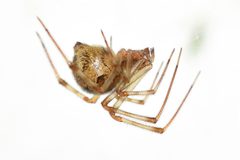
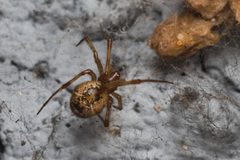
in this possess a characteristic teardrop-shaped or nearly spherical with the section elevated above the and pointed downward. The abdomen exhibits highly variable coloration, ranging from greyish brown to blackish brown or bright orange, often with a broad longitudinal cardiac pattern and transverse spots. The carapace is oval. Males possess a stridulating apparatus consisting of partial lunate plates on either side of the . is slight, with males visually similar to females but somewhat smaller. Leg formula is 1243 in males and 1423 in females.
Habitat
The is primarily Old World in distribution, with native occupying diverse across Asia, New Guinea, and parts of Europe. Several species, notably Parasteatoda tepidariorum, have become and are strongly associated with human habitations, found under eaves, in window wells, rock retaining walls, and tree holes. These introduced thrive in built environments and are seldom found in natural settings.
Distribution
Native range encompasses Asia, New Guinea, and parts of Europe. The has become increasingly widespread in the Americas and Europe due to human-mediated introduction of several . Parasteatoda tepidariorum specifically has achieved distribution through global commerce, with suspected South American origin despite initial description from German specimens.
Host Associations
- Zatypota albicoxa - ectoparasitoidIchneumonid that parasitizes Parasteatoda tepidariorum in southwestern Japan
Life Cycle
For Parasteatoda tepidariorum: Females produce numerous tan, papery, pear-shaped sacs from late spring through late summer, each containing 100–600+ eggs. In laboratory conditions at 25°C, eggs hatch in approximately 7 days. Juveniles undergo several over 2–3 months to reach sexual maturity. Mated females can repeat egg production cycles every 4–6 days without remating, producing up to ~10 egg sacs. The exhibits under short-day conditions.
Behavior
Parasteatoda tepidariorum exhibits complex including nest-building, , courtship, and care. Females engage in web-twanging behavior that appears to advertise receptivity and leads to successful matings. occurs among juveniles from single egg sacs. Males may share female webs. Females are largely sedentary on their webs while males are more active walkers. Re-mating rates are low in this , with most females mating only once regardless of whether encounters are with the same or different males.
Ecological Role
As members of Theridiidae, Parasteatoda function as of insects and other small arthropods. In urban environments, P. tepidariorum occupies building surfaces as a microhabitat . The contributes to spider conservation in urban landscapes, with P. tepidariorum specifically classified as a space-web weaving guild member that benefits from -infested trees and associated prey .
Human Relevance
Parasteatoda tepidariorum, the Common House Spider, is one of the most familiar spiders in human dwellings across much of the world and serves as an important model organism for evolutionary developmental research. Its has been sequenced, revealing whole genome duplication within chelicerates. The is not considered dangerously venomous to humans or pets, though it is frequently misidentified as the venomous Brown Widow. Other species in the have been introduced to new regions through human commerce and are becoming more widespread.
Similar Taxa
- SteatodaRelated theridiid ; Parasteatoda differs in having more pronounced teardrop-shaped with elevation, distinct leg formula, and male stridulatory apparatus
- LatrodectusBrown Widow and related widows share Theridiidae and similar web architecture; distinguished by presence of red/orange hourglass marking on underside (absent in Parasteatoda) and more potent venom
- AchaearaneaHistorical taxonomic confusion—P. tepidariorum was placed in this by Levi in 1955, but current places it in Parasteatoda based on morphological and phylogenetic evidence
More Details
Etymology
The name combines Ancient Greek "para-" (παρά), meaning "near" or "next to", with the theridiid genus Steatoda, indicating close taxonomic relationship.
Japanese name
The Japanese name for this is O-himegumo zoku (大姫蜘蛛属).
Taxonomic history
Parasteatoda tepidariorum has undergone repeated taxonomic revision: originally described as Theridion tepidariorum by C.L. Koch in 1841, transferred to Parasteatoda by Archer in 1946, moved to Achaearanea by Levi in 1955, and currently returned to Parasteatoda. Some references still use Achaearanea.
Research significance
P. tepidariorum has emerged as a premier model for evolutionary developmental , with techniques including parental interference, microinjection, multicolor fluorescence in situ hybridization, and laser ablation enabling functional gene discovery. Research areas include axis formation, segmentation mechanisms, self-regulatory capabilities of the embryonic field, whole duplication effects, and evolution of lineage-specific organs (book lungs, , silk glands, venom glands).
Sources and further reading
- BugGuide
- Wikipedia
- GBIF taxonomy match
- iNaturalist taxon
- NCBI Taxonomy
- Catalogue of Life
- Bug Eric: Spider Sunday: Common House Spider
- Bug Eric: March 2012
- Bug Eric: Spider Sunday: Brown Widow
- Bug Eric: One Night, One House, Seventeen Spider Species
- Scale Insects on Urban Trees Benefit Spiders, Other Natural Enemies in Plants Below
- Bug Eric: Spider Sunday: Triangulate Cobweb Weaver
- The common house spider Parasteatoda tepidariorum
- Evolutionary crossroads in developmental biology: the spiderParasteatoda tepidariorum
- Primary cell culture from embryos of the common house spider Parasteatoda tepidariorum
- The mating system of the common house spider Parasteatoda tepidariorum
- Seasonal Life Cycle ofZatypota albicoxa(Hymenoptera: Ichneumonidae), an Ectoparasitoid ofParasteatoda tepidariorum(Araneae: Theridiidae), in Southwestern Japan
- Female mating rates and their fitness consequences in the common house spider Parasteatoda tepidariorum