
Theridion
Walckenaer, 1805
tangle-web spiders
Species Guides
31- Theridion agrifoliae
- Theridion albidum(White Long-legged Cobweaver)
- Theridion arizonense
- Theridion australe
- Theridion californicum
- Theridion cheimatos
- Theridion differens(Different Cobweb Spider)
- Theridion dilutum
- Theridion flavonotatum
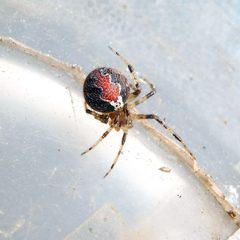
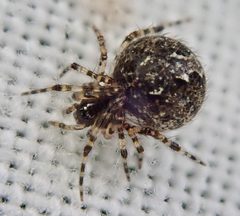
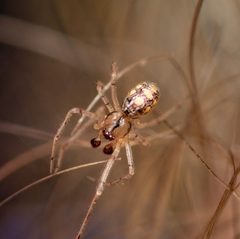
Theridion is a large of tangle-web spiders ( Theridiidae) with nearly 600 described distributed worldwide. The genus has historically served as a wastebasket for theridiid species lacking a colulus that did not fit into other genera. Notable species include T. grallator, the Hawaiian happy spider, recognized for its distinctive abdominal color patterns, and T. nigroannulatum, one of few spider species known to live in social groups and hunt cooperatively. Molecular studies have revealed that Theridion as traditionally defined is para- or polyphyletic, with Hawaiian representatives representing at least two independent events from different continental sources.
Pronunciation
How to pronounce Theridion: /θɛˈrɪdiˌɒn/
These audio files are automatically generated. While they are not always 100% accurate, they are a good starting point.
Identification
Spiders in this are about as long or longer than wide. The bear two or fewer teeth on the front edge and none on the back edge. The first leg is longest in both sexes; the second leg is next longest in males, while the fourth leg is next longest in females. The epigyne is variable, but the possesses a and a colulus is absent in both sexes. In several , males have mastidia (projections) on the chelicerae. The row is slightly curved with a distinct gap between it and the eye row; this separates Theridion from the similar genus Enoplognatha, which has an almost straight anterior eye row and minimal gap between eye rows.
Images
Habitat
Theridion construct tangle webs, typically positioned under leaves and among vegetation. Spiders hang upside-down in these webs at night and retreat to hiding positions nearby during daylight hours.
Distribution
Worldwide distribution. Records include North America (Vermont, United States), Europe (Denmark, Norway, Sweden), and Hawaii. The has been introduced to many regions through human commerce.
Behavior
Theridion build irregular, three-dimensional tangle webs. They exhibit web-occupancy , hanging inverted in webs at night while retreating to concealed positions during the day. Mating behavior involves , multiple sperm inductions, and copulatory sequences. Males approach females in the female's retreat (a hood-shaped web structure). Males perform contralateral insertions, inserting the left palp into the female's right copulatory duct and vice versa. Females show reduced post-mating aggression compared to other theridiid . One species, T. nigroannulatum, exhibits social behavior, living in colonies and attacking prey en masse to overwhelm victims through cooperative hunting.
Ecological Role
Theridion serves as prey for other spiders; Philodromus cespitum, a running crab spider, has been documented preying on Theridion in European fruit orchards.
Human Relevance
The includes of research interest: T. grallator serves as a model organism for studying the of genetic diversity and color pattern evolution, while T. nigroannulatum provides insights into the evolution of social in spiders. The genus has been used in molecular studies developing microsatellite markers for assessing genetic effects of fragmentation.
Similar Taxa
- EnoplognathaDistinguished by row shape: Enoplognatha has an almost straight anterior eye row with minimal gap between eye rows, versus Theridion's slightly curved anterior eye row with distinct gap.
- ParasteatodaFormerly confused with Theridion; Parasteatoda tepidariorum was originally described as Theridion tepidariorum. Parasteatoda are more strongly associated with human structures and have different genitalic .
Sources and further reading
- BugGuide
- Wikipedia
- GBIF taxonomy match
- iNaturalist taxon
- NCBI Taxonomy
- Catalogue of Life
- Bug Eric: Spider Sunday: Common House Spider
- “Cicindelophilically” | Beetles In The Bush
- Bug Eric: March 2012
- DNA extraction in Theridion evexum v1
- Environment and Behaviour of Theridion Saxatile
- Molecular insights into the phylogenetic structure of the spider genus Theridion (Araneae, Theridiidae) and the origin of the Hawaiian Theridion‐like fauna
- BROOD-CARE BEHAVIOR IN THERIDION JAPONICUM OBSERVED AT A LABORATORY