
Philodromus cespitum
(Walckenaer, 1802)
Turf Running Spider, Running Crab Spider
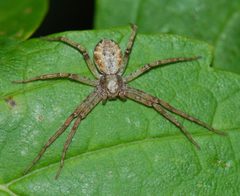
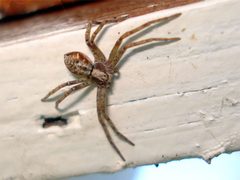
Philodromus cespitum is a small running crab spider in the Philodromidae, widely distributed across the Holarctic region. It is the spider in Central European fruit orchards, where it functions as an important agent. Males measure 3.5–5.0 mm, females approximately 5.3 mm. Body coloration is variable, typically in shades of brown or yellow with spotted patterns. The species exhibits distinctive reproductive including male courtship tapping and the use of genital plugs during copulation.
Pronunciation
How to pronounce Philodromus cespitum: /ˈfɪloʊˌdroʊməs ˈsɛspɪtəm/
These audio files are automatically generated. While they are not always 100% accurate, they are a good starting point.
Identification
Distinguished from other Philodromus by male , particularly the asymmetric sperm duct. Within the Philodromus aureolus , it is the only Holarctic species. Differs from P. lividus by sperm duct shape; from P. longipalpis by female epigyne structure (smaller plate and atrium); from P. fuscolimbatus by sperm duct shape, with sympatry in the northern Alps. Second pair of legs longest distinguishes Philodromidae from Selenopidae (flatties), which have legs increasingly longer from front to back.
Images
Habitat
Foliage-dweller in diverse environments; in Central European fruit orchards, more concentrated in orchard centers than edges; also occurs in cotton fields. Occupies arboreal microhabitats, typically on vegetation rather than ground.
Distribution
Holarctic: North America, Europe, North Africa, Turkey, Caucasus, Russia (including Siberia), Kazakhstan, China, Korea, and Japan. The only Holarctic member of the Philodromus aureolus .
Seasonality
females most commonly observed June–July; spiderlings present year-round, most abundant August–October. Males more active diurnally; females more active at dawn and dusk with secondary twelve-hour activity cycle.
Diet
ambush ; feeds primarily on aphids and other insects including the pest Cacopsylla pyri; occasionally preys on competitor spider (Theridion spiders) and smaller spiders through intraguild . Foraging aggressiveness positively correlated with body size and capture success; can exhibit overkilling .
Life Cycle
Females lay approximately 250 distributed across five to seven egg cocoons. Oviposition to hatching: 20 days at 15°C, 10 days at 24°C. Nymph developmental period approximately 430 days, longer for females than males regardless of temperature. Spiderlings present year-round.
Behavior
ambush hunter; males court females by tapping on female bodies with forelegs, with tap frequency positively correlated with relative male length. Males insert genital plugs during copulation; subsequent males can mate with plugged females by removing part of plug. Males discriminate among females based on virginity and plug size, assessed via female draglines and plug . Females end copulation by shaking body to dislodge male; typically permit two to three copulation rounds. Exhibits circadian locomotor rhythms: males more active during day, females at dawn and dusk with additional twelve-hour cycle.
Ecological Role
in Central European orchard agroecosystems; important agent suppressing pest including aphids and pear psyllids. Coexists with related (P. albidus, P. aureolus) through trophic and partitioning.
Human Relevance
Significant agent in European fruit orchards and Chinese/Iranian cotton fields, reducing reliance on chemical . Vulnerable to exposure; exhibits altered prey preferences and increased foraging aggressiveness when exposed to insecticides. Mortality rates from insecticides range 0–80% depending on compound. Less sensitive to neonicotinoids due to modified receptor structure. Endosymbiotic bacterial diversity influences insecticide resistance.
Similar Taxa
- Philodromus lividusOriginally considered ; distinguished by differently shaped male sperm ducts
- Philodromus longipalpisOriginally considered ; females have larger plate and atrium of epigyne
- Philodromus fuscolimbatusOriginally considered ; distinguished by sperm duct shape; sympatric in northern Alps
- Philodromus aureolusCoexists through partitioning; member of same but not Holarctic
- Philodromus albidusCoexists through partitioning in same geographic areas
- Philodromus buchariFemales closely resemble P. cespitum females but slightly larger
Sources and further reading
- BugGuide
- Wikipedia
- GBIF taxonomy match
- iNaturalist taxon
- NCBI Taxonomy
- Catalogue of Life
- Bug Eric: Shower Spiders
- Bug Eric: July 2013
- Bug Eric: Spider Sunday: Flatties
- Bug Eric: October 2014
- Bug Eric: Return of "Arachtober!"
- Differences in the abundance and diversity of endosymbiotic bacteria drive host resistance of Philodromus cespitum, a dominant spider of central European orchards, to selected insecticides