
Enoplognatha
Pavesi, 1880
Candystripe Spider (E. ovata)
Species Guides
7- Enoplognatha caricis(Leaf-backed Long-jawed Cobweaver)
- Enoplognatha intrepida
- Enoplognatha joshua
- Enoplognatha latimana(Scarce candy-striped spider)
- Enoplognatha marmorata(marbled cobweb spider)
- Enoplognatha ovata(candy-striped spider)
- Enoplognatha thoracica
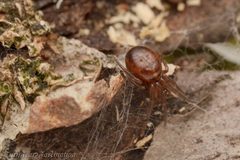
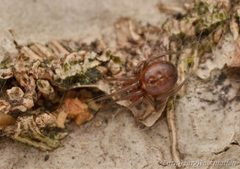
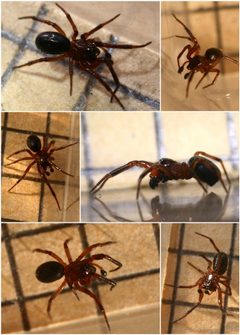
Enoplognatha is a of comb-footed spiders (Theridiidae) first described by P. Pavesi in 1880. The genus includes approximately 75 with distribution. Members are characterized by a large colulus, subspherical , and males typically possess enlarged . The genus is considered a senior synonym of Symopagia.
Pronunciation
How to pronounce Enoplognatha: /ɛˌnɒpləˈɡnæθə/
These audio files are automatically generated. While they are not always 100% accurate, they are a good starting point.
Identification
Distinguished from other theridiid by the combination of large colulus and subspherical . Males can be identified by enlarged , a trait shared with Steatoda. Enoplognatha ovata is particularly recognizable due to its polymorphic coloration with red or black markings on pale background, earning it the 'Candystripe Spider' or 'Polymorphic Spider'.
Images
Habitat
Diverse including ground debris, understory vegetation in woodlands, meadows, fields, and agricultural settings such as citrus orchards and cotton fields. Some construct webs under stones or ground debris; others build webs on, between, and around leaves. Enoplognatha ovata spins tangled snares in understory vegetation and among wildflowers and herbs.
Distribution
distribution including North America, Europe, Asia, South America, Africa, Greenland, and Western Australia. Specific records include: North America (New England, Great Lakes region, Pacific states inland to Montana and Utah); Europe (including Poland, Spain, Czechia, Ireland, UK); South Africa; and Peru.
Seasonality
Spiderlings emerge from sacs in autumn and overwinter in leaf litter and protected ground . Females guard egg sacs in late summer.
Diet
Predatory. Enoplognatha molesta has been observed feeding on red spider mites, larval and stages of Helicoverpa armigera, leafhoppers, and aphids in laboratory conditions.
Host Associations
- Wolbachia supergroup A - endosymbiontFirst documented in E. latimana from Poland; bacterial
- Oxyrrhexis zephyrus - Ichneumonid of E. serratosignata
- Trombidiidae and Erythraeidae mites - Larval mites parasitize spiderlings of E. ovata
Life Cycle
Females deposit white or bluish sacs in the web. Spiderlings emerge in autumn and overwinter in protected . Development includes egg, spiderling, and stages. Timing of red pigment deposition in E. ovata varies genetically: early in development for ovata morph, either early or late for redimita morph.
Behavior
Constructs cobwebs or tangled snares. Hides by day under curled leaves. Females guard sacs vigilantly. Spiderlings subject to mite during development.
Ecological Role
in terrestrial . Documented as abundant in agricultural systems (citrus orchards, cotton fields) where it may contribute to pest control.
Human Relevance
Generally harmless to humans despite being venomous (all spiders use venom to subdue prey). Bites may cause localized redness, swelling, and itching but are not dangerously venomous to healthy humans. Occasionally found in gardens, agricultural settings, and rarely indoors. Enoplognatha ovata is a familiar in North America despite being probably native to Eurasia and introduced long ago.
Similar Taxa
Misconceptions
Despite bright coloration in some morphs (red stripes), Enoplognatha ovata is not dangerously venomous to humans. The 'Candystripe Spider' and colorful appearance may cause unnecessary alarm.
More Details
Taxonomic synonymy
Enoplognatha is considered a senior synonym of Symopagia
Genetic research
E. ovata has been extensively studied for genetic regulation of pigmentation, with multiple morphs controlled by regulatory loci showing geographic variation in phenotype frequencies
Agricultural significance
In South Africa, E. molesta was the most abundant theridiid in citrus orchards and the most common in cotton fields, suggesting potential as a biocontrol agent
Sources and further reading
- BugGuide
- Wikipedia
- GBIF taxonomy match
- iNaturalist taxon
- NCBI Taxonomy
- Catalogue of Life
- Bug Eric: Candystripe Spider
- Enoplognatha mandibularis Lucas, 1846 (Arachnida, Araneae, Theridiidae), new theridiid to the community of Galicia
- Geographical distribution of phenotypes regulating pigmentation in the spider Enoplognatha ovata (Clerck) (Araneae: Theridiidae)
- Wolbachia supergroup A in Enoplognatha latimana (Araneae: Theridiidae) in Poland as an example of possible horizontal transfer of bacteria
- Enoplognatha bryjai new species, a bizzare cobweb spider of the Pannonian swamps (Araneae, Theridiidae)
- Genetics and distribution of black spotting in Enoplognatha ovata (Araneae: Theridiidae), and the role of intermittent drift in population differentiation
- Natural history of Oxyrrhexis zephyrus sp.n. (Hymenoptera: Ichneumonidae), a parasitoid of Enoplognatha serratosignata (Araneae: Theridiidae), with notes on taxonomy and other host species of Oxyrrhexis