
Enoplognatha latimana
Hippa & Oksala, 1982
Scarce candy-striped spider
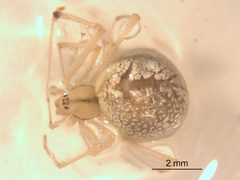
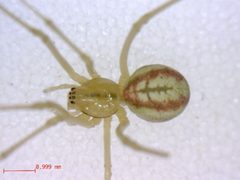
Enoplognatha latimana is a cobweb spider in the Theridiidae, described by Hippa & Oksala in 1982. It belongs to a noted for polymorphic coloration, though specific appearance details for this are not well documented. The species has been recorded across a broad Palearctic range and has been introduced to Canada. A 2024 study documented the first known in this species, representing supergroup A bacteria in a specimen from north-western Poland.
Pronunciation
How to pronounce Enoplognatha latimana: /ɛˌnɒpləˈnæθə læˈtɪmənə/
These audio files are automatically generated. While they are not always 100% accurate, they are a good starting point.
Images
Habitat
One documented specimen was collected in an area with shrubs and rich herbaceous undergrowth, shaded and located near a municipal waste landfill in Poznań, Wielkopolska Voivodeship, Poland. This represents the only specific microhabitat description available for the .
Distribution
Native to Europe, North Africa, Turkey, the Caucasus, Russia (European), and Central Asia through Iran. Introduced to Canada. GBIF records indicate presence across these regions; iNaturalist documents 55 observations.
Host Associations
- Wolbachia supergroup A - intracellular bacterial endosymbiontFirst documented in this , detected in a female from Poland via multilocus sequence typing of eight housekeeping genes and the wsp gene. Phylogenetic analysis shows relation to in other spiders and in Diptera and Hymenoptera. A unique ftsZ gene sequence was identified.
Similar Taxa
- Enoplognatha ovataCongeneric with well-documented ; both are cobweb spiders in Theridiidae with polymorphic coloration patterns. E. ovata is commonly known as the candystripe or polymorphic spider and has been introduced to North America, whereas E. latimana is less studied and has a more restricted documented range. The two may overlap in European distribution.
More Details
Wolbachia research significance
The 2024 documentation of supergroup A in E. latimana contributes to limited knowledge of intracellular in spiders. The study suggests possible horizontal transfer of bacteria, as the strain shows phylogenetic affinity with both spider-hosted and insect-hosted Wolbachia. Gene sequences have been deposited in public databases for comparative research.
Taxonomic note
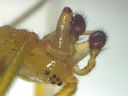
The epithet 'latimana' refers to the broad male characteristic of this species, distinguishing it from . Described relatively recently (1982), it remains less studied than the more widespread E. ovata.