
Enoplognatha ovata
(Clerck, 1757)
candy-striped spider, common candy-striped spider, polymorphic spider
Enoplognatha ovata is a small theridiid spider native to Europe and introduced to North America. The exhibits striking color , with three main morphs varying in abdominal pigmentation from plain to striped patterns. Despite its diminutive size (4-7 mm), it is an effective capable of capturing prey substantially larger than itself. Females construct tangled webs on the undersides of leaves and demonstrate maternal care by guarding sacs and provisioning spiderlings.
Pronunciation
How to pronounce Enoplognatha ovata: /ɛnɒplɒɡˈneɪθə əʊˈvɑːtə/
These audio files are automatically generated. While they are not always 100% accurate, they are a good starting point.
Identification
Virtually indistinguishable from E. latimana without microscopic examination; mature specimens require inspection of male palpal bulb or female epigyne for definitive separation. The three color morphs (lineata, redimita, ovata) occur in both , though lineata is most common in E. latimana. Color within E. ovata itself is not diagnostic for distinguishing between these .
Images
Appearance
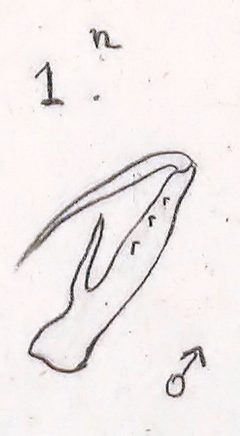
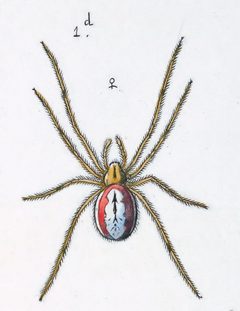
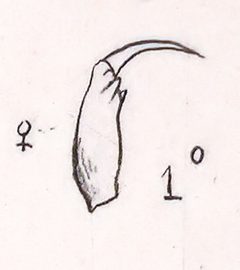
Small spider with globular, -shaped and translucent legs. females measure 4.3-7 mm in body length; males 3.5-5.2 mm. Males distinguished by modified and elongated . Three distinct color morphs: 'lineata' (white, cream, or yellow background with or without black spots), 'redimita' (paired red stripes), and 'ovata' (entire dorsal surface red). The 'ovata' morph is the rarest. Background coloration ranges from white, cream, green, to yellow.
Habitat
Found in open fields, forests, and roadsides. Constructs webs on undersides of leaves and low-growing vegetation. Webs typically built in understory vegetation in woodlands, and among wildflowers and herbs in meadows and fields. Spiders hide by day under curled leaves, using silk to pull leaf edges down and create a concealed retreat.
Distribution
Native to Europe, Turkey, Caucasus, Russia (Europe to Middle Siberia), Kazakhstan, Iran, Central Asia, Korea, and Japan. Introduced to North America with established across the United States from coast to coast, including New England, Great Lakes region, and Pacific states inland to Montana and Utah. Not recorded as far south as Mexico.
Seasonality
Spiderlings emerge from sacs in autumn and overwinter in leaf litter and protected ground . active spring through fall with bimodal activity patterns possible; peak observation in late summer when females guard egg sacs.
Diet
Predatory; feeds on insects and other small arthropods. Has been observed capturing prey many times its own size. Specific prey not documented in available sources.
Life Cycle
Female deposits in white sac that gradually changes to blue-grey after several days. Egg sac secreted within rolled-up leaf fastened with silk. Female guards egg sac until hatching and has been observed defending eggs from . Spiderlings emerge in autumn. Mothers provision prey to baby spiderlings after hatching. Spiderlings overwinter in leaf litter. Development includes egg, spiderling, and stages. Spiderlings subject to by larval mites (Trombidiidae and Erythraeidae).
Behavior
Constructs small, tangled webs on leaf undersides. Hides by day under curled leaves with edges pulled down by silk threads. Female exhibits maternal care: guards sac, defends against , and provisions prey to newly hatched spiderlings. Not dangerously venomous to humans; bites may cause local redness, swelling, and itching in sensitive individuals but are not life-threatening.
Ecological Role
of insects and small arthropods; control of potential pest in gardens and agricultural settings. Serves as for parasitic mites (Trombidiidae, Erythraeidae).
Human Relevance
Occasionally encountered in gardens and agricultural settings where it may help control pest insects. Bites can occur during gardening activities but are not medically significant for healthy individuals; may cause localized reactions in sensitive persons. Not considered a household pest as it primarily inhabits outdoor vegetation.
Similar Taxa
- Enoplognatha latimanaVirtually identical in external appearance and color morphs; requires microscopic examination of male palpal bulb or female epigyne for definitive identification
More Details
Color polymorphism genetics
Three main morphs (lineata, redimita, ovata) controlled by genetic loci; timing of red pigment deposition regulated by a closely linked regulatory locus with geographic variation in frequencies between
Population structure
often occur in dense clumps sometimes referred to as colonies; genetic studies suggest intermittent drift contributes to population differentiation in spotting
Sources and further reading
- BugGuide
- Wikipedia
- GBIF taxonomy match
- iNaturalist taxon
- NCBI Taxonomy
- Catalogue of Life
- Is Jade Lucky? Well, Bumble Bees Like It! | Bug Squad
- Bug Eric: Candystripe Spider
- Two new species of wart sea slugs discovered from Indonesia
- Flatfaced longhorn: Leptostylus transversus | Beetles In The Bush
- These are a few of my favorite trees | Beetles In The Bush
- Juglandaceae | Beetles In The Bush
- Geographical distribution of phenotypes regulating pigmentation in the spider Enoplognatha ovata (Clerck) (Araneae: Theridiidae)
- Genetics and distribution of black spotting in Enoplognatha ovata (Araneae: Theridiidae), and the role of intermittent drift in population differentiation