
Mimetidae
Simon, 1881
Pirate spiders
Genus Guides
2Pirate spiders (Mimetidae) are a of araneomorph spiders renowned for their specialized araneophagic —they hunt and feed on other spiders rather than building webs to capture prey. Members of this family employ , infiltrating the webs of cobweb weavers, orb weavers, and other spiders, then subduing their with spider-specific venom. The family contains approximately 200 across 12 worldwide, with highest diversity in the Neotropics. North America hosts 18 described species in three genera, with another ten species awaiting formal description. These small spiders (typically 3–7 mm body length) are characterized by long leg spines and distinctive arrangements.
Pronunciation
How to pronounce Mimetidae: /mɪˈmiːtɪdiː/
These audio files are automatically generated. While they are not always 100% accurate, they are a good starting point.
Identification
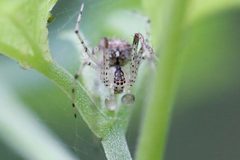
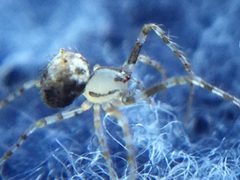
Pirate spiders possess long, conspicuous spines on their legs that distinguish them from superficially similar cobweb spiders (Theridiidae) and sheet-web weavers. They typically have four patches arranged in two rows. The of mature males are modified for sperm transfer. Body size ranges from 3–7 mm. Some display distinctive abdominal markings; for example, Mimetus guiyang has large bubble-shaped ossified hair bases on the , a rarity among . The loosely-woven, "fluffy" appearance of Mimetus sacs is fairly diagnostic for the .
Images
Habitat
Pirate spiders occupy diverse from sea level to 1,600 m elevation, including heathlands, forests, grasslands, and human-altered environments. They are frequently encountered in and around the webs of other spiders, including on vegetation, under eaves, and occasionally indoors. In temperate regions, they are active from late spring through autumn, with peak visibility in fall when mature individuals are most conspicuous.
Distribution
Worldwide distribution with highest diversity in the Neotropics of Central and South America. North America: 18 described in three north of Mexico, with Mimetus puritanus being the most common species in the eastern United States. China: at least eight Mimetus species in Guizhou Province alone, the highest diversity in that country. India: multiple species including recently described M. parvulus and M. spinatus. New Zealand and Australia: Mimetus species present. Europe: recorded from Slovakia and other Central European countries.
Seasonality
In temperate climates, pirate spiders are most conspicuous in autumn when mature individuals actively seek prey and mates. Pitfall trapping studies indicate activity across the warmer months, with varying by and locality. In laboratory and field studies, Mimetus species from New Zealand and Queensland displayed year-round activity in suitable conditions.
Diet
Specialized araneophages that feed primarily on other spiders. Documented prey includes orb web-building spiders (Araneidae) and cobweb weavers (Theridiidae). They capture prey by invading webs, performing vibratory to lure the spider, then lunging at close range to subdue the victim with spider-specific venom while holding it in a 'basket' formed by spine-covered legs. They feed sequentially on the legs of their prey, draining the victim completely. Occasionally consume insects ensnared in host webs and spider sacs.
Life Cycle
sacs are loosely woven with a characteristic fluffy appearance. Juveniles and occupy the webs of other spiders. Sexual maturity is reached after several ; males can be distinguished by modified . Females are generally larger than males. In some , males ride piggyback on females, sharing in the female's kills.
Behavior
Employ as primary hunting strategy: invade webs of other spiders, generate vibrations that mimic prey or potential mates, then attack when the investigates. Attack by biting legs of prey spiders first, possibly because their jaw bases prevent opening wide enough to bite other body parts. Vision appears to be of little or no importance in predatory ; hunting relies on tactile and vibrational cues. Some observed feeding on insects when opportunity presents, though this is secondary to spider .
Ecological Role
Intraguild that regulate of web-building spiders. Their specialized araneophagy places them as secondary or tertiary consumers in . By preying on common web-building spiders, they may influence web architecture and foraging of their prey through non-consumptive effects.
Human Relevance
Occasionally encountered indoors, particularly in autumn when wandering males seek mates. One observer reported a pirate spider on a Dairy window in Colorado. Generally harmless to humans due to small size and specialized venom effective against spiders but not mammals. Their presence may indicate healthy of other spiders. No significant economic impact; not considered household pests.
Similar Taxa
- Theridiidae (cobweb spiders)Resemble pirate spiders in general body form and are frequently found in association with them; distinguished by lack of long leg spines and web-building rather than web invasion.
- Anyphaenidae (ghost spiders)Share prowling habits and pale coloration with some mimetids, but are primarily insectivorous rather than araneophagous, and lack the distinctive leg spines of pirate spiders.
- Portia (Salticidae)Another araneophagic spider that invades webs and uses ; distinguished by jumping spider with large and active hunting without leg spines.
Sources and further reading
- BugGuide
- GBIF taxonomy match
- iNaturalist taxon
- NCBI Taxonomy
- Catalogue of Life
- Bug Eric: Spider Sunday: Pirate Spiders
- new species | Blog - Part 4
- Bug Eric: October 2009
- Bug Eric: 2009
- Celebrating One Year on Weibo | Blog
- Bug Eric: The Tarantula Hunt
- Notes on the Biology of Mimetus puritanus Chamberlin (Araneae: Mimetidae)
- Taxonomic notes on a pirate spider occurring in China (Araneae, Mimetidae)
- Taxonomic revision of the Neotropical pirate spiders of the genus Gelanor Thorell, 1869 (Araneae, Mimetidae) with the description of five new species
- Two new species and a new transfer in the pirate spider genus Mimetus Hentz, 1832 (Araneae: Mimetidae: Mimetinae) from India
- A morphological and combined phylogenetic analysis of pirate spiders (Araneae, Mimetidae): evolutionary relationships, taxonomy and character evolution
- CHAPTER 20. Ghosts, Goblins, Pirates, and Other Wandering Hunters: Mimetidae, Corrinidae, Trachelidae, Gnaphosidae, Caponiidae, Dysderidae, Oonopidae, Anyphaenidae, Miturgidae, Eutichuridae, and Liocranidae
- Three new species of the genus Mimetus Hentz, 1832 (Araneae: Mimetidae) from Yunnan-Guizhou Plateau of China
- Altella aussereri, Mimetus laevigatus, and Trichoncyboides simoni (Araneae: Dictynidae, Mimetidae, Linyphiidae), three species of spiders new for Slovakia
- The phenology of spiders on heathland in Dorset. Families Lycosidae, Pisauridae, Agelenidae, Mimetidae, Theridiidae, Tetragnathidae, Argiopidae
- The biology of New Zealand and Queensland pirate spiders (Araneae, Mimetidae): aggressive mimicry, araneophagy and prey specialization