
Mimetus puritanus
Chamberlin, 1923
Common Pirate Spider, Pirate Spider
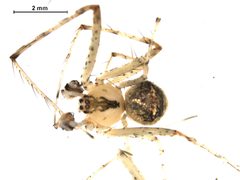
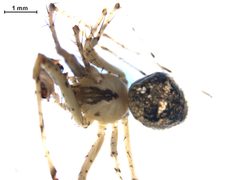
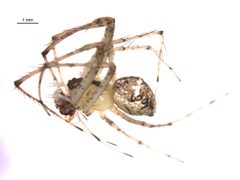
Mimetus puritanus is a small araneophagous spider in the Mimetidae, commonly known as the Common Pirate Spider. It is the most frequently encountered pirate spider in the eastern United States. Unlike web-building spiders, M. puritanus infiltrates the webs of other spiders—particularly cobweb weavers and orb weavers—to prey upon them. The species exhibits specialized predatory adaptations including jaws that restrict gape width, leading it to attack prey spiders by biting their legs sequentially. measure 3–7 mm in body length and are primarily .
Pronunciation
How to pronounce Mimetus puritanus: /mɪˈmeːtʊs pʊrɪˈtaːnʊs/
These audio files are automatically generated. While they are not always 100% accurate, they are a good starting point.
Identification
Mimetus puritanus can be distinguished from other spiders by the presence of long, conspicuous spines on its legs, which separate it from cobweb spiders (Theridiidae) and sheet-web weavers (Linyphiidae) that it superficially resembles. The has four patches arranged in two rows. It is most reliably identified by its : it is frequently found occupying the webs of other spiders, where it adopts a posture distinct from the web's builder. Males possess modified resembling small boxing gloves. The sacs are diagnostic for the —loosely woven with a fluffy, irregular appearance unlike the more structured sacs of many other spider .
Images
Distribution
Eastern United States, with records extending from Massachusetts southward. The has been documented in South Deerfield, Massachusetts; Colorado Springs, Colorado; and Mission, Texas, suggesting a broader range than initially recognized. GBIF records indicate presence in the USA, Jamaica, and Vermont.
Seasonality
Active during warmer months. have been observed in Massachusetts in October and July, with an sac found in Colorado in late July. Activity appears to peak in late summer and early autumn.
Diet
Specialized of other spiders (araneophagy). Prey includes cobweb spiders (Theridiidae), orb weavers, and other web-building spiders. The attacks prey by biting their legs sequentially, feeding from one leg to another until the victim is depleted. This leg-targeting may be an to jaw bases that limit mouthpart gape. Mimetus puritanus will also consume the sacs of its prey spiders. Insects are occasionally taken when encountered in webs.
Life Cycle
involves production of loosely woven, fluffy sacs characteristic of the Mimetus. Development includes egg, spiderling, and stages. is present: males possess modified for sperm transfer and tend to wander, while females may remain in or near webs.
Behavior
hunting strategy involving web infiltration and . The spider enters foreign webs and may vibrate the silk to simulate prey or potential mates, luring the resident spider within attack range. When attacking, it bites prey spider legs rather than body regions, sequentially consuming limbs. The demonstrates flexibility, occurring both outdoors in vegetation and indoors on ceilings and walls.
Ecological Role
Intraguild regulating of web-building spiders. By specializing on other spiders, M. puritanus occupies a distinctive trophic position that may influence local spider structure and web-site turnover.
Human Relevance
Occasionally encountered indoors, where it may be mistaken for cobweb spiders. Not considered dangerous to humans due to small size and specialized venom adapted for spider prey rather than vertebrates. Its presence in buildings indicates proximity to other spider , which it may help suppress.
Similar Taxa
- Mimetus hesperusWestern North American with overlapping morphological features; distinguished by geographic range and subtle genitalic differences
- Mimetus notiusSouthern ; requires examination of male or female for definitive separation
- Theridiidae (cobweb spiders)Resemblance in body form and occurrence in similar microhabitats; distinguished by absence of prominent leg spines and presence of comb feet (ctenidia) in theridiids
- Anyphaenidae (ghost spiders) wandering spiders of similar size; distinguished by pale coloration, different arrangement, and non-araneophagous diet