
Mimetus
Hentz, 1832
Pirate spiders, Cannibal spiders
Species Guides
8- Mimetus aktius(pirate spider)
- Mimetus epeiroides(pirate spider)
- Mimetus eutypus(pirate spider)
- Mimetus hesperus(pirate spider)
- Mimetus notius(Reticulated Pirate Spider)
- Mimetus puritanus(Common Pirate Spider)
- Mimetus syllepsicus
- Mimetus tillandsiae
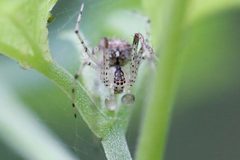
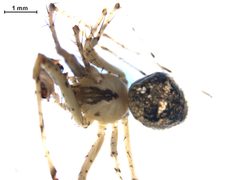
Mimetus is a of pirate spiders in the Mimetidae, comprising approximately 71 distributed worldwide. These small arachnids (3–7 mm body length) are obligate spider , employing specialized hunting tactics to infiltrate webs of other spiders and kill them through leg bites. They exhibit distinctive including globular with curved bristle-like hairs and elongated legs. The genus is recognized for its ecological role as an intraguild predator and its convergent resemblance to comb-footed spiders (Theridiidae).
Pronunciation
How to pronounce Mimetus: /mɪˈmiːtəs/
These audio files are automatically generated. While they are not always 100% accurate, they are a good starting point.
Identification
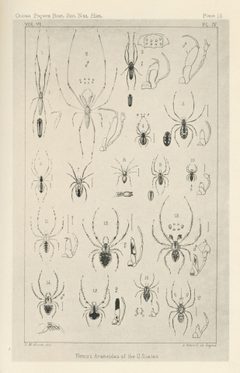
Distinguished from similar spiders by: (1) arrangement—distance from edge to anterior medial eyes is ⅓–½ the distance between anterior and medial eyes; (2) elongated anterior legs relative to posterior pair; (3) presence of long leg spines; (4) curved bristle-like hairs on . Resembles Theridiidae but differs in eye arrangement and leg proportions. Distinguished from other mimetid by specific genitalic requiring microscopic examination.
Images
Appearance
Small spiders with globular resembling theridiids. Upper abdomen bears curved bristle-like hairs. with diagnostic arrangement: distance from edge to anterior medial eyes is one-third to one-half of distance between anterior and medial eyes. Anterior legs elongated, 1.5–1.7 times length of posterior pair. Body length 3–7 mm. Legs bear long spines. sacs have distinctive fluffy, loosely-woven silk appearance.
Habitat
Found in vegetation and under loose bark. occupy varied including xerothermic habitats in Central Europe and diverse environments across their worldwide range. Often detected in webs of other spiders, which they invade for hunting.
Distribution
Worldwide distribution. Documented from North America (18+ north of Mexico), Central and South America, Europe (including first records from Slovakia extending Central European range), Asia (China: Guizhou Province with highest diversity in country, Yunnan-Guizhou Plateau, India), and other regions. Specific distribution varies by species.
Seasonality
peak in late summer for at least some (e.g., M. puritanus). Activity patterns likely vary geographically; observations suggest primarily in some regions.
Diet
Obligate spider (araneophagous). Prey includes cobweb spiders (Theridiidae), orb weavers (Araneidae), and other spiders. Will also consume prey items encountered in webs and sacs of victim spiders. Venom specialized to kill spiders rapidly.
Life Cycle
sacs with fluffy, loosely-woven silk structure. Developmental stages not well documented in available sources. size reached at 3–7 mm body length.
Behavior
Specialized spider-hunting tactics: slow, deliberate movement; stalking or ambushing prey; invading webs of other spiders and vibrating silk to mimic prey or mates, luring the spider; attacking by biting legs and injecting toxins, then retreating until prey is paralyzed; feeding on body fluids of immobilized victim. Sometimes observed feeding on insects or prey items in host webs. No web-spinning for prey capture.
Ecological Role
Intraguild specializing in spider . Functions as control agent for web-building spiders. Contributes to trophic complexity in spider through specialized araneophagy.
Human Relevance
Occasionally encountered indoors. No medical significance; venom specialized for spiders, not dangerous to humans. Serves as agent for other spiders in domestic and natural environments. Subject of taxonomic research with new regularly described.
Similar Taxa
- TheridiidaeResembles comb-footed spiders in globular shape, but distinguished by arrangement, leg proportions, and absence of comb-footed hind legs
- Other Mimetidae generaShare characteristics but require genitalic examination for definitive separation; Mimetus distinguished by specific morphological features including - proportions
Misconceptions
'cannibal spiders' is misleading—Mimetus preys on other spider , not conspecifics. Not all individuals found in webs of other spiders are pirates; careful examination of arrangement and leg proportions required for identification.
More Details
Taxonomic diversity
As of October 2025, the includes 71 and one . Recent descriptions include new species from China (M. guiyang, M. lanmeiae, M. bucerus, M. lingbaoshanensis, M. yinae), India (M. parvulus, M. spinatus), and ongoing undescribed diversity in North America (10+ species awaiting description).
Research methods
(COI gene sequencing) increasingly used to support identification and match sexes, critical given subtle in the .
Sources and further reading
- BugGuide
- Wikipedia
- GBIF taxonomy match
- iNaturalist taxon
- NCBI Taxonomy
- Catalogue of Life
- biodiversity | Blog - Part 6
- Bug Eric: Spider Sunday: Pirate Spiders
- Celebrating One Year on Weibo | Blog
- Notes on the Biology of Mimetus puritanus Chamberlin (Araneae: Mimetidae)
- Three new species of the genus Mimetus Hentz, 1832 (Araneae: Mimetidae) from Yunnan-Guizhou Plateau of China
- Altella aussereri, Mimetus laevigatus, and Trichoncyboides simoni (Araneae: Dictynidae, Mimetidae, Linyphiidae), three species of spiders new for Slovakia
- Two new species and a new transfer in the pirate spider genus Mimetus Hentz, 1832 (Araneae: Mimetidae: Mimetinae) from India